

305
20.7. Quark weak currents
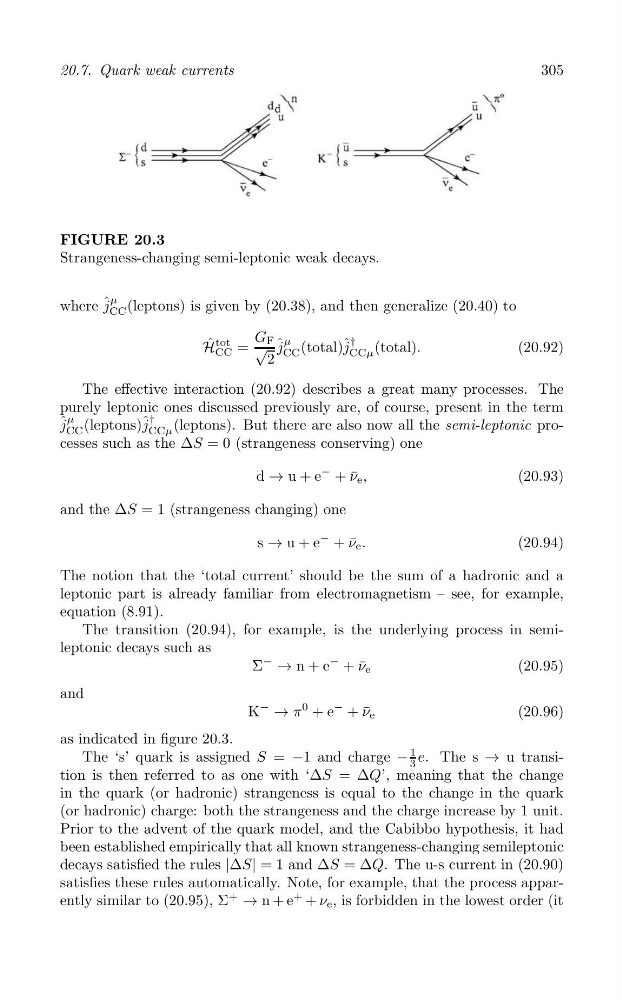
FIGURE 20.3
Strangeness-changing semi-leptonic weak decays.
μ
where ˆ j (leptons) is given by (20.38), and then generalize (20.40) to
CC
H ˆ tot
G F ˆ μ
†
= √ j (total) ˆ j
(total).
(20.92)
CC
CC
CCμ
2
The effective interaction (20.92) describes a great many processes. The
purely leptonic ones discussed previously are, of course, present in the term
μ
†
ˆ j (leptons) ˆ j
(leptons). But there are also now all the semi-leptonic proCC
CCμ
cesses such as the ΔS = 0 (strangeness conserving) one
d → u + e
− + ¯
ν e ,
(20.93)
and the ΔS = 1 (strangeness changing) one
s → u + e
− + ¯
ν e .
(20.94)
The notion that the ‘total current’ should be the sum of a hadronic and a
leptonic part is already familiar from electromagnetism – see, for example,
equation (8.91).
The transition (20.94), for example, is the underlying process in semileptonic decays such as
Σ
−
→ n + e
− + ¯
ν e
(20.95)
and
K
−
→ π
0 + e
− + ¯
ν e
(20.96)
as indicated in figure 20.3.
The ‘s’ quark is assigned S = −1 and charge −
1 e. The s → u transi3
tion is then referred to as one with ‘ΔS = ΔQ’, meaning that the change
in the quark (or hadronic) strangeness is equal to the change in the quark
(or hadronic) charge: both the strangeness and the charge increase by 1 unit.
Prior to the advent of the quark model, and the Cabibbo hypothesis, it had
been established empirically that all known strangeness-changing semileptonic
decays satisfied the rules |ΔS| = 1 and ΔS = ΔQ. The u-s current in (20.90)
satisfies these rules automatically. Note, for example, that the process apparently similar to (20.95), Σ
+
→ n + e
+ + ν e , is forbidden in the lowest order (it