

301
20.5. Calculation of the cross section for ν μ + e
−
→ μ
− + ν e
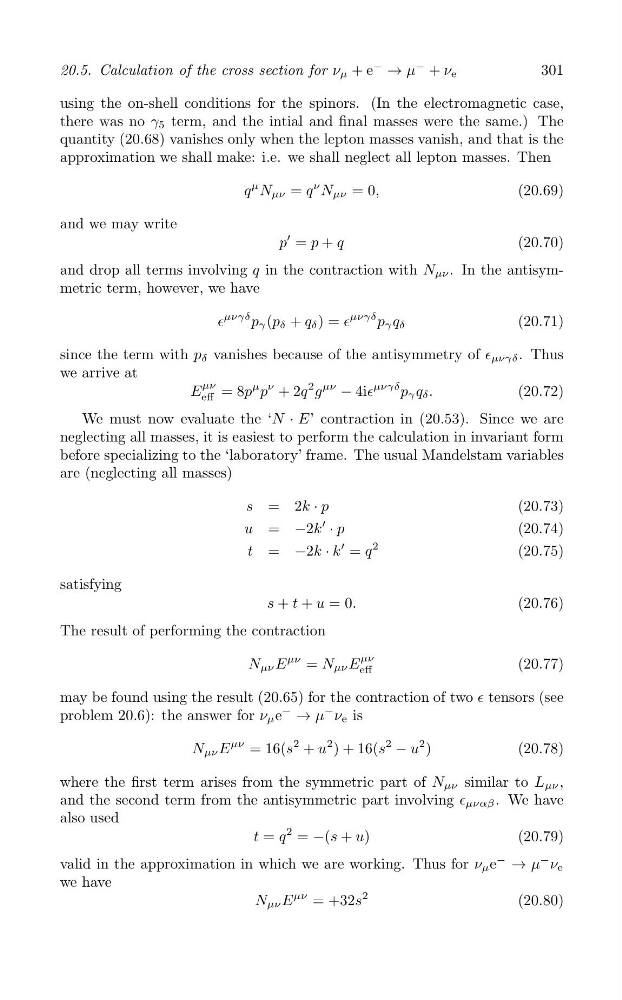
using the on-shell conditions for the spinors. (In the electromagnetic case,
there was no γ 5 term, and the intial and final masses were the same.) The
quantity (20.68) vanishes only when the lepton masses vanish, and that is the
approximation we shall make: i.e. we shall neglect all lepton masses. Then
q
μ N μν = q
ν N μν = 0,
(20.69)
and we may write
′
p = p + q
(20.70)
and drop all terms involving q in the contraction with N μν . In the antisymmetric term, however, we have
∈
μνγδ p γ (p δ + q δ ) = ∈
μνγδ p γ q δ
(20.71)
since the term with p δ vanishes because of the antisymmetry of ∈ μνγδ . Thus
we arrive at
μν
μ
2 μν
− 4i∈
μνγδ
E = 8p p
ν + 2q g
p γ q δ .
(20.72)
eff
We must now evaluate the ‘N · E’ contraction in (20.53). Since we are
neglecting all masses, it is easiest to perform the calculation in invariant form
before specializing to the ‘laboratory’ frame. The usual Mandelstam variables
are (neglecting all masses)
s = 2k · p
(20.73)
u = −2k
′
· p
(20.74)
2
t = −2k · k
′ = q
(20.75)
satisfying
s + t + u = 0.
(20.76)
The result of performing the contraction
μν
N μν E
μν = N μν E
(20.77)
eff
may be found using the result (20.65) for the contraction of two ∈ tensors (see
problem 20.6): the answer for ν μ e
−
→ μ
− ν e is
2
N μν E
μν = 16(s + u
2 ) + 16(s
2
− u
2 )
(20.78)
where the first term arises from the symmetric part of N μν similar to L μν ,
and the second term from the antisymmetric part involving ∈ μναβ . We have
also used
2
t = q = −(s + u)
(20.79)
valid in the approximation in which we are working. Thus for ν μ e
−
→ μ
− ν e
we have
2
N μν E
μν = +32s
(20.80)