

299
20.5. Calculation of the cross section for ν μ + e
−
→ μ
− + ν e
(8.183) for example. In the case of neutrino-electron scattering, we must average over initial electron states for unpolarized electrons and sum over the final
muon polarization states. For the neutrinos there is no averaging over initial
neutrino helicities, since only left-handed (massless) neutrinos participate in
the weak interaction. Similarly, there is no sum over final neutrino helicities.
However, for convenience of calculation, we can in fact sum over both helicity
states of both neutrinos since the (1 − γ 5 ) factors guarantee that right-handed
neutrinos contribute nothing to the cross section. As for the eμ scattering
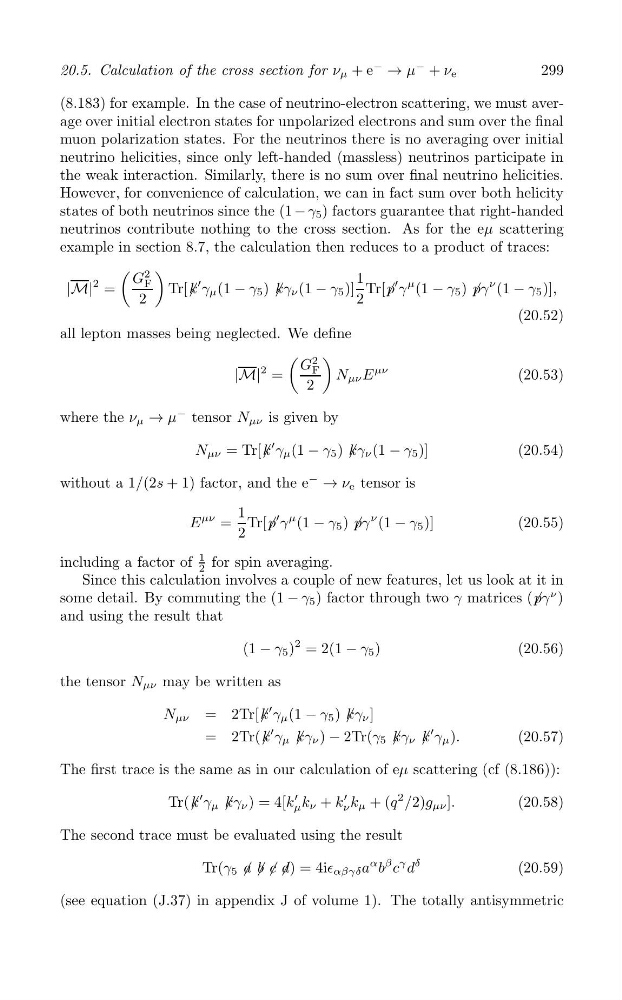
example in section 8.7, the calculation then reduces to a product of traces:
(
)
G
2
1
F
|M|
2 =
Tr[/ k
′ γ μ (1 − γ 5 ) / kγ ν (1 − γ 5 )] Tr[/ p
′ γ
μ (1 − γ 5 ) / pγ
ν (1 − γ 5 )],
2
2
(20.52)
all lepton masses being neglected. We define
(
)
G
2
F
|M|
2 =
N μν E
μν
(20.53)
2
where the ν μ → μ
− tensor N μν is given by
N μν = Tr[/ k
′ γ μ (1 − γ 5 ) / kγ ν (1 − γ 5 )]
(20.54)
without a 1/(2s + 1) factor, and the e
−
→ ν e tensor is
1
E
μν = Tr[/ p
′ γ
μ (1 − γ 5 ) / pγ
ν (1 − γ 5 )]
(20.55)
2
including a factor of
1 for spin averaging.
2
Since this calculation involves a couple of new features, let us look at it in
some detail. By commuting the (1 − γ 5 ) factor through two γ matrices (/ pγ
ν )
and using the result that
(1 − γ 5 )
2 = 2(1 − γ 5 )
(20.56)
the tensor N μν may be written as
N μν = 2Tr[/ k
′ γ μ (1 − γ 5 ) / kγ ν ]
= 2Tr(/ k
′ γ μ / kγ ν ) − 2Tr(γ 5 / kγ ν / k
′ γ μ ).
(20.57)
The first trace is the same as in our calculation of eμ scattering (cf (8.186)):
Tr(/ k
′ γ μ / kγ ν ) = 4[k μ
′ k ν + k ν
′ k μ + (q
2 /2)g μν ].
(20.58)
The second trace must be evaluated using the result
Tr(γ 5 / a / b / c / d) = 4i∈ αβγδ a
α b
β c
γ d
δ
(20.59)
(see equation (J.37) in appendix J of volume 1). The totally antisymmetric