

20.4. The universal current × current theory for weak interactions of leptons 297
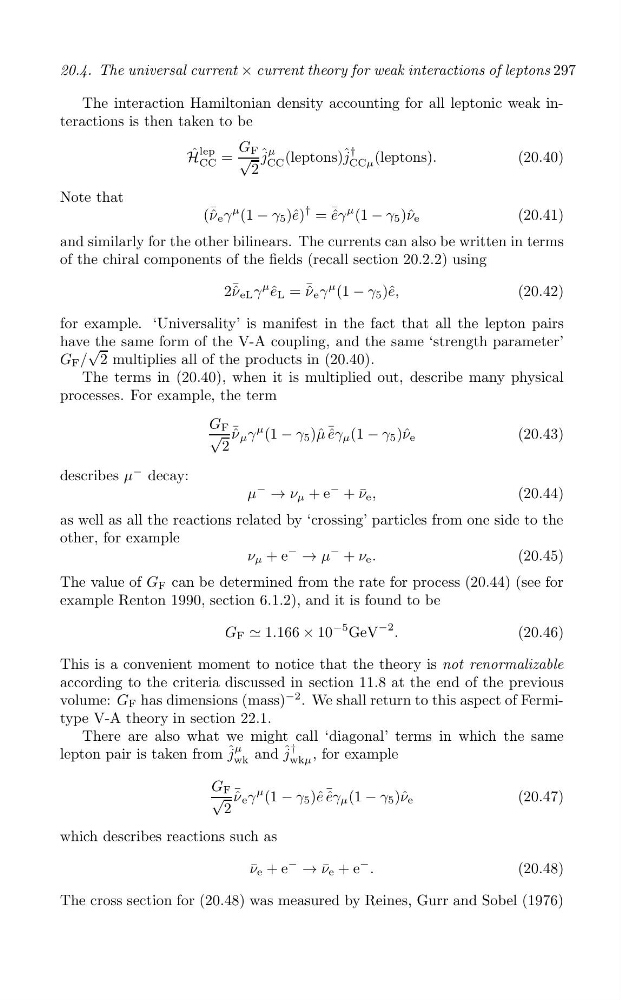
The interaction Hamiltonian density accounting for all leptonic weak interactions is then taken to be
H ˆ lep
G F μ
†
= √ ˆ j (leptons) ˆ j
(leptons).
(20.40)
CC
CC
CCμ
2
Note that
(ν ¯ ˆ e γ
μ (1 − γ 5 )ˆ e)
† = ¯ eγ
μ (1 − γ 5 )ˆ
(20.41)
ˆ
ν e
and similarly for the other bilinears. The currents can also be written in terms
of the chiral components of the fields (recall section 20.2.2) using
2ν ¯ ˆ eL γ
μ e ˆ L = ν ¯ ˆ e γ
μ (1 − γ 5 )ˆ e,
(20.42)
for example. ‘Universality’ is manifest in the fact that all the lepton pairs
have the same form of the V-A coupling, and the same ‘strength parameter’
√
G F / 2 multiplies all of the products in (20.40).
The terms in (20.40), when it is multiplied out, describe many physical
processes. For example, the term
G F
√ ν ¯ μ γ
μ (1 − γ 5 )ˆ ˆ
ν e
ˆ
μ ¯ eγ μ (1 − γ 5 )ˆ
(20.43)
2
describes μ
− decay:
μ
−
→ ν μ + e
− + ¯
ν e ,
(20.44)
as well as all the reactions related by ‘crossing’ particles from one side to the
other, for example
ν μ + e
−
→ μ
− + ν e .
(20.45)
The value of G F can be determined from the rate for process (20.44) (see for
example Renton 1990, section 6.1.2), and it is found to be
G F ⋍ 1.166 × 10
−5 GeV
−2 .
(20.46)
This is a convenient moment to notice that the theory is not renormalizable
according to the criteria discussed in section 11.8 at the end of the previous
volume: G F has dimensions (mass)
−2 . We shall return to this aspect of Fermitype V-A theory in section 22.1.
There are also what we might call ‘diagonal’ terms in which the same
μ
†
lepton pair is taken from ˆ j and ˆ j
, for example
wk
wkμ
G F
¯
√ ν ¯ ˆ e γ
μ (1 − γ 5 )ˆ e eγ ˆ μ (1 − γ 5 )ˆ ν e
(20.47)
2
which describes reactions such as
−
ν ¯ e + e
−
→ ν ¯ e + e .
(20.48)
The cross section for (20.48) was measured by Reines, Gurr and Sobel (1976)