

295
20.3. Lepton number and lepton flavours
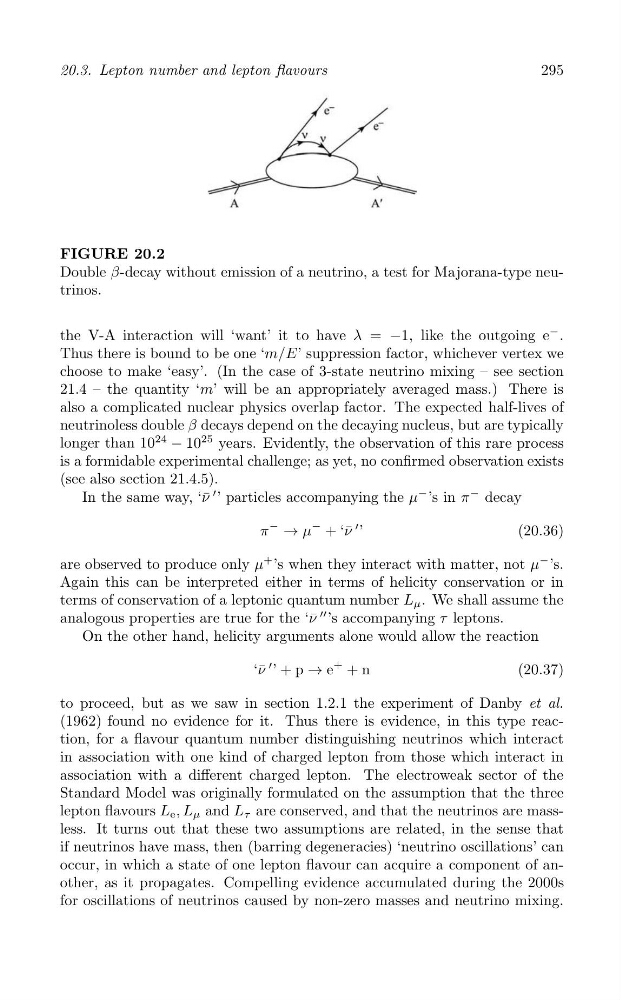
FIGURE 20.2
Double β-decay without emission of a neutrino, a test for Majorana-type neutrinos.
the V-A interaction will ‘want’ it to have λ = −1, like the outgoing e
− .
Thus there is bound to be one ‘m/E’ suppression factor, whichever vertex we
choose to make ‘easy’. (In the case of 3-state neutrino mixing – see section
21.4 – the quantity ‘m’ will be an appropriately averaged mass.) There is
also a complicated nuclear physics overlap factor. The expected half-lives of
neutrinoless double β decays depend on the decaying nucleus, but are typically
longer than 10
24
− 10
25 years. Evidently, the observation of this rare process
is a formidable experimental challenge; as yet, no confirmed observation exists
(see also section 21.4.5).
In the same way, ‘¯ ν
′ ’ particles accompanying the μ
− ’s in π
− decay
π
−
→ μ
− + ‘¯ ν
′ ’
(20.36)
are observed to produce only μ
+ ’s when they interact with matter, not μ
− ’s.
Again this can be interpreted either in terms of helicity conservation or in
terms of conservation of a leptonic quantum number L μ . We shall assume the
analogous properties are true for the ‘¯ ν
′′ ’s accompanying τ leptons.
On the other hand, helicity arguments alone would allow the reaction
+
‘¯ ν
′ ’ + p → e + n
(20.37)
to proceed, but as we saw in section 1.2.1 the experiment of Danby et al.
(1962) found no evidence for it. Thus there is evidence, in this type reaction, for a flavour quantum number distinguishing neutrinos which interact
in association with one kind of charged lepton from those which interact in
association with a different charged lepton. The electroweak sector of the
Standard Model was originally formulated on the assumption that the three
lepton flavours L e , L μ and L τ are conserved, and that the neutrinos are massless. It turns out that these two assumptions are related, in the sense that
if neutrinos have mass, then (barring degeneracies) ‘neutrino oscillations’ can
occur, in which a state of one lepton flavour can acquire a component of another, as it propagates. Compelling evidence accumulated during the 2000s
for oscillations of neutrinos caused by non-zero masses and neutrino mixing.