

Problems
279
the fermions. As we will see in chapter 22, the gauge symmetry of the weak
interactions is a chiral one, which requires that there should be no explicit
fermion masses in the Lagrangian. We saw in chapter 18 how there is good
evidence that the strong QCD interactions break chiral symmetry spontaneously, but that there is also a need for small Lagrangian masses for the
quarks, which break chiral symmetry explicitly (so as to give mass to the
pions, for example). The leptons are of course not coupled to QCD, and
we have to assume Lagrangian masses for them too. Thus for both quarks
and leptons chiral-symmetry-breaking mass terms seem to be required. The
only way to preserve the weak chiral gauge symmetry is to assume that these
fermion masses must, in their turn, be interpreted as arising ‘spontaneously’
also; that is, not via an explicit mass term in the Lagrangian. The dynamical
generation of quark and lepton masses would, in fact, be closely analogous
to the generation of the energy gap in the BCS theory, as we saw in section
18.1. So we may ask: is it possible to find a dynamical theory which generates masses for both the vector bosons, and the fermions? Such theories are
generically known as ‘technicolour models’ (Weinberg 1979b, Susskind 1979),
and they have been intensively studied (see, for example, Peskin 1997). One
problem is that such theories are already tightly constrained by the precision
electroweak experiments (see chapter 22), and meeting these constraints seems
to require rather elaborate kinds of models. However, technicolour theories do
offer the prospect of a new strongly interacting sector, which could possibly
be probed at the LHC. But such ideas take us beyond the scope of the present
volume. Within the Standard Model, one proceeds along what seems a more
phenomenological route, attributing the masses of fermions to their couplings
with the Higgs field, in a way that will be explained in chapter 22: briefly, the
¯
couplings have the Yukawa form g f f ˆ f ˆ φ ˆ , so that when φ ˆ develops a vev v, the
fermions gain a mass m f = g f v.
We now turn, in the last part of the book, to weak interactions and the
electroweak theory.
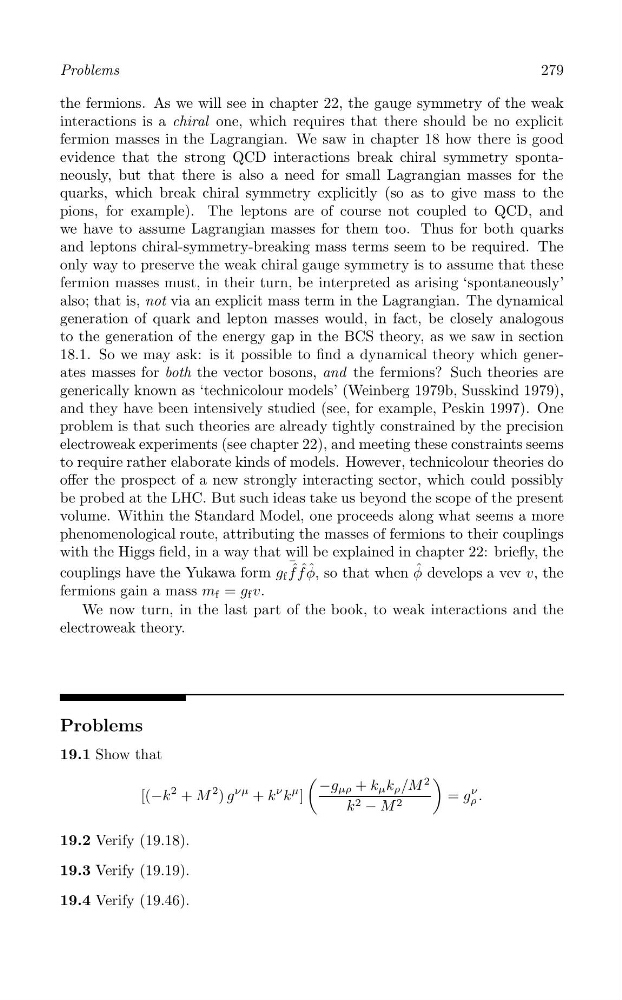
Problems
19.1 Show that
(
)
−g μρ + k μ k ρ /M
2
νμ
ν
[(−k
2 + M
2 ) g + k
ν k
μ ]
= g ρ .
k 2 − M 2
19.2 Verify (19.18).
19.3 Verify (19.19).
19.4 Verify (19.46).