

57
2.6. Comments on the gauge principle in electromagnetism
at work in generating weak interactions as well. The associated symmetry or
conservation law is, however, of a very subtle kind. Incidentally, although all
particles of a given charge q interact electromagnetically in a universal way,
there is nothing at all in the preceding argument to indicate why, in nature,
the charges of observed particles are all integer multiples of one basic charge.
Comment (iii)
Returning to comment (i), we may wish that we had not had to introduce the
absolute conservation of charge as a separate axiom. As remarked earlier, at
the end of section 2.2, we should like to relate that conservation law to the
symmetry involved, namely invariance under (2.54). It is worth looking at the
nature of this symmetry in a little more detail. It is not a symmetry which
– as in the case of translation and rotation invariances for instance – involves
changes in the space–time coordinates x and t. Instead, it operates on the
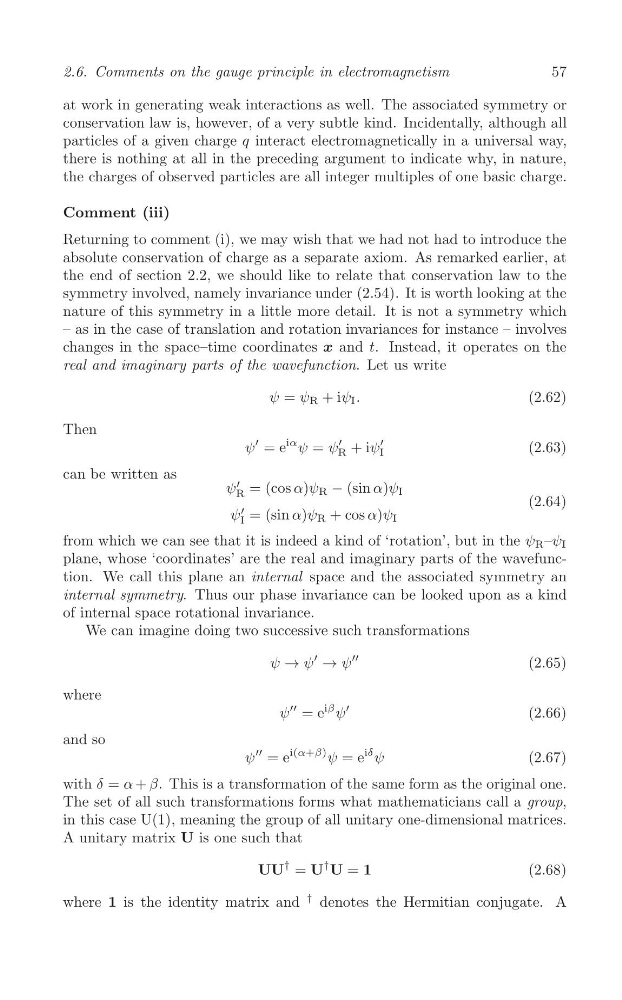
real and imaginary parts of the wavefunction. Let us write
ψ = ψ R + iψ I .
(2.62)
Then
ψ
′
iα ψ ψ
′
= e
= R + iψ
′
(2.63)
I
can be written as
ψ
′ = (cos α)ψ R − (sin α)ψ I
R
(2.64)
ψ
′ = (sin α)ψ R + cos α)ψ I
I
from which we can see that it is indeed a kind of ‘rotation’, but in the ψ R –ψ I
plane, whose ‘coordinates’ are the real and imaginary parts of the wavefunction. We call this plane an internal space and the associated symmetry an
internal symmetry. Thus our phase invariance can be looked upon as a kind
of internal space rotational invariance.
We can imagine doing two successive such transformations
→ ψ
′′
ψ → ψ
′
(2.65)
where
ψ
′′
iβ ψ
′
= e
(2.66)
and so
ψ
′′
iδ ψ
i(α+β) ψ = e
= e
(2.67)
with δ = α + β. This is a transformation of the same form as the original one.
The set of all such transformations forms what mathematicians call a group,
in this case U(1), meaning the group of all unitary one-dimensional matrices.
A unitary matrix U is one such that
UU
† = U
† U = 1
(2.68)
where 1 is the identity matrix and
† denotes the Hermitian conjugate. A
2.6. Comments on the gauge principle in electromagnetism
at work in generating weak interactions as well. The associated symmetry or
conservation law is, however, of a very subtle kind. Incidentally, although all
particles of a given charge q interact electromagnetically in a universal way,
there is nothing at all in the preceding argument to indicate why, in nature,
the charges of observed particles are all integer multiples of one basic charge.
Comment (iii)
Returning to comment (i), we may wish that we had not had to introduce the
absolute conservation of charge as a separate axiom. As remarked earlier, at
the end of section 2.2, we should like to relate that conservation law to the
symmetry involved, namely invariance under (2.54). It is worth looking at the
nature of this symmetry in a little more detail. It is not a symmetry which
– as in the case of translation and rotation invariances for instance – involves
changes in the space–time coordinates x and t. Instead, it operates on the
real and imaginary parts of the wavefunction. Let us write
ψ = ψ R + iψ I .
(2.62)
Then
ψ
′
iα ψ ψ
′
= e
= R + iψ
′
(2.63)
I
can be written as
ψ
′ = (cos α)ψ R − (sin α)ψ I
R
(2.64)
ψ
′ = (sin α)ψ R + cos α)ψ I
I
from which we can see that it is indeed a kind of ‘rotation’, but in the ψ R –ψ I
plane, whose ‘coordinates’ are the real and imaginary parts of the wavefunction. We call this plane an internal space and the associated symmetry an
internal symmetry. Thus our phase invariance can be looked upon as a kind
of internal space rotational invariance.
We can imagine doing two successive such transformations
→ ψ
′′
ψ → ψ
′
(2.65)
where
ψ
′′
iβ ψ
′
= e
(2.66)
and so
ψ
′′
iδ ψ
i(α+β) ψ = e
= e
(2.67)
with δ = α + β. This is a transformation of the same form as the original one.
The set of all such transformations forms what mathematicians call a group,
in this case U(1), meaning the group of all unitary one-dimensional matrices.
A unitary matrix U is one such that
UU
† = U
† U = 1
(2.68)
where 1 is the identity matrix and
† denotes the Hermitian conjugate. A