

258
19. Spontaneously Broken Local Symmetry
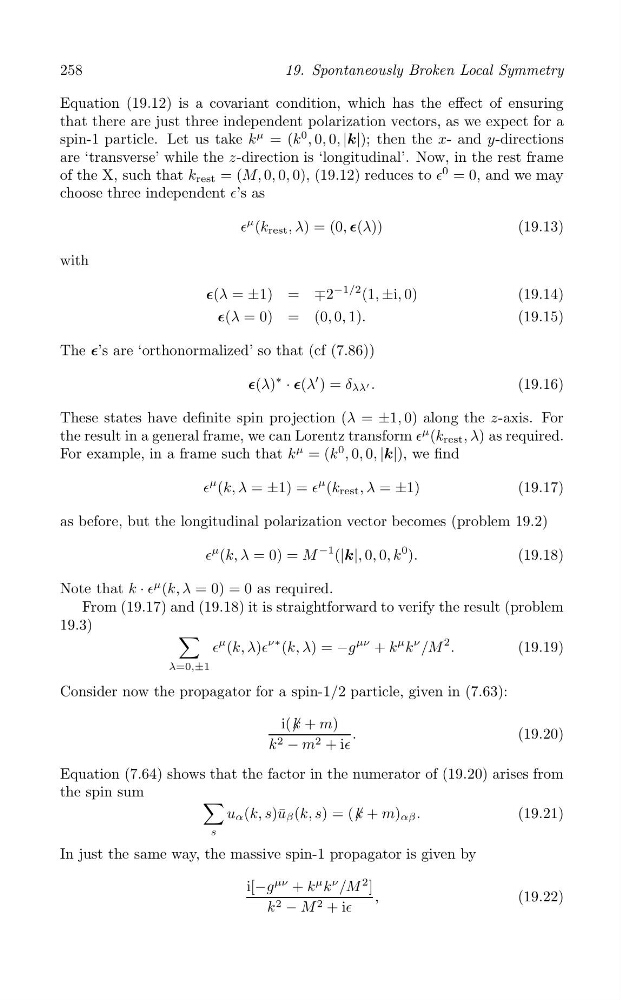
Equation (19.12) is a covariant condition, which has the effect of ensuring
that there are just three independent polarization vectors, as we expect for a
spin-1 particle. Let us take k
μ = (k
0 , 0, 0, |k|); then the x- and y-directions
are ‘transverse’ while the z-direction is ‘longitudinal’. Now, in the rest frame
of the X, such that k
0
rest = (M, 0, 0, 0), (19.12) reduces to ∈ = 0, and we may
choose three independent ∈’s as
∈
μ (k rest , λ) = (0, ∊(λ))
(19.13)
with
∊(λ = ±1) = ∓2
−1/2 (1, ±i, 0)
(19.14)
∊(λ = 0) = (0, 0, 1).
(19.15)
The ∊’s are ‘orthonormalized’ so that (cf (7.86))
∊(λ)
∗
· ∊(λ
′ ) = δ λλ ′ .
(19.16)
These states have definite spin projection (λ = ±1, 0) along the z-axis. For
the result in a general frame, we can Lorentz transform ∈
μ (k rest , λ) as required.
For example, in a frame such that k
μ = (k
0 , 0, 0, |k|), we find
∈
μ (k, λ = ±1) = ∈
μ (k rest , λ = ±1)
(19.17)
as before, but the longitudinal polarization vector becomes (problem 19.2)
∈
μ (k, λ = 0) = M
−1 (|k|, 0, 0, k
0 ).
(19.18)
Note that k · ∈
μ (k, λ = 0) = 0 as required.
From (19.17) and (19.18) it is straightforward to verify the result (problem
19.3)
∑
∈
μ (k, λ)∈
ν∗ (k, λ) =
2
λ
−g
μν + k
μ k
ν /M .
(19.19)
=0,±1
Consider now the propagator for a spin-1/2 particle, given in (7.63):
i( k + m) .
(19.20)
k 2 − m 2 + i∈
Equation (7.64) shows that the factor in the numerator of (19.20) arises from
the spin sum
∑
u α (k, s)¯ u β (k, s) = (k + m) αβ .
(19.21)
s
In just the same way, the massive spin-1 propagator is given by
i[−g
μν + k
μ k
ν /M
2 ] ,
(19.22)
k 2 − M 2 + i∈
/
/