

256
19. Spontaneously Broken Local Symmetry
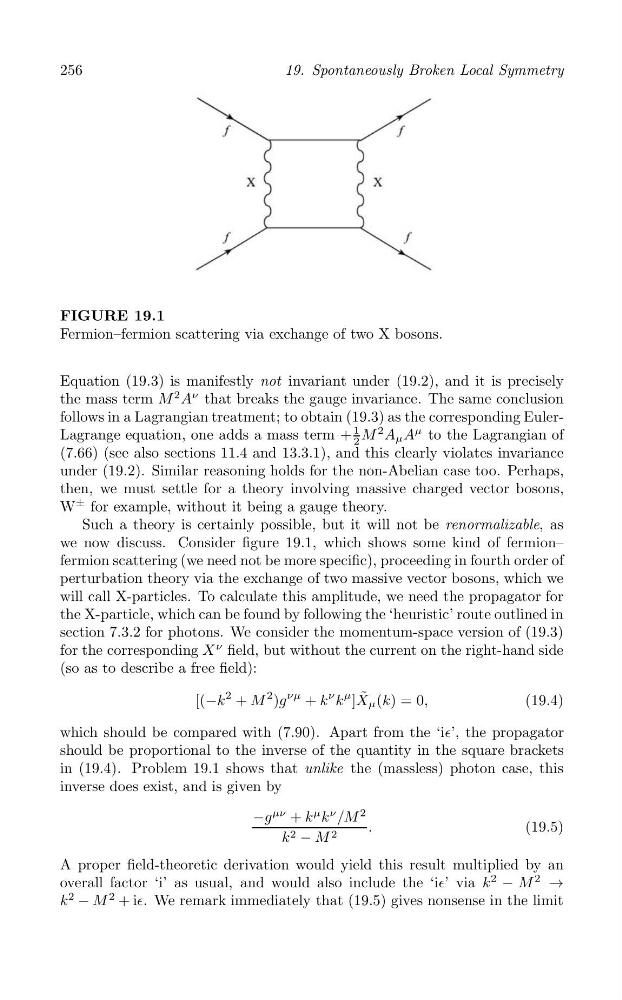
FIGURE 19.1
Fermion–fermion scattering via exchange of two X bosons.
Equation (19.3) is manifestly not invariant under (19.2), and it is precisely
the mass term M
2 A
ν that breaks the gauge invariance. The same conclusion
follows in a Lagrangian treatment; to obtain (19.3) as the corresponding EulerLagrange equation, one adds a mass term +
1 M
2 A μ A
μ to the Lagrangian of
2
(7.66) (see also sections 11.4 and 13.3.1), and this clearly violates invariance
under (19.2). Similar reasoning holds for the non-Abelian case too. Perhaps,
then, we must settle for a theory involving massive charged vector bosons,
W
± for example, without it being a gauge theory.
Such a theory is certainly possible, but it will not be renormalizable, as
we now discuss. Consider figure 19.1, which shows some kind of fermion–
fermion scattering (we need not be more specific), proceeding in fourth order of
perturbation theory via the exchange of two massive vector bosons, which we
will call X-particles. To calculate this amplitude, we need the propagator for
the X-particle, which can be found by following the ‘heuristic’ route outlined in
section 7.3.2 for photons. We consider the momentum-space version of (19.3)
for the corresponding X
ν field, but without the current on the right-hand side
(so as to describe a free field):
νμ
[(−k
2 + M
2 )g + k
ν k
μ ]X ˜ μ (k) = 0,
(19.4)
which should be compared with (7.90). Apart from the ‘i∈’, the propagator
should be proportional to the inverse of the quantity in the square brackets
in (19.4). Problem 19.1 shows that unlike the (massless) photon case, this
inverse does exist, and is given by
μν
−g + k
μ k
ν /M
2
.
(19.5)
k 2 − M 2
A proper field-theoretic derivation would yield this result multiplied by an
overall factor ‘i’ as usual, and would also include the ‘i∈’ via k
2
− M
2
→
k
2
− M
2 + i∈. We remark immediately that (19.5) gives nonsense in the limit