

245
18.3. Effective Lagrangians
E
2 /f
2 , we must ensure that our effective Lagrangian contains all the approπ
priate counter terms which are allowed by the symmetry. For example, at
one-loop order for L ˆ 2 , we need to include the 4-derivative terms
ˆ
ˆ
ˆ
ˆ U
† ∂
μ ˆ
L 4 = c 1 Tr(∂ μ U∂
μ U ˆ † ∂ ν U ∂
ν U ˆ † ) + c 2 Tr(∂ μ U∂ ν ˆ
U ∂
ν U ˆ † ).
(18.104)
To perform a one-loop calculation, one uses L ˆ 2 at tree-level and in one-loop
diagrams, and L ˆ 4 at tree-level only.
Real pions, however, are not massless, nor are real quarks. We need to
extend our effective Lagrangian to include explicit chiral symmetry breaking
mass terms.
18.3.2 Inclusion of explicit symmetry breaking: masses for
pions and quarks
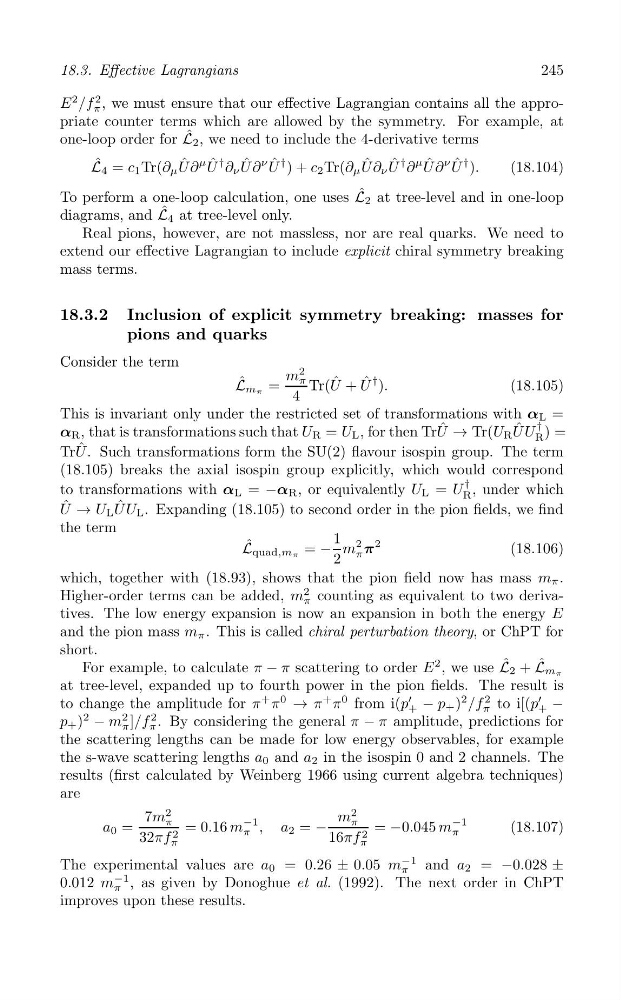
Consider the term
2
m π
L ˆ mπ =
Tr(U ˆ + U ˆ † ).
(18.105)
4
This is invariant only under the restricted set of transformations with α L =
†
ˆ
α R , that is transformations such that U R = U L , for then TrU ˆ → Tr(U R U U ) =
R
TrU ˆ . Such transformations form the SU(2) flavour isospin group. The term
(18.105) breaks the axial isospin group explicitly, which would correspond
†
to transformations with α L = −α R , or equivalently U L = U , under which
R
ˆ
ˆ
U → U L U U L . Expanding (18.105) to second order in the pion fields, we find
the term
2
L ˆ quad,mπ = −
1 m π π
2
(18.106)
2
which, together with (18.93), shows that the pion field now has mass m π .
2
Higher-order terms can be added, m counting as equivalent to two derivaπ
tives. The low energy expansion is now an expansion in both the energy E
and the pion mass m π . This is called chiral perturbation theory, or ChPT for
short.
For example, to calculate π − π scattering to order E
2 , we use L ˆ 2 + L ˆ mπ
at tree-level, expanded up to fourth power in the pion fields. The result is
′
′
to change the amplitude for π
+ π
0
→ π
+ π
0 from i(p − p + )
2 /f
2 to i[(p −
+
π
+
2
p + )
2
− m ]/f
2 . By considering the general π − π amplitude, predictions for
π
π
the scattering lengths can be made for low energy observables, for example
the s-wave scattering lengths a 0 and a 2 in the isospin 0 and 2 channels. The
results (first calculated by Weinberg 1966 using current algebra techniques)
are
2
2
7m
m
π
−1
π
−1
a 0 =
= 0.16 m , a 2 = −
= −0.045 m
(18.107)
32πf 2
π
16πf 2
π
π
π
−1
The experimental values are a 0 = 0.26 ± 0.05 m
and a 2 = −0.028 ±
π
0.012 m
−1 , as given by Donoghue et al. (1992). The next order in ChPT
π
improves upon these results.