

243
18.3. Effective Lagrangians
the lowest number of derivatives which contributes to the π − π scattering
amplitude is
1
6v 2 [(π ˆ · ∂ μ π ˆ )(π ˆ · ∂
μ
π ˆ ) − π ˆ
2 ∂ μ π ˆ · ∂
μ
π ˆ ],
(18.94)
since the S ˆ − π ˆ − π ˆ vertex already has two derivatives. The reader may
check that the amplitude for π
+ π
0
→ π
+ π
0 calculated from (18.94) is iq
2 /v
2 ,
exactly as before, but this time without having to go through the cancellation
argument.
The fields in ˆ
S and ˆ
the other, are related
Σ on the one hand, and in ˆ
U on
non-linearly, but a physical amplitude calculated with either representation
has turned out to be the same, in this simple case. It is in fact generally
true that such non-linear field redefinitions lead to the same physics (Haag
1958, Coleman, Wess and Zumino 1969, Callan, Coleman, Wess and Zumino
1969). It is clearly advantageous to work with L ˆ S , which builds in the desired
derivatives of the Goldstone modes.
Indeed, we can simplify matters even further. Since S ˆ is invariant under
SU(2) L × SU(2) R , the full symmetry of the Lagrangian is maintained with only
the field U ˆ , transforming by (18.90), and we may as well discard S ˆ altogether.
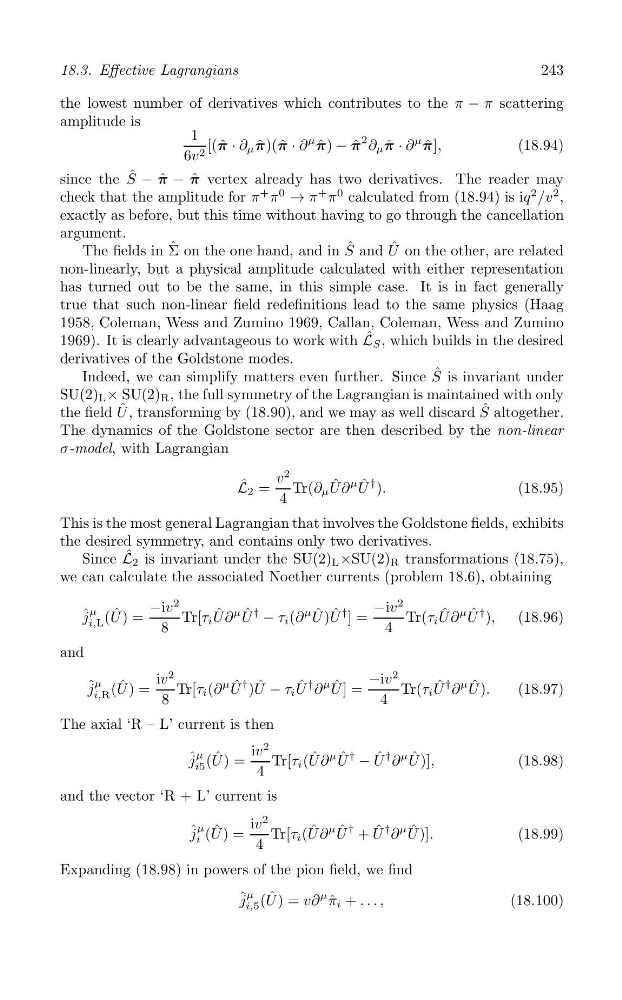
The dynamics of the Goldstone sector are then described by the non-linear
σ-model, with Lagrangian
2
v
ˆ
ˆ U
† ).
L 2 = Tr(∂ μ U∂
μ ˆ
(18.95)
4
This is the most general Lagrangian that involves the Goldstone fields, exhibits
the desired symmetry, and contains only two derivatives.
Since L ˆ 2 is invariant under the SU(2) L ×SU(2) R transformations (18.75),
we can calculate the associated Noether currents (problem 18.6), obtaining
2
2
−iv
−iv
μ
ˆ ( ˆ
ˆ
ˆ
j U ) =
Tr[τ i U∂
μ U ˆ † − τ i (∂
μ U ˆ )U ˆ † ] =
Tr(τ i U ∂
μ U ˆ † ),
(18.96)
i,L
8
4
and
2
2
iv
−iv
μ
ˆ j (U ˆ ) =
Tr[τ i (∂
μ U ˆ † )U ˆ − τ i U ˆ † ∂
μ U ˆ ] =
Tr(τ i U ˆ † ∂
μ U ˆ ).
(18.97)
i,R
8
4
The axial ‘R – L’ current is then
2
ˆ j
μ U ) =
iv Tr[τ i ( ˆ U
†
− U ˆ † ∂
μ ˆ
(18.98)
( ˆ
U ∂
μ ˆ
U )],
i5
4
and the vector ‘R + L’ current is
2
ˆ ( ˆ
iv
U
† + U ˆ † ∂
μ ˆ
μ
j U ) =
U ∂
μ ˆ
(18.99)
Tr[τ i ( ˆ
U )].
i
4
Expanding (18.98) in powers of the pion field, we find
μ
ˆ (U ˆ ) = v∂
μ ˆ
. . . ,
(18.100)
j i,5
π i +