

234
18. Chiral Symmetry Breaking
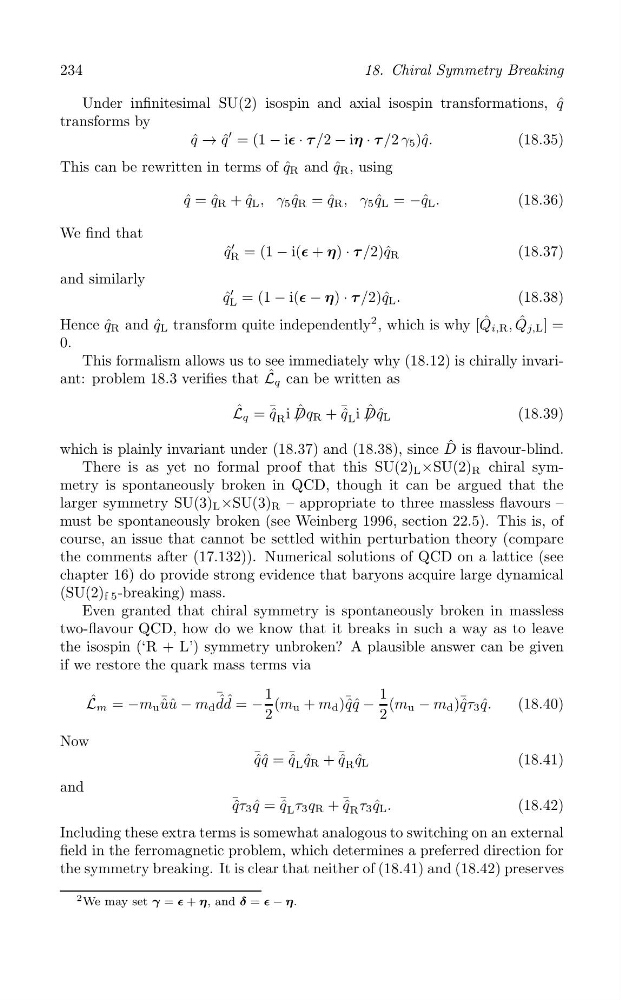
Under infinitesimal SU(2) isospin and axial isospin transformations, ˆ
q
transforms by
′
q ˆ → q ˆ = (1 − i∊ · τ /2 − iη · τ /2 γ 5 )ˆ q.
(18.35)
This can be rewritten in terms of ˆ
q R and ˆ
q R , using
q ˆ = ˆ
q R + ˆ
q L , γ 5 q ˆ R = ˆ
q R , γ 5 q ˆ L = −q ˆ L .
(18.36)
We find that
′
q ˆ R = (1 − i(∊ + η) · τ /2)ˆ q R
(18.37)
and similarly
′
q ˆ L = (1 − i(∊ − η) · τ /2)ˆ q L .
(18.38)
ˆ
Hence ˆ
q R and ˆ
q L transform quite independently
2 , which is why [ Q ˆ i,R , Q j,L ] =
0.
This formalism allows us to see immediately why (18.12) is chirally invariant: problem 18.3 verifies that L ˆ q can be written as
ˆ
¯ ˆ
¯ ˆ
L q = q R i Dq R + q L i Dq ˆ L
(18.39)
ˆ /
ˆ /
which is plainly invariant under (18.37) and (18.38), since D ˆ is flavour-blind.
There is as yet no formal proof that this SU(2) L ×SU(2) R chiral symmetry is spontaneously broken in QCD, though it can be argued that the
larger symmetry SU(3) L ×SU(3) R – appropriate to three massless flavours –
must be spontaneously broken (see Weinberg 1996, section 22.5). This is, of
course, an issue that cannot be settled within perturbation theory (compare
the comments after (17.132)). Numerical solutions of QCD on a lattice (see
chapter 16) do provide strong evidence that baryons acquire large dynamical
(SU(2) f 5 -breaking) mass.
Even granted that chiral symmetry is spontaneously broken in massless
two-flavour QCD, how do we know that it breaks in such a way as to leave
the isospin (‘R + L’) symmetry unbroken? A plausible answer can be given
if we restore the quark mass terms via
ˆ
−m u u ¯ ˆ m d
¯ ˆ d
1
m d ) ¯ q ˆ
1
m d ) ¯ qτ 3 ˆ
(18.40)
L m =
ˆu −
d ˆ = − (m u +
ˆq − (m u −
ˆ q.
2
2
Now
¯
¯
¯
q ˆq ˆ = q ˆ L q ˆ R + q ˆ R q ˆ L
(18.41)
and
¯
¯
¯
ˆ q = ˆ
ˆ q L .
(18.42)
qτ 3 ˆ q L τ 3 q R + q R τ 3 ˆ
Including these extra terms is somewhat analogous to switching on an external
field in the ferromagnetic problem, which determines a preferred direction for
the symmetry breaking. It is clear that neither of (18.41) and (18.42) preserves
2 We may set γ = ∊ + η, and δ = ∊ − η.