

231
18.1. The Nambu analogy
and Schrauner 1962) showed how the amplitudes for the emission of a single
‘soft’ (nearly massless, low momentum) pion could be calculated, for various
processes. These developments culminated in the Adler-Weisberger relation
(Adler 1965, Weisberger 1965) which involves two soft pions.
This work was all done in the absence of an agreed theory of the strong
interactions (the NJ-L theory was an illustrative working model of dynamically generated spontaneous symmetry breaking, but not a complete theory
of strong interactions). QCD became widely accepted as that theory around
1973. In this case, of course, the ‘fermions in question’ are quarks, and the
interactions between them are gluon exchanges, which conserve chirality as
noted in section 12.4.2. The bulk of the masses of the qqq bound states which
form baryons is then interpreted as being spontaneously generated, while a
small explicit quark mass term in the Lagrangian is responsible for the nonzero pion mass. Let us therefore now turn to two-flavour QCD.
18.1.1 Two flavour QCD and SU(2) f L ×SU(2) f R
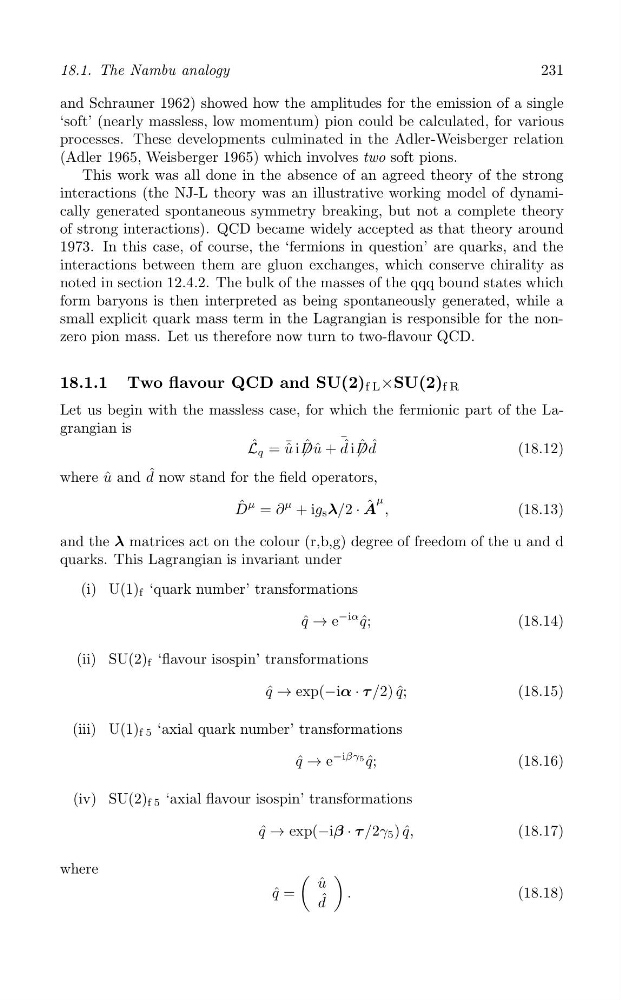
Let us begin with the massless case, for which the fermionic part of the Lagrangian is
ˆ
¯ ˆ
¯ ˆ ˆ
L q = u ˆ iD / u ˆ + d iD / d ˆ
(18.12)
where ˆ
u and d ˆ now stand for the field operators,
μ
D ˆ μ = ∂
μ + ig s λ/2 · A ˆ ,
(18.13)
and the λ matrices act on the colour (r,b,g) degree of freedom of the u and d
quarks. This Lagrangian is invariant under
(i) U(1) f ‘quark number’ transformations
−iα ˆ
q ˆ → e q;
(18.14)
(ii) SU(2) f ‘flavour isospin’ transformations
q ˆ → exp(−iα · τ /2) ˆ
q;
(18.15)
(iii) U(1) f 5 ‘axial quark number’ transformations
−iβγ5 ˆ
q ˆ → e
q;
(18.16)
(iv) SU(2) f 5 ‘axial flavour isospin’ transformations
q ˆ → exp(−iβ · τ /2γ 5 ) ˆ
q,
(18.17)
where
(
)
u ˆ
q ˆ =
.
(18.18)
ˆ
d