

229
18.1. The Nambu analogy
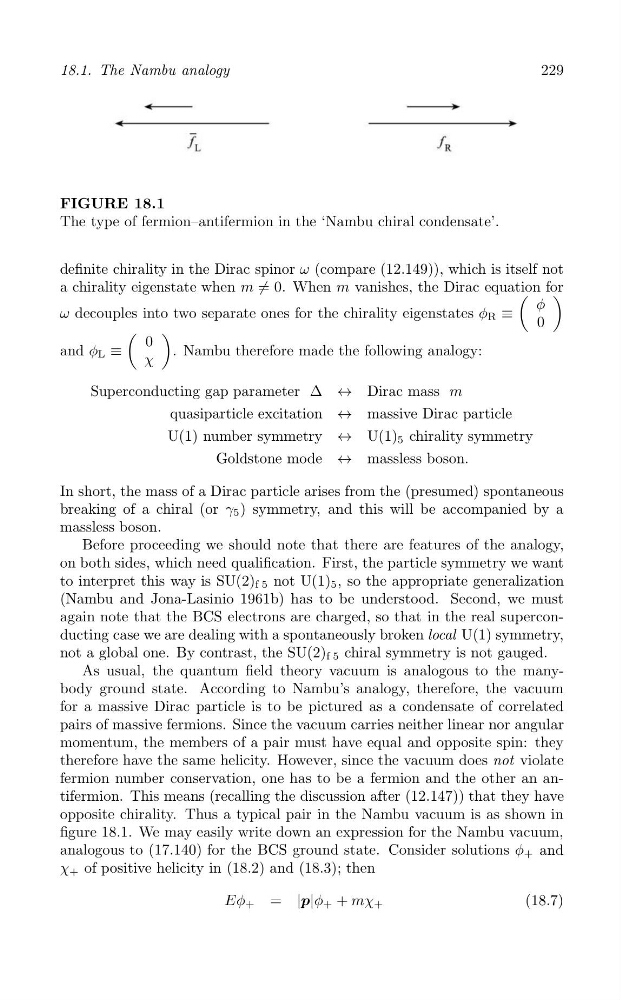
FIGURE 18.1
The type of fermion–antifermion in the ‘Nambu chiral condensate’.
definite chirality in the Dirac spinor ω (compare (12.149)), which is itself not
a chirality eigenstate when m /
(
)
= 0. When m vanishes, the Dirac equation for
φ
ω decouples into two separate ones for the chirality eigenstates φ R ≡
0
(
)
0
and φ L ≡
. Nambu therefore made the following analogy:
χ
Superconducting gap parameter Δ ↔ Dirac mass m
quasiparticle excitation ↔ massive Dirac particle
U(1) number symmetry ↔ U(1) 5 chirality symmetry
Goldstone mode ↔ massless boson.
In short, the mass of a Dirac particle arises from the (presumed) spontaneous
breaking of a chiral (or γ 5 ) symmetry, and this will be accompanied by a
massless boson.
Before proceeding we should note that there are features of the analogy,
on both sides, which need qualification. First, the particle symmetry we want
to interpret this way is SU(2) f 5 not U(1) 5 , so the appropriate generalization
(Nambu and Jona-Lasinio 1961b) has to be understood. Second, we must
again note that the BCS electrons are charged, so that in the real superconducting case we are dealing with a spontaneously broken local U(1) symmetry,
not a global one. By contrast, the SU(2) f 5 chiral symmetry is not gauged.
As usual, the quantum field theory vacuum is analogous to the manybody ground state. According to Nambu’s analogy, therefore, the vacuum
for a massive Dirac particle is to be pictured as a condensate of correlated
pairs of massive fermions. Since the vacuum carries neither linear nor angular
momentum, the members of a pair must have equal and opposite spin: they
therefore have the same helicity. However, since the vacuum does not violate
fermion number conservation, one has to be a fermion and the other an antifermion. This means (recalling the discussion after (12.147)) that they have
opposite chirality. Thus a typical pair in the Nambu vacuum is as shown in
figure 18.1. We may easily write down an expression for the Nambu vacuum,
analogous to (17.140) for the BCS ground state. Consider solutions φ + and
χ + of positive helicity in (18.2) and (18.3); then
Eφ + = |p|φ + + mχ +
(18.7)