

54
2. Electromagnetism as a Gauge Theory
of phase, it is destructive and |ψ|
2 has a minimum. It is clear that if the
individual phases δ 1 and δ 2 are each shifted by the same amount, there will
be no observable consequences, since only the phase difference δ enters.
The situation in which the wavefunction can be changed in a certain way
without leading to any observable effects is precisely what is entailed by a
symmetry or invariance principle in quantum mechanics. In the case under
discussion, the invariance is that of a constant overall change in phase. In
performing calculations it is necessary to make some definite choice of phase;
that is, to adopt a ‘phase convention’. The invariance principle guarantees
that any such choice, or convention, is equivalent to any other.
Invariance under a constant change in phase is an example of a global
invariance, according to the terminology introduced in the previous section.
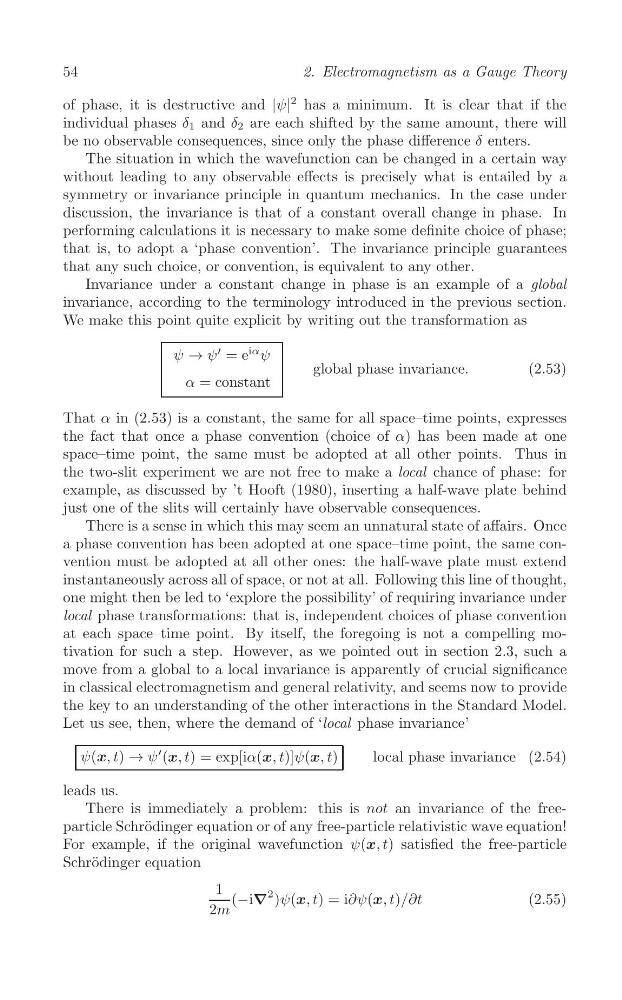
We make this point quite explicit by writing out the transformation as
′
iα ψ
ψ → ψ = e
global phase invariance.
(2.53)
α = constant
That α in (2.53) is a constant, the same for all space–time points, expresses
the fact that once a phase convention (choice of α) has been made at one
space–time point, the same must be adopted at all other points. Thus in
the two-slit experiment we are not free to make a local chance of phase: for
example, as discussed by ’t Hooft (1980), inserting a half-wave plate behind
just one of the slits will certainly have observable consequences.
There is a sense in which this may seem an unnatural state of affairs. Once
a phase convention has been adopted at one space–time point, the same convention must be adopted at all other ones: the half-wave plate must extend
instantaneously across all of space, or not at all. Following this line of thought,
one might then be led to ‘explore the possibility’ of requiring invariance under
local phase transformations: that is, independent choices of phase convention
at each space–time point. By itself, the foregoing is not a compelling motivation for such a step. However, as we pointed out in section 2.3, such a
move from a global to a local invariance is apparently of crucial significance
in classical electromagnetism and general relativity, and seems now to provide
the key to an understanding of the other interactions in the Standard Model.
Let us see, then, where the demand of ‘local phase invariance’
ψ(x, t) → ψ
′ (x, t) = exp[iα(x, t)]ψ(x, t)
local phase invariance (2.54)
leads us.
There is immediately a problem: this is not an invariance of the freeparticle Schr¨ odinger equation or of any free-particle relativistic wave equation!
For example, if the original wavefunction ψ(x, t) satisfied the free-particle
Schr¨ odinger equation
1 (−i∇
2 )ψ(x, t) = i∂ψ(x, t)/∂t
(2.55)
2m
2. Electromagnetism as a Gauge Theory
of phase, it is destructive and |ψ|
2 has a minimum. It is clear that if the
individual phases δ 1 and δ 2 are each shifted by the same amount, there will
be no observable consequences, since only the phase difference δ enters.
The situation in which the wavefunction can be changed in a certain way
without leading to any observable effects is precisely what is entailed by a
symmetry or invariance principle in quantum mechanics. In the case under
discussion, the invariance is that of a constant overall change in phase. In
performing calculations it is necessary to make some definite choice of phase;
that is, to adopt a ‘phase convention’. The invariance principle guarantees
that any such choice, or convention, is equivalent to any other.
Invariance under a constant change in phase is an example of a global
invariance, according to the terminology introduced in the previous section.
We make this point quite explicit by writing out the transformation as
′
iα ψ
ψ → ψ = e
global phase invariance.
(2.53)
α = constant
That α in (2.53) is a constant, the same for all space–time points, expresses
the fact that once a phase convention (choice of α) has been made at one
space–time point, the same must be adopted at all other points. Thus in
the two-slit experiment we are not free to make a local chance of phase: for
example, as discussed by ’t Hooft (1980), inserting a half-wave plate behind
just one of the slits will certainly have observable consequences.
There is a sense in which this may seem an unnatural state of affairs. Once
a phase convention has been adopted at one space–time point, the same convention must be adopted at all other ones: the half-wave plate must extend
instantaneously across all of space, or not at all. Following this line of thought,
one might then be led to ‘explore the possibility’ of requiring invariance under
local phase transformations: that is, independent choices of phase convention
at each space–time point. By itself, the foregoing is not a compelling motivation for such a step. However, as we pointed out in section 2.3, such a
move from a global to a local invariance is apparently of crucial significance
in classical electromagnetism and general relativity, and seems now to provide
the key to an understanding of the other interactions in the Standard Model.
Let us see, then, where the demand of ‘local phase invariance’
ψ(x, t) → ψ
′ (x, t) = exp[iα(x, t)]ψ(x, t)
local phase invariance (2.54)
leads us.
There is immediately a problem: this is not an invariance of the freeparticle Schr¨ odinger equation or of any free-particle relativistic wave equation!
For example, if the original wavefunction ψ(x, t) satisfied the free-particle
Schr¨ odinger equation
1 (−i∇
2 )ψ(x, t) = i∂ψ(x, t)/∂t
(2.55)
2m