

226
17. Spontaneously Broken Global Symmetry
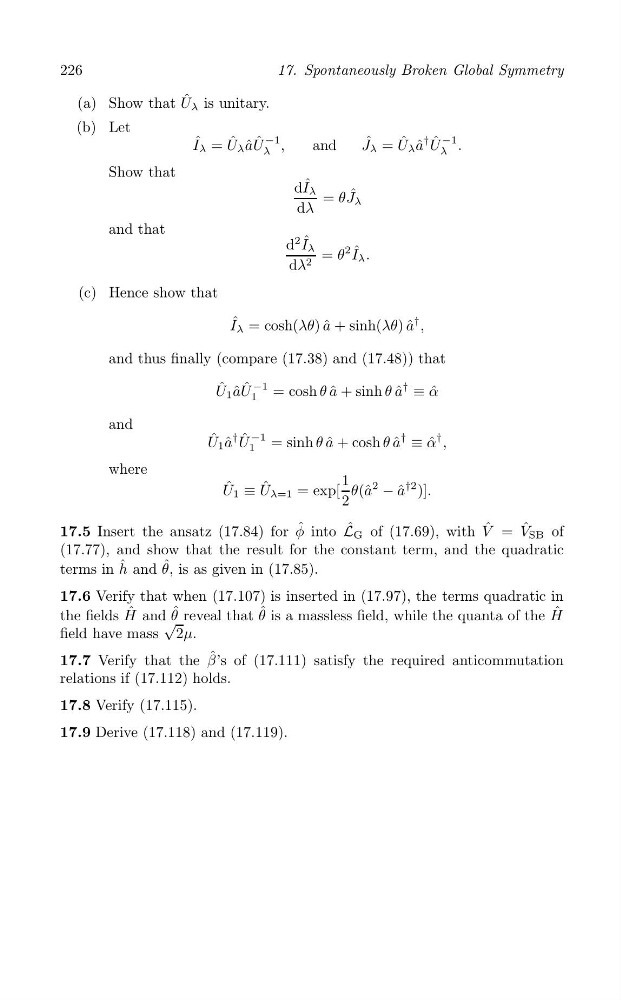
(a) Show that U ˆ λ is unitary.
(b) Let
ˆ
ˆ U ˆ −1
ˆ
ˆ † U ˆ −1
= U λ a ˆ
,
and
J λ = U λ a ˆ
.
I λ
λ
λ
Show that
dI ˆ λ = θJ ˆ λ
dλ
and that
d
2 ˆ
I λ
θ
2 ˆ
= I λ .
dλ 2
(c) Hence show that
ˆ
I λ = cosh(λθ) ˆ
a + sinh(λθ) ˆ
a
† ,
and thus finally (compare (17.38) and (17.48)) that
ˆ U ˆ −1
U 1 a ˆ
= cosh θ a ˆ + sinh θ a ˆ
†
≡ α ˆ
1
and
ˆ † U ˆ −1
†
≡ α ˆ
†
sinh θ ˆ + cosh θ ˆ
U 1 ˆ
a 1 =
a
a
,
where
1
U ˆ 1 ≡ ˆ
2
− ˆ
†2 )].
U λ=1 = exp[ θ(ˆ a
a
2
17.5 Insert the ansatz (17.84) for φ ˆ into L ˆ G of (17.69), with V ˆ = V ˆ SB of
(17.77), and show that the result for the constant term, and the quadratic
terms in h ˆ and θ ˆ , is as given in (17.85).
17.6 Verify that when (17.107) is inserted in (17.97), the terms quadratic in
the fields H ˆ and √ θ ˆ reveal that θ ˆ is a massless field, while the quanta of the H ˆ
field have mass 2μ.
17.7 Verify that the β ˆ ’s of (17.111) satisfy the required anticommutation
relations if (17.112) holds.
17.8 Verify (17.115).
17.9 Derive (17.118) and (17.119).