

220
17. Spontaneously Broken Global Symmetry
interpreted a chiral symmetry breaking fermionic mass term as an analogous
‘gap’. We emphasize at the outset that we shall here not treat electromagnetic
interactions in the superconducting state, leaving that topic for chapter 19.
Our discussion will deliberately have some similarity to that of section
17.3.2. In the present case, of course, we shall be dealing with fermions –
namely electrons – rather than the bosons of a superfluid. Nevertheless, we
shall see that a similar kind of ‘condensation’ occurs in the superconductor
too. Naturally, such a phenomenon can only occur for bosons. Thus an essential element in the BCS theory is the identification of a mechanism whereby
pairs of electrons become correlated, the behaviour of which may have some
similarity to that of bosons. Now, direct Coulomb interaction between a pair
of electrons is repulsive, and it remains so despite the screening that occurs
in a solid. But the positively charged ions do provide sources of attraction
for the electrons, and may be used as intermediaries (via ‘electron-phonon
interactions’) to promote an effective attraction between electrons in certain
circumstances. At this point we recall the characteristic feature of a weakly
interacting gas of electrons at zero temperature: thanks to the Exclusion Principle, the electrons populate single particle energy levels up to some maximum
energy E F (the Fermi energy), whose value is fixed by the electron density. It
turns out (see for example Kittel 1987, chapter 8) that electron–electron scattering, mediated by phonon exchange, leads to an effective attraction between
two electrons whose energies ∈ k lie in a thin band E F − ω D < ∈ k < E F + ω D
around E F , where ω D is the Debye frequency associated with lattice vibrations. Cooper (1956) was the first to observe that the Fermi ‘sea’ was unstable
with respect to the formation of bound pairs, in the presence of an attractive
interaction. What this means is that the energy of the system can be lowered
by exciting a pair of electrons above E F , which then become bound to a state
with a total energy less than 2E F . This instability modifies the Fermi sea in a
fundamental way: a sort of ‘condensate’ of pairs is created around the Fermi
energy, and we need a many-body formalism to handle the situation.
For simplicity we shall consider pairs of equal and opposite momentum
k, so their total momentum is zero. It can also be argued that the effective
attraction will be greater when the spins are antiparallel, but the spin will
not be indicated explicitly in what follows: ‘k’ will stand for ‘k with spin up’,
and ‘−k’ for ‘−k with spin down’. With this by way of motivation, we thus
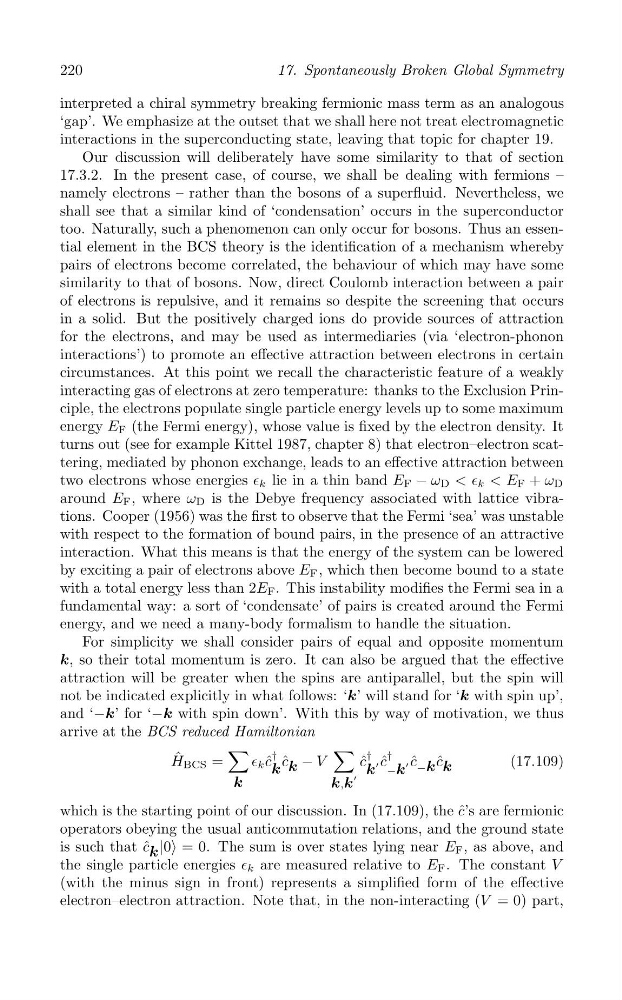
arrive at the BCS reduced Hamiltonian
∑
∑
ˆ
H BCS =
∈ k c ˆ
† c ˆ
k k − V
c ˆ
† c ˆ
†
c ˆ c ˆ
(17.109)
k
′
k
′ −k k
′
−
k
k,k
which is the starting point of our discussion. In (17.109), the c ˆ’s are fermionic
operators obeying the usual anticommutation relations, and the ground state
is such that c ˆ |0› = 0. The sum is over states lying near E F , as above, and
k
the single particle energies ∈ k are measured relative to E F . The constant V
(with the minus sign in front) represents a simplified form of the effective
electron–electron attraction. Note that, in the non-interacting (V = 0) part,