

17.5. Spontaneously broken global U(1) symmetry: the Goldstone model 215
ˆ
h ˆ 2
h
1
λ
λ
+ ∂ μ θ∂
μ θ ˆ +
θ∂
μ ˆ
,
(17.85)
ˆ
∂ μ ˆ θ − vh ˆ 3 − h ˆ 4
v
2 v 2
16
16
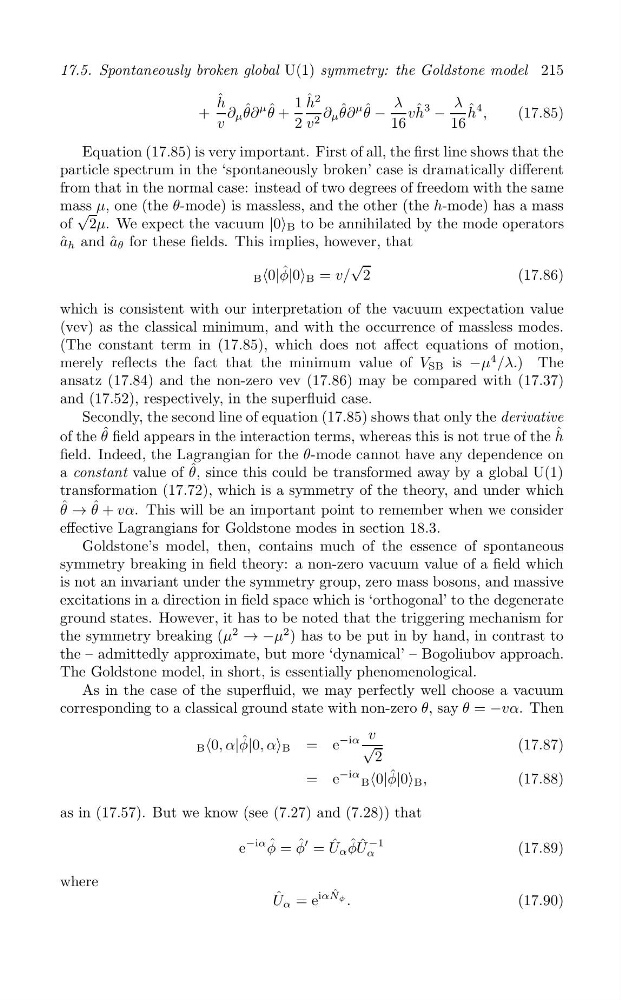
Equation (17.85) is very important. First of all, the first line shows that the
particle spectrum in the ‘spontaneously broken’ case is dramatically different
from that in the normal case: instead of two degrees of freedom with the same
mass μ, one (the θ-mode) is massless, and the other (the h-mode) has a mass
√
of 2μ. We expect the vacuum |0› B to be annihilated by the mode operators
a ˆ h and ˆ
a θ for these fields. This implies, however, that
√
B ‹0|φ ˆ |0› B = v/ 2
(17.86)
which is consistent with our interpretation of the vacuum expectation value
(vev) as the classical minimum, and with the occurrence of massless modes.
(The constant term in (17.85), which does not affect equations of motion,
merely reflects the fact that the minimum value of V SB is −μ
4 /λ.) The
ansatz (17.84) and the non-zero vev (17.86) may be compared with (17.37)
and (17.52), respectively, in the superfluid case.
Secondly, the second line of equation (17.85) shows that only the derivative
of the θ ˆ field appears in the interaction terms, whereas this is not true of the h ˆ
field. Indeed, the Lagrangian for the θ-mode cannot have any dependence on
a constant value of θ ˆ , since this could be transformed away by a global U(1)
transformation (17.72), which is a symmetry of the theory, and under which
θ ˆ → ˆ
θ + vα. This will be an important point to remember when we consider
effective Lagrangians for Goldstone modes in section 18.3.
Goldstone’s model, then, contains much of the essence of spontaneous
symmetry breaking in field theory: a non-zero vacuum value of a field which
is not an invariant under the symmetry group, zero mass bosons, and massive
excitations in a direction in field space which is ‘orthogonal’ to the degenerate
ground states. However, it has to be noted that the triggering mechanism for
the symmetry breaking (μ
2
→ −μ
2 ) has to be put in by hand, in contrast to
the – admittedly approximate, but more ‘dynamical’ – Bogoliubov approach.
The Goldstone model, in short, is essentially phenomenological.
As in the case of the superfluid, we may perfectly well choose a vacuum
corresponding to a classical ground state with non-zero θ, say θ = −vα. Then
v
−iα
B ‹0, α|φ ˆ |0, α› B = e
√
(17.87)
2
= e
−iα
B ‹0|φ ˆ |0› B ,
(17.88)
as in (17.57). But we know (see (7.27) and (7.28)) that
e
−iα φ ˆ = φ ˆ ′ = U ˆ α φ ˆ U ˆ −1
(17.89)
α
where
ˆ
N φ
iα ˆ
U α = e
.
(17.90)
ˆ
h ˆ 2
h
1
λ
λ
+ ∂ μ θ∂
μ θ ˆ +
θ∂
μ ˆ
,
(17.85)
ˆ
∂ μ ˆ θ − vh ˆ 3 − h ˆ 4
v
2 v 2
16
16
Equation (17.85) is very important. First of all, the first line shows that the
particle spectrum in the ‘spontaneously broken’ case is dramatically different
from that in the normal case: instead of two degrees of freedom with the same
mass μ, one (the θ-mode) is massless, and the other (the h-mode) has a mass
√
of 2μ. We expect the vacuum |0› B to be annihilated by the mode operators
a ˆ h and ˆ
a θ for these fields. This implies, however, that
√
B ‹0|φ ˆ |0› B = v/ 2
(17.86)
which is consistent with our interpretation of the vacuum expectation value
(vev) as the classical minimum, and with the occurrence of massless modes.
(The constant term in (17.85), which does not affect equations of motion,
merely reflects the fact that the minimum value of V SB is −μ
4 /λ.) The
ansatz (17.84) and the non-zero vev (17.86) may be compared with (17.37)
and (17.52), respectively, in the superfluid case.
Secondly, the second line of equation (17.85) shows that only the derivative
of the θ ˆ field appears in the interaction terms, whereas this is not true of the h ˆ
field. Indeed, the Lagrangian for the θ-mode cannot have any dependence on
a constant value of θ ˆ , since this could be transformed away by a global U(1)
transformation (17.72), which is a symmetry of the theory, and under which
θ ˆ → ˆ
θ + vα. This will be an important point to remember when we consider
effective Lagrangians for Goldstone modes in section 18.3.
Goldstone’s model, then, contains much of the essence of spontaneous
symmetry breaking in field theory: a non-zero vacuum value of a field which
is not an invariant under the symmetry group, zero mass bosons, and massive
excitations in a direction in field space which is ‘orthogonal’ to the degenerate
ground states. However, it has to be noted that the triggering mechanism for
the symmetry breaking (μ
2
→ −μ
2 ) has to be put in by hand, in contrast to
the – admittedly approximate, but more ‘dynamical’ – Bogoliubov approach.
The Goldstone model, in short, is essentially phenomenological.
As in the case of the superfluid, we may perfectly well choose a vacuum
corresponding to a classical ground state with non-zero θ, say θ = −vα. Then
v
−iα
B ‹0, α|φ ˆ |0, α› B = e
√
(17.87)
2
= e
−iα
B ‹0|φ ˆ |0› B ,
(17.88)
as in (17.57). But we know (see (7.27) and (7.28)) that
e
−iα φ ˆ = φ ˆ ′ = U ˆ α φ ˆ U ˆ −1
(17.89)
α
where
ˆ
N φ
iα ˆ
U α = e
.
(17.90)