

196
17. Spontaneously Broken Global Symmetry
where φ ˆ †
A and φ ˆ †
B are related to each other by (cf (12.100))
[ ˆ
Q, φ ˆ
A
† ] = φ ˆ †
(17.2)
B
for some generator Q ˆ of a symmetry group, such that
[ ˆ
Q, H ˆ ] = 0.
(17.3)
(17.2) is equivalent to
U φ ˆ † U ˆ −1 ≈ ˆ
φ A
†
†
+ i∈φ ˆ
B
ˆ
(17.4)
A
†
for an infinitesimal transformation U ˆ ≈ 1 + i∈Q ˆ . Thus ˆ
†
is ‘rotated’ into φ ˆ
B
φ A
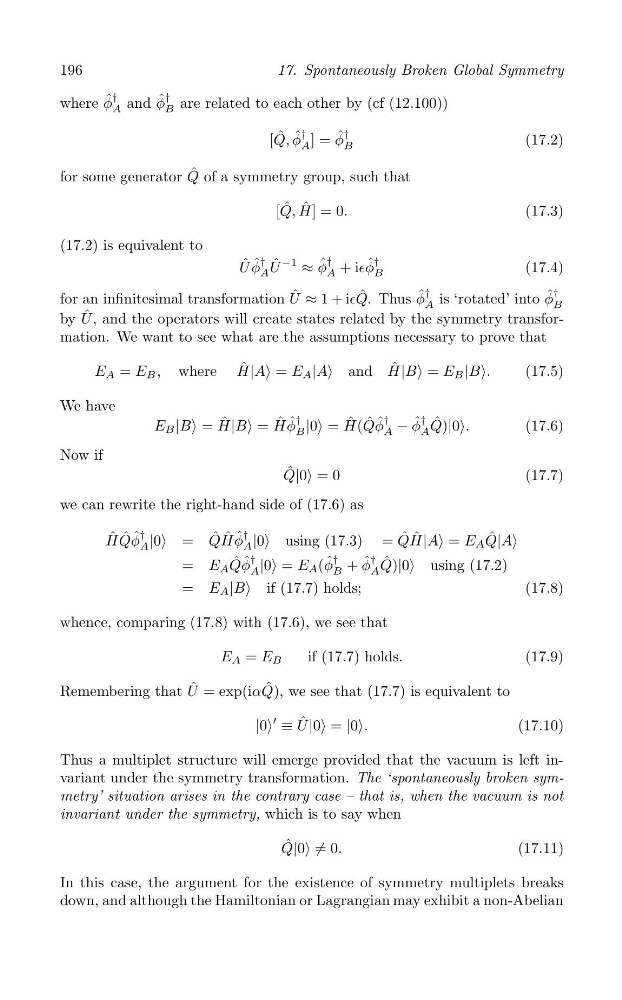
by U ˆ , and the operators will create states related by the symmetry transformation. We want to see what are the assumptions necessary to prove that
ˆ
ˆ
E A = E B , where H|A› = E A |A› and H|B› = E B |B›.
(17.5)
We have
†
ˆ
ˆ
H|B› = H ˆ |0› = H ˆ (Q ˆ ˆ
φ
†
A
†
− φ ˆ
A
ˆ
Q)|0›.
(17.6)
E B |B› =
φ B
Now if
ˆ
Q|0› = 0
(17.7)
we can rewrite the right-hand side of (17.6) as
†
H ˆ Q ˆ ˆ
†
Q ˆ H ˆ ˆ
ˆ
ˆ
QH ˆ |A› = E A Q|A›
|0›
†
|0›
Qφ ˆ
φ
φ
using (17.3)
=
=
A
A
†
E A (φ ˆ
†
+ φ ˆ
A
ˆ
ˆ
Q)|0›
|0›
E A
using (17.2)
=
=
A
B
E A |B› if (17.7) holds;
(17.8)
=
whence, comparing (17.8) with (17.6), we see that
E A = E B
if (17.7) holds.
(17.9)
Remembering that U ˆ = exp(iαQ ˆ ), we see that (17.7) is equivalent to
|0›
′
≡ U ˆ |0› = |0›.
(17.10)
Thus a multiplet structure will emerge provided that the vacuum is left invariant under the symmetry transformation. The ‘spontaneously broken symmetry’ situation arises in the contrary case – that is, when the vacuum is not
invariant under the symmetry, which is to say when
ˆ
Q|0› /
(17.11)
= 0.
In this case, the argument for the existence of symmetry multiplets breaks
down, and although the Hamiltonian or Lagrangian may exhibit a non-Abelian