

190
16. Lattice Field Theory, and the Renormalization Group Revisited
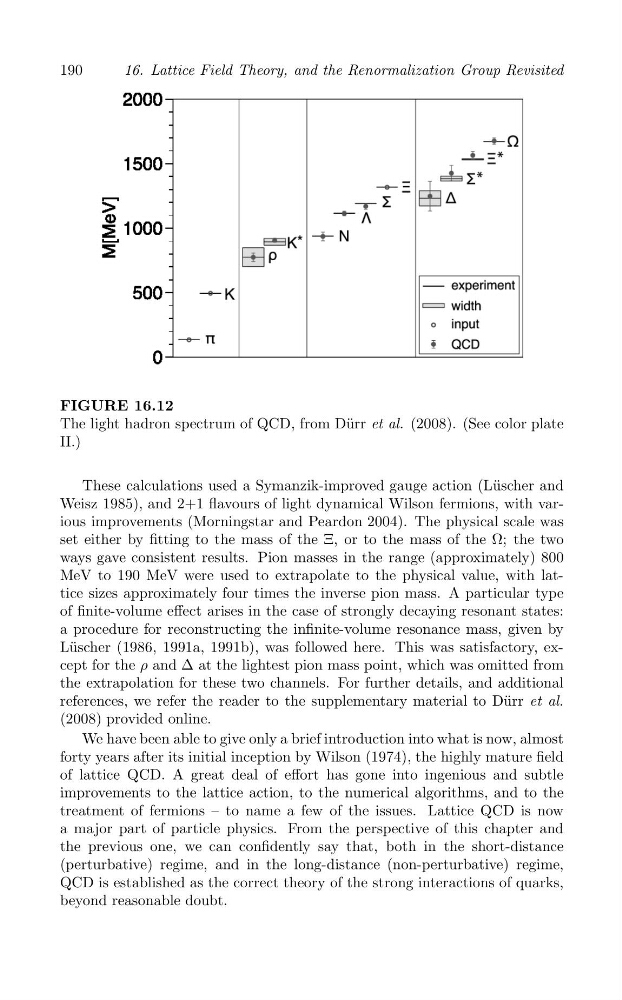
FIGURE 16.12
The light hadron spectrum of QCD, from D¨ urr et al. (2008). (See color plate
II.)
These calculations used a Symanzik-improved gauge action (L¨ uscher and
Weisz 1985), and 2+1 flavours of light dynamical Wilson fermions, with various improvements (Morningstar and Peardon 2004). The physical scale was
set either by fitting to the mass of the Ξ, or to the mass of the Ω; the two
ways gave consistent results. Pion masses in the range (approximately) 800
MeV to 190 MeV were used to extrapolate to the physical value, with lattice sizes approximately four times the inverse pion mass. A particular type
of finite-volume effect arises in the case of strongly decaying resonant states:
a procedure for reconstructing the infinite-volume resonance mass, given by
L¨ uscher (1986, 1991a, 1991b), was followed here. This was satisfactory, except for the ρ and Δ at the lightest pion mass point, which was omitted from
the extrapolation for these two channels. For further details, and additional
references, we refer the reader to the supplementary material to D¨ urr et al.
(2008) provided online.
We have been able to give only a brief introduction into what is now, almost
forty years after its initial inception by Wilson (1974), the highly mature field
of lattice QCD. A great deal of effort has gone into ingenious and subtle
improvements to the lattice action, to the numerical algorithms, and to the
treatment of fermions – to name a few of the issues. Lattice QCD is now
a major part of particle physics. From the perspective of this chapter and
the previous one, we can confidently say that, both in the short-distance
(perturbative) regime, and in the long-distance (non-perturbative) regime,
QCD is established as the correct theory of the strong interactions of quarks,
beyond reasonable doubt.