

16.4. Renormalization, and the renormalization group, on the lattice
181
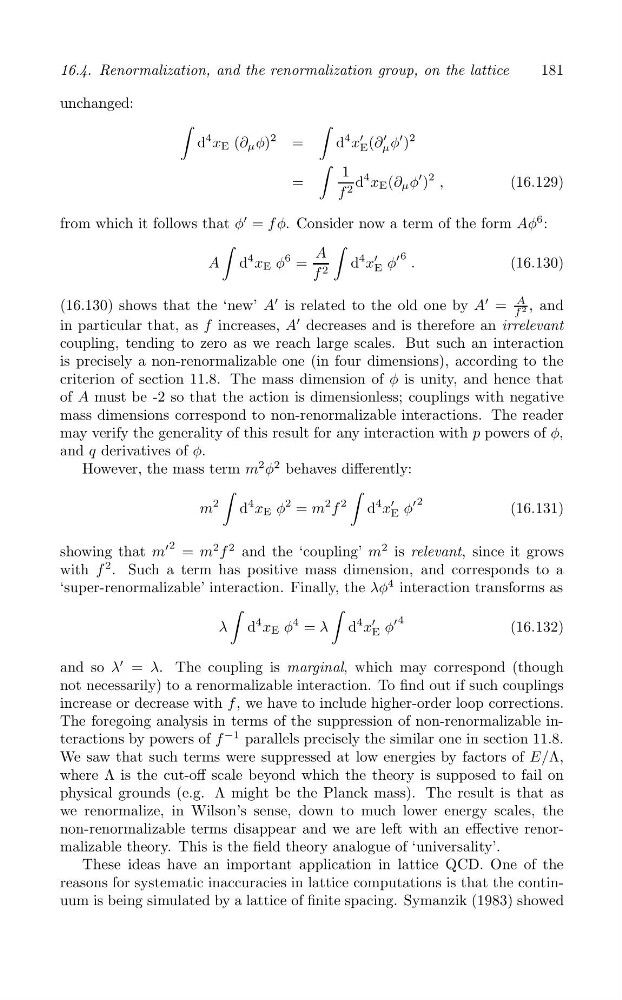
unchanged:
∫
∫
d
4 x E (∂ μ φ)
2
=
d
4 x
′
E (∂ μ
′ φ
′ )
2
∫ 1
=
d
4 x
2
E (∂ μ φ
′ ) ,
(16.129)
f 2
from which it follows that φ
′ = f φ. Consider now a term of the form Aφ
6 :
∫
∫
A
A d
4
6
x
6
4
E φ =
d x
′
E φ
′ .
(16.130)
f 2
(16.130) shows that the ‘new’ A
′ is related to the old one by A
′ =
A
f 2 , and
in particular that, as f increases, A
′ decreases and is therefore an irrelevant
coupling, tending to zero as we reach large scales. But such an interaction
is precisely a non-renormalizable one (in four dimensions), according to the
criterion of section 11.8. The mass dimension of φ is unity, and hence that
of A must be -2 so that the action is dimensionless; couplings with negative
mass dimensions correspond to non-renormalizable interactions. The reader
may verify the generality of this result for any interaction with p powers of φ,
and q derivatives of φ.
However, the mass term m
2 φ
2 behaves differently:
∫
∫
m
2
d
4 x E φ
2
2
= m
2 f
2
d
4 x
′
E φ
′
(16.131)
2
showing that m
′ = m
2 f
2 and the ‘coupling’ m
2 is relevant, since it grows
with f
2 . Such a term has positive mass dimension, and corresponds to a
‘super-renormalizable’ interaction. Finally, the λφ
4 interaction transforms as
∫
∫
λ d
4 x E φ
4 = λ d
4 x
′
4
E φ
′
(16.132)
and so λ
′ = λ. The coupling is marginal, which may correspond (though
not necessarily) to a renormalizable interaction. To find out if such couplings
increase or decrease with f , we have to include higher-order loop corrections.
The foregoing analysis in terms of the suppression of non-renormalizable interactions by powers of f
−1 parallels precisely the similar one in section 11.8.
We saw that such terms were suppressed at low energies by factors of E/Λ,
where Λ is the cut-off scale beyond which the theory is supposed to fail on
physical grounds (e.g. Λ might be the Planck mass). The result is that as
we renormalize, in Wilson’s sense, down to much lower energy scales, the
non-renormalizable terms disappear and we are left with an effective renormalizable theory. This is the field theory analogue of ‘universality’.
These ideas have an important application in lattice QCD. One of the
reasons for systematic inaccuracies in lattice computations is that the continuum is being simulated by a lattice of finite spacing. Symanzik (1983) showed