

15.5. A more general form of the RGE
131
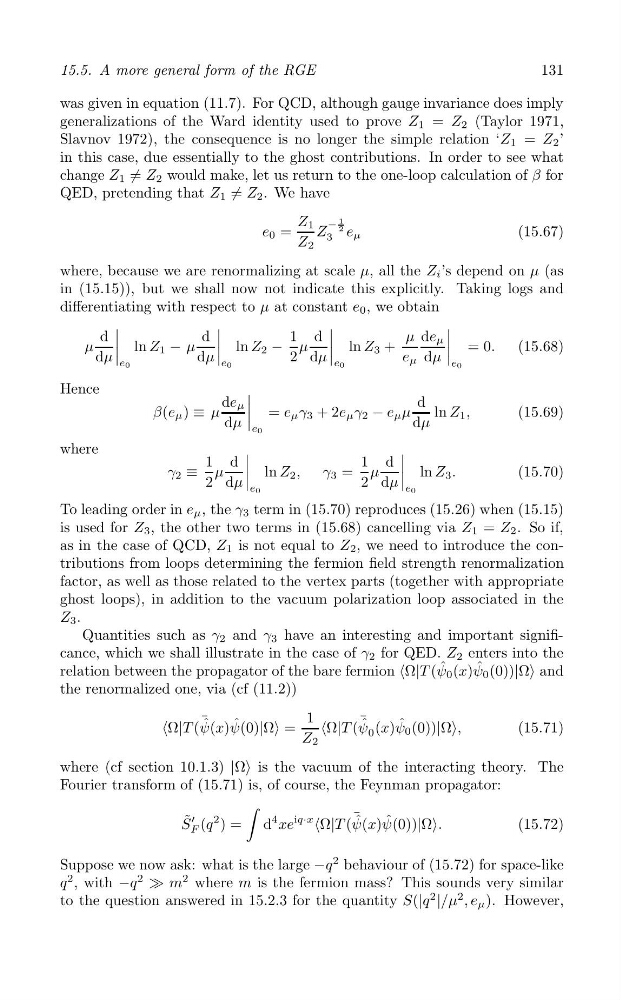
was given in equation (11.7). For QCD, although gauge invariance does imply
generalizations of the Ward identity used to prove Z 1 = Z 2 (Taylor 1971,
Slavnov 1972), the consequence is no longer the simple relation ‘Z 1 = Z 2 ’
in this case, due essentially to the ghost contributions. In order to see what
change Z 1 = Z 2 would make, let us return to the one-loop calculation of β for
QED, pretending that Z 1 = Z 2 . We have
Z 1
e 0 =
Z
−
1
2
3 e μ
(15.67)
Z 2
where, because we are renormalizing at scale μ, all the Z i ’s depend on μ (as
in (15.15)), but we shall now not indicate this explicitly. Taking logs and
differentiating with respect to μ at constant e 0 , we obtain
|
|
|
|
d |
d |
1 d |
μ de μ |
μ |
Z 1
|
| ln
dμ
− μ | ln Z 2
μ |
|
| ln Z 3 +
| = 0.
(15.68)
e
dμ
0
e
2
0
−
dμ e
e μ dμ
0
e0
Hence
|
de |
d
β(e μ )
|
≡
μ
μ
| = e μ γ 3 + 2e μ γ 2 e μ μ
ln Z 1 ,
(15.69)
dμ e
dμ
0
−
where
|
|
1 d |
d |
γ 2 ≡ μ |
1 μ |
| ln Z 2 ,
γ 3 =
| ln Z 3 .
(15.70)
2 dμ e
2 dμ
0
e0
To leading order in e μ , the γ 3 term in (15.70) reproduces (15.26) when (15.15)
is used for Z 3 , the other two terms in (15.68) cancelling via Z 1 = Z 2 . So if,
as in the case of QCD, Z 1 is not equal to Z 2 , we need to introduce the contributions from loops determining the fermion field strength renormalization
factor, as well as those related to the vertex parts (together with appropriate
ghost loops), in addition to the vacuum polarization loop associated in the
Z 3 .
Quantities such as γ 2 and γ 3 have an interesting and important significance, which we shall illustrate in the case of γ 2 for QED. Z 2 enters into the
ˆ
ˆ
relation between the propagator of the bare fermion ‹Ω|T (ψ 0 (x)ψ 0 (0))|Ω› and
the renormalized one, via (cf (11.2))
¯
1
¯
‹Ω| ˆ
ˆ
ˆ
ˆ
T (ψ(x)ψ(0)|Ω› =
‹Ω|T (ψ 0 (x)ψ 0 (0))
Z 2
|Ω›,
(15.71)
where (cf section 10.1.3) |Ω› is the vacuum of the interacting theory. The
Fourier transform of (15.71) is, of course, the Feynman propagator:
∫
˜ ′ 2
4
iq·x
¯
‹ | ˆ
ˆ
S F (q ) = d xe
Ω T (ψ(x)ψ(0))|Ω›.
(15.72)
Suppose we now ask: what is the large q
2 behaviour of (15.72) for space-like
q
2 , with −q
2
2
−
≫ m where m is the fermion mass? This sounds very similar
to the question answered in 15.2.3 for the quantity S(|q
2
|/μ
2 , e μ ). However,
/
/