

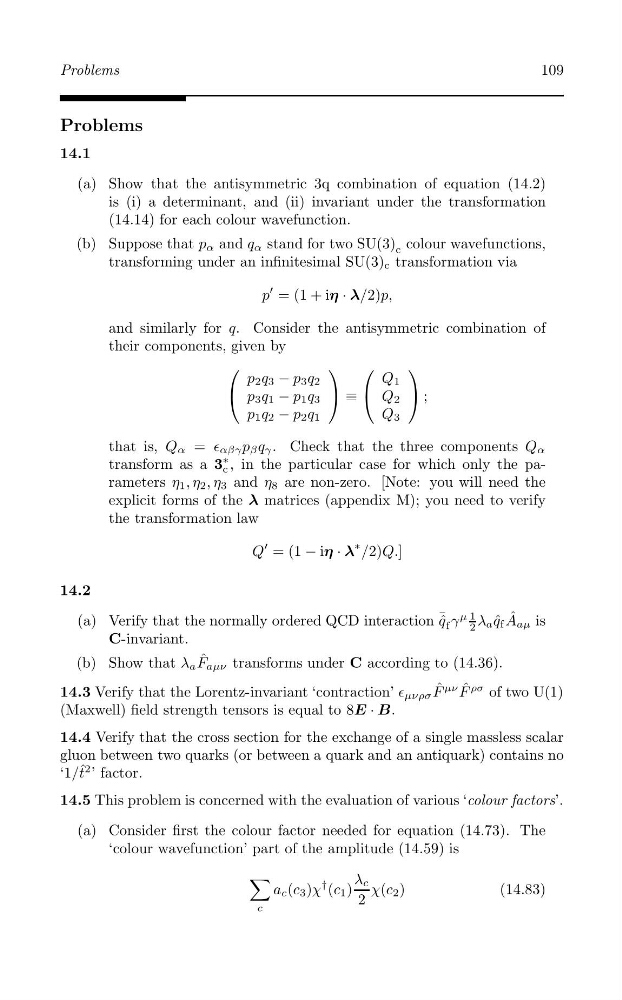
Problems
109
Problems
14.1
(a) Show that the antisymmetric 3q combination of equation (14.2)
is (i) a determinant, and (ii) invariant under the transformation
(14.14) for each colour wavefunction.
(b) Suppose that p α and q α stand for two SU(3) c colour wavefunctions,
transforming under an infinitesimal SU(3) c transformation via
p
′ = (1 + iη · λ/2)p,
and similarly for q. Consider the antisymmetric combination of
their components, given by
(
) (
)
p 2 q 3 − p 3 q 2
Q 1
( p 3 q 1 − p 1 q 3 ) ≡ ( Q 2 ) ;
p 1 q 2 − p 2 q 1
Q 3
that is, Q α = ∈ αβγ p β q γ . Check that the three components Q α
transform as a 3
∗
c , in the particular case for which only the parameters η 1 , η 2 , η 3 and η 8 are non-zero. [Note: you will need the
explicit forms of the λ matrices (appendix M); you need to verify
the transformation law
Q
′ = (1 − iη · λ
∗ /2)Q.]
14.2
¯
ˆ
(a) Verify that the normally ordered QCD interaction q ˆ f γ
μ 1 λ a q ˆ f A aμ is
2
C-invariant.
ˆ
(b) Show that λ a F aμν transforms under C according to (14.36).
ˆ ˆ
14.3 Verify that the Lorentz-invariant ‘contraction’ ∈ μνρσ F
μν F
ρσ of two U(1)
(Maxwell) field strength tensors is equal to 8E · B.
14.4 Verify that the cross section for the exchange of a single massless scalar
gluon between two quarks (or between a quark and an antiquark) contains no
‘1/t ˆ 2 ’ factor.
14.5 This problem is concerned with the evaluation of various ‘colour factors’.
(a) Consider first the colour factor needed for equation (14.73). The
‘colour wavefunction’ part of the amplitude (14.59) is
∑
λ
a c (c 3 )χ
†
c
(c 1 ) χ(c 2 )
(14.83)
2
c