

90
14. QCD I: Introduction, Tree Graph Predictions, and Jets
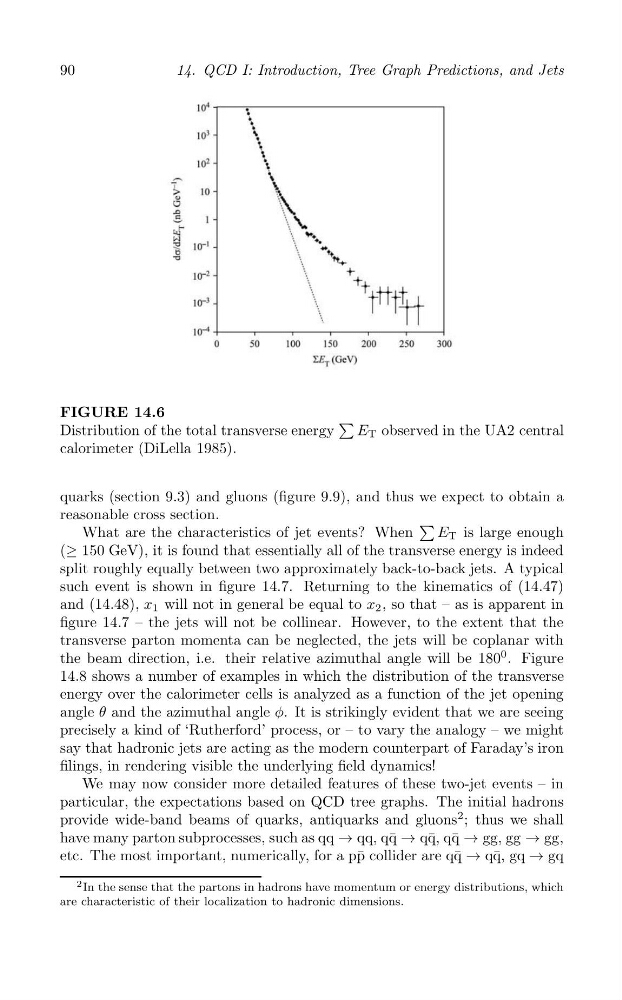
FIGURE 14.6
Distribution of the total transverse energy
E T observed in the UA2 central
calorimeter (DiLella 1985).
quarks (section 9.3) and gluons (figure 9.9), and thus we expect to obtain a
reasonable cross section.
What are the characteristics of jet events? When
E T is large enough
(≥ 150 GeV), it is found that essentially all of the transverse energy is indeed
split roughly equally between two approximately back-to-back jets. A typical
such event is shown in figure 14.7. Returning to the kinematics of (14.47)
and (14.48), x 1 will not in general be equal to x 2 , so that – as is apparent in
figure 14.7 – the jets will not be collinear. However, to the extent that the
transverse parton momenta can be neglected, the jets will be coplanar with
the beam direction, i.e. their relative azimuthal angle will be 180
0 . Figure
14.8 shows a number of examples in which the distribution of the transverse
energy over the calorimeter cells is analyzed as a function of the jet opening
angle θ and the azimuthal angle φ. It is strikingly evident that we are seeing
precisely a kind of ‘Rutherford’ process, or – to vary the analogy – we might
say that hadronic jets are acting as the modern counterpart of Faraday’s iron
filings, in rendering visible the underlying field dynamics!
We may now consider more detailed features of these two-jet events – in
particular, the expectations based on QCD tree graphs. The initial hadrons
provide wide-band beams of quarks, antiquarks and gluons
2 ; thus we shall
have many parton subprocesses, such as qq → qq, qq ¯ → q¯ q, qq ¯ → gg, gg → gg,
etc. The most important, numerically, for a pp ¯ collider are qq ¯ → q¯ q, gq → gq
2 In the sense that the partons in hadrons have momentum or energy distributions, which
are characteristic of their localization to hadronic dimensions.
14. QCD I: Introduction, Tree Graph Predictions, and Jets
FIGURE 14.6
Distribution of the total transverse energy
E T observed in the UA2 central
calorimeter (DiLella 1985).
quarks (section 9.3) and gluons (figure 9.9), and thus we expect to obtain a
reasonable cross section.
What are the characteristics of jet events? When
E T is large enough
(≥ 150 GeV), it is found that essentially all of the transverse energy is indeed
split roughly equally between two approximately back-to-back jets. A typical
such event is shown in figure 14.7. Returning to the kinematics of (14.47)
and (14.48), x 1 will not in general be equal to x 2 , so that – as is apparent in
figure 14.7 – the jets will not be collinear. However, to the extent that the
transverse parton momenta can be neglected, the jets will be coplanar with
the beam direction, i.e. their relative azimuthal angle will be 180
0 . Figure
14.8 shows a number of examples in which the distribution of the transverse
energy over the calorimeter cells is analyzed as a function of the jet opening
angle θ and the azimuthal angle φ. It is strikingly evident that we are seeing
precisely a kind of ‘Rutherford’ process, or – to vary the analogy – we might
say that hadronic jets are acting as the modern counterpart of Faraday’s iron
filings, in rendering visible the underlying field dynamics!
We may now consider more detailed features of these two-jet events – in
particular, the expectations based on QCD tree graphs. The initial hadrons
provide wide-band beams of quarks, antiquarks and gluons
2 ; thus we shall
have many parton subprocesses, such as qq → qq, qq ¯ → q¯ q, qq ¯ → gg, gg → gg,
etc. The most important, numerically, for a pp ¯ collider are qq ¯ → q¯ q, gq → gq
2 In the sense that the partons in hadrons have momentum or energy distributions, which
are characteristic of their localization to hadronic dimensions.