

88
14. QCD I: Introduction, Tree Graph Predictions, and Jets
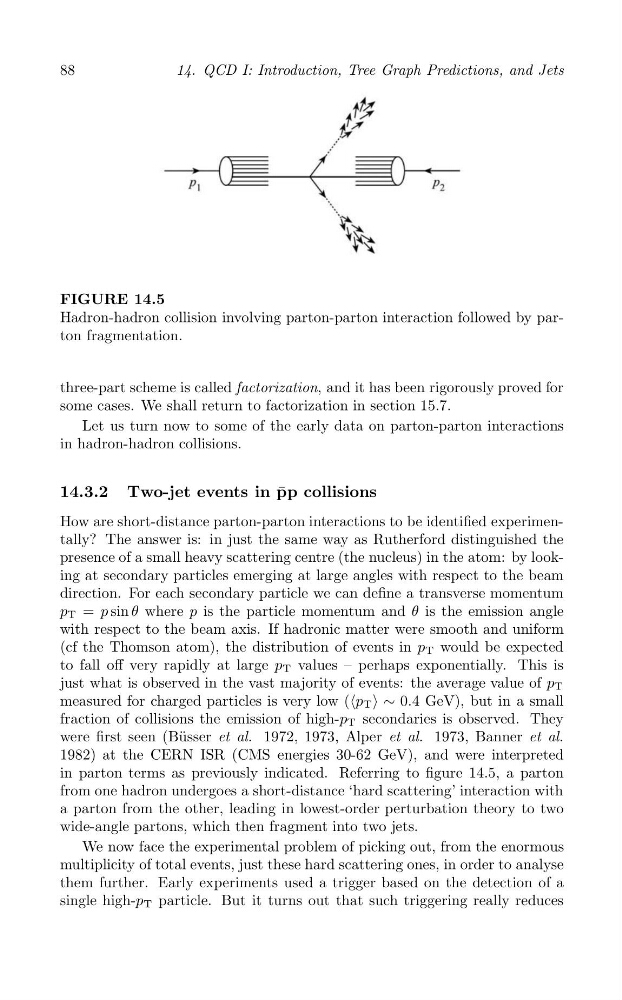
FIGURE 14.5
Hadron-hadron collision involving parton-parton interaction followed by parton fragmentation.
three-part scheme is called factorization, and it has been rigorously proved for
some cases. We shall return to factorization in section 15.7.
Let us turn now to some of the early data on parton-parton interactions
in hadron-hadron collisions.
¯
14.3.2 Two-jet events in pp collisions
How are short-distance parton-parton interactions to be identified experimentally? The answer is: in just the same way as Rutherford distinguished the
presence of a small heavy scattering centre (the nucleus) in the atom: by looking at secondary particles emerging at large angles with respect to the beam
direction. For each secondary particle we can define a transverse momentum
p T = p sin θ where p is the particle momentum and θ is the emission angle
with respect to the beam axis. If hadronic matter were smooth and uniform
(cf the Thomson atom), the distribution of events in p T would be expected
to fall off very rapidly at large p T values – perhaps exponentially. This is
just what is observed in the vast majority of events: the average value of p T
measured for charged particles is very low (‹p T › ∼ 0.4 GeV), but in a small
fraction of collisions the emission of high-p T secondaries is observed. They
were first seen (B¨ usser et al. 1972, 1973, Alper et al. 1973, Banner et al.
1982) at the CERN ISR (CMS energies 30-62 GeV), and were interpreted
in parton terms as previously indicated. Referring to figure 14.5, a parton
from one hadron undergoes a short-distance ‘hard scattering’ interaction with
a parton from the other, leading in lowest-order perturbation theory to two
wide-angle partons, which then fragment into two jets.
We now face the experimental problem of picking out, from the enormous
multiplicity of total events, just these hard scattering ones, in order to analyse
them further. Early experiments used a trigger based on the detection of a
single high-p T particle. But it turns out that such triggering really reduces
14. QCD I: Introduction, Tree Graph Predictions, and Jets
FIGURE 14.5
Hadron-hadron collision involving parton-parton interaction followed by parton fragmentation.
three-part scheme is called factorization, and it has been rigorously proved for
some cases. We shall return to factorization in section 15.7.
Let us turn now to some of the early data on parton-parton interactions
in hadron-hadron collisions.
¯
14.3.2 Two-jet events in pp collisions
How are short-distance parton-parton interactions to be identified experimentally? The answer is: in just the same way as Rutherford distinguished the
presence of a small heavy scattering centre (the nucleus) in the atom: by looking at secondary particles emerging at large angles with respect to the beam
direction. For each secondary particle we can define a transverse momentum
p T = p sin θ where p is the particle momentum and θ is the emission angle
with respect to the beam axis. If hadronic matter were smooth and uniform
(cf the Thomson atom), the distribution of events in p T would be expected
to fall off very rapidly at large p T values – perhaps exponentially. This is
just what is observed in the vast majority of events: the average value of p T
measured for charged particles is very low (‹p T › ∼ 0.4 GeV), but in a small
fraction of collisions the emission of high-p T secondaries is observed. They
were first seen (B¨ usser et al. 1972, 1973, Alper et al. 1973, Banner et al.
1982) at the CERN ISR (CMS energies 30-62 GeV), and were interpreted
in parton terms as previously indicated. Referring to figure 14.5, a parton
from one hadron undergoes a short-distance ‘hard scattering’ interaction with
a parton from the other, leading in lowest-order perturbation theory to two
wide-angle partons, which then fragment into two jets.
We now face the experimental problem of picking out, from the enormous
multiplicity of total events, just these hard scattering ones, in order to analyse
them further. Early experiments used a trigger based on the detection of a
single high-p T particle. But it turns out that such triggering really reduces