

14.2. The dynamics of colour
79
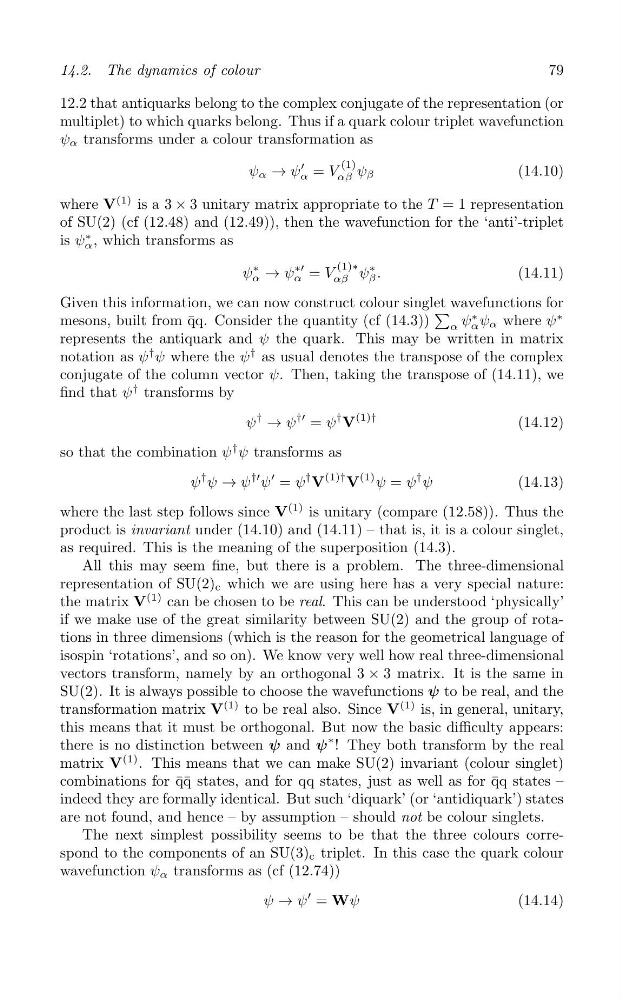
12.2 that antiquarks belong to the complex conjugate of the representation (or
multiplet) to which quarks belong. Thus if a quark colour triplet wavefunction
ψ α transforms under a colour transformation as
ψ α → ψ α
′
(1)
= V αβ ψ β
(14.10)
where V
(1) is a 3 × 3 unitary matrix appropriate to the T = 1 representation
of SU(2) (cf (12.48) and (12.49)), then the wavefunction for the ‘anti’-triplet
is ψ α
∗ , which transforms as
∗
→
∗′
(1)
ψ α
ψ α = V
∗
αβ ψ β
∗ .
(14.11)
Given this information, we can now construct colour singlet wavefunctions for
mesons, built from qq. ¯ Consider the quantity (cf (14.3)) α ψ α
∗ ψ α where ψ
∗
represents the antiquark and ψ the quark. This may be written in matrix
notation as ψ
† ψ where the ψ
† as usual denotes the transpose of the complex
conjugate of the column vector ψ. Then, taking the transpose of (14.11), we
find that ψ
† transforms by
ψ
†
→ ψ
†′ = ψ
† V
(1)†
(14.12)
so that the combination ψ
† ψ transforms as
ψ
† ψ → ψ
†′ ψ
′ = ψ
† V
(1)† V
(1) ψ = ψ
† ψ
(14.13)
where the last step follows since V
(1) is unitary (compare (12.58)). Thus the
product is invariant under (14.10) and (14.11) – that is, it is a colour singlet,
as required. This is the meaning of the superposition (14.3).
All this may seem fine, but there is a problem. The three-dimensional
representation of SU(2) c which we are using here has a very special nature:
the matrix V
(1) can be chosen to be real. This can be understood ‘physically’
if we make use of the great similarity between SU(2) and the group of rotations in three dimensions (which is the reason for the geometrical language of
isospin ‘rotations’, and so on). We know very well how real three-dimensional
vectors transform, namely by an orthogonal 3 × 3 matrix. It is the same in
SU(2). It is always possible to choose the wavefunctions ψ to be real, and the
transformation matrix V
(1) to be real also. Since V
(1) is, in general, unitary,
this means that it must be orthogonal. But now the basic difficulty appears:
there is no distinction between ψ and ψ
∗ ! They both transform by the real
matrix V
(1) . This means that we can make SU(2) invariant (colour singlet)
combinations for q¯ ¯q states, and for qq states, just as well as for qq ¯ states –
indeed they are formally identical. But such ‘diquark’ (or ‘antidiquark’) states
are not found, and hence – by assumption – should not be colour singlets.
The next simplest possibility seems to be that the three colours correspond to the components of an SU(3) c triplet. In this case the quark colour
wavefunction ψ α transforms as (cf (12.74))
ψ → ψ
′ = Wψ
(14.14)
79
12.2 that antiquarks belong to the complex conjugate of the representation (or
multiplet) to which quarks belong. Thus if a quark colour triplet wavefunction
ψ α transforms under a colour transformation as
ψ α → ψ α
′
(1)
= V αβ ψ β
(14.10)
where V
(1) is a 3 × 3 unitary matrix appropriate to the T = 1 representation
of SU(2) (cf (12.48) and (12.49)), then the wavefunction for the ‘anti’-triplet
is ψ α
∗ , which transforms as
∗
→
∗′
(1)
ψ α
ψ α = V
∗
αβ ψ β
∗ .
(14.11)
Given this information, we can now construct colour singlet wavefunctions for
mesons, built from qq. ¯ Consider the quantity (cf (14.3)) α ψ α
∗ ψ α where ψ
∗
represents the antiquark and ψ the quark. This may be written in matrix
notation as ψ
† ψ where the ψ
† as usual denotes the transpose of the complex
conjugate of the column vector ψ. Then, taking the transpose of (14.11), we
find that ψ
† transforms by
ψ
†
→ ψ
†′ = ψ
† V
(1)†
(14.12)
so that the combination ψ
† ψ transforms as
ψ
† ψ → ψ
†′ ψ
′ = ψ
† V
(1)† V
(1) ψ = ψ
† ψ
(14.13)
where the last step follows since V
(1) is unitary (compare (12.58)). Thus the
product is invariant under (14.10) and (14.11) – that is, it is a colour singlet,
as required. This is the meaning of the superposition (14.3).
All this may seem fine, but there is a problem. The three-dimensional
representation of SU(2) c which we are using here has a very special nature:
the matrix V
(1) can be chosen to be real. This can be understood ‘physically’
if we make use of the great similarity between SU(2) and the group of rotations in three dimensions (which is the reason for the geometrical language of
isospin ‘rotations’, and so on). We know very well how real three-dimensional
vectors transform, namely by an orthogonal 3 × 3 matrix. It is the same in
SU(2). It is always possible to choose the wavefunctions ψ to be real, and the
transformation matrix V
(1) to be real also. Since V
(1) is, in general, unitary,
this means that it must be orthogonal. But now the basic difficulty appears:
there is no distinction between ψ and ψ
∗ ! They both transform by the real
matrix V
(1) . This means that we can make SU(2) invariant (colour singlet)
combinations for q¯ ¯q states, and for qq states, just as well as for qq ¯ states –
indeed they are formally identical. But such ‘diquark’ (or ‘antidiquark’) states
are not found, and hence – by assumption – should not be colour singlets.
The next simplest possibility seems to be that the three colours correspond to the components of an SU(3) c triplet. In this case the quark colour
wavefunction ψ α transforms as (cf (12.74))
ψ → ψ
′ = Wψ
(14.14)