

38
1. The Particles and Forces of the Standard Model
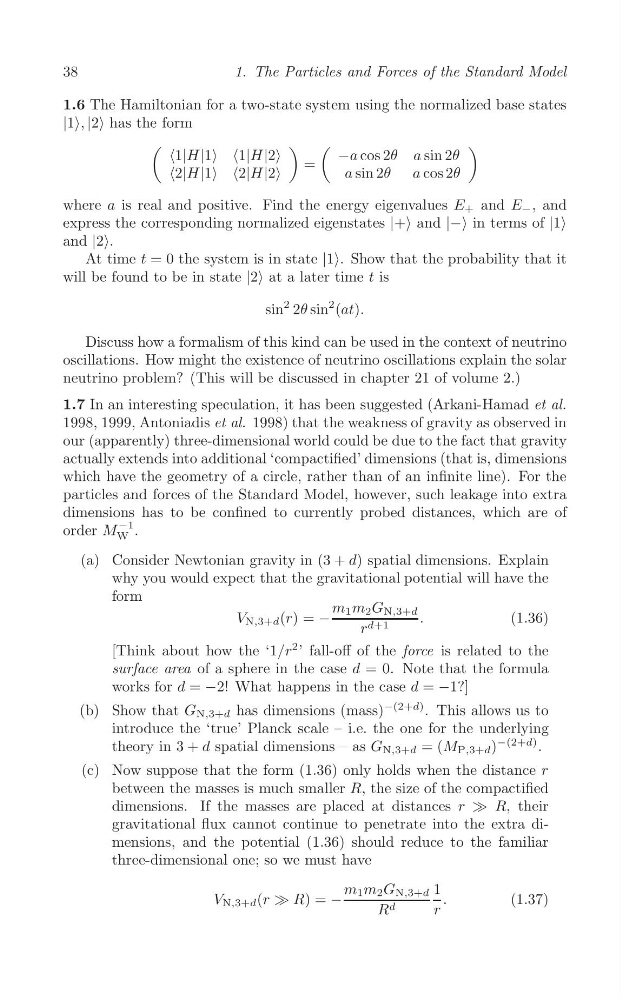
1.6 The Hamiltonian for a two-state system using the normalized base states
|1>, |2> has the form
(
) (
)
<1|H|1> <1|H|2>
−a cos 2θ asin 2θ
=
<2|H|1> <2|H|2>
a sin 2θ a cos 2θ
where a is real and positive. Find the energy eigenvalues E + and E − , and
express the corresponding normalized eigenstates |+> and |−> in terms of |1>
and |2>.
At time t = 0 the system is in state |1>. Show that the probability that it
will be found to be in state |2> at a later time t is
sin
2 2θ sin
2 (at).
Discuss how a formalism of this kind can be used in the context of neutrino
oscillations. How might the existence of neutrino oscillations explain the solar
neutrino problem? (This will be discussed in chapter 21 of volume 2.)
1.7 In an interesting speculation, it has been suggested (Arkani-Hamad et al.
1998, 1999, Antoniadis et al. 1998) that the weakness of gravity as observed in
our (apparently) three-dimensional world could be due to the fact that gravity
actually extends into additional ‘compactified’ dimensions (that is, dimensions
which have the geometry of a circle, rather than of an infinite line). For the
particles and forces of the Standard Model, however, such leakage into extra
dimensions has to be confined to currently probed distances, which are of
order M
−1 .
W
(a) Consider Newtonian gravity in (3 + d) spatial dimensions. Explain
why you would expect that the gravitational potential will have the
form
m 1 m 2 G N,3+d
V N,3+d (r) = −
.
(1.36)
r d+1
[Think about how the ‘1/r
2 ’ fall-off of the force is related to the
surface area of a sphere in the case d = 0. Note that the formula
works for d = −2! What happens in the case d = −1?]
(b) Show that G N,3+d has dimensions (mass)
−(2+d) . This allows us to
introduce the ‘true’ Planck scale – i.e. the one for the underlying
as G N,3+d = (M P,3+d )
−(2+d)
theory in 3 + d spatial dimensions –
.
(c) Now suppose that the form (1.36) only holds when the distance r
between the masses is much smaller R, the size of the compactified
dimensions. If the masses are placed at distances r ≫ R, their
gravitational flux cannot continue to penetrate into the extra dimensions, and the potential (1.36) should reduce to the familiar
three-dimensional one; so we must have
m 1 m 2 G N,3+d 1
V N,3+d (r ≫ R) = −
.
(1.37)
R d
r
1. The Particles and Forces of the Standard Model
1.6 The Hamiltonian for a two-state system using the normalized base states
|1>, |2> has the form
(
) (
)
<1|H|1> <1|H|2>
−a cos 2θ asin 2θ
=
<2|H|1> <2|H|2>
a sin 2θ a cos 2θ
where a is real and positive. Find the energy eigenvalues E + and E − , and
express the corresponding normalized eigenstates |+> and |−> in terms of |1>
and |2>.
At time t = 0 the system is in state |1>. Show that the probability that it
will be found to be in state |2> at a later time t is
sin
2 2θ sin
2 (at).
Discuss how a formalism of this kind can be used in the context of neutrino
oscillations. How might the existence of neutrino oscillations explain the solar
neutrino problem? (This will be discussed in chapter 21 of volume 2.)
1.7 In an interesting speculation, it has been suggested (Arkani-Hamad et al.
1998, 1999, Antoniadis et al. 1998) that the weakness of gravity as observed in
our (apparently) three-dimensional world could be due to the fact that gravity
actually extends into additional ‘compactified’ dimensions (that is, dimensions
which have the geometry of a circle, rather than of an infinite line). For the
particles and forces of the Standard Model, however, such leakage into extra
dimensions has to be confined to currently probed distances, which are of
order M
−1 .
W
(a) Consider Newtonian gravity in (3 + d) spatial dimensions. Explain
why you would expect that the gravitational potential will have the
form
m 1 m 2 G N,3+d
V N,3+d (r) = −
.
(1.36)
r d+1
[Think about how the ‘1/r
2 ’ fall-off of the force is related to the
surface area of a sphere in the case d = 0. Note that the formula
works for d = −2! What happens in the case d = −1?]
(b) Show that G N,3+d has dimensions (mass)
−(2+d) . This allows us to
introduce the ‘true’ Planck scale – i.e. the one for the underlying
as G N,3+d = (M P,3+d )
−(2+d)
theory in 3 + d spatial dimensions –
.
(c) Now suppose that the form (1.36) only holds when the distance r
between the masses is much smaller R, the size of the compactified
dimensions. If the masses are placed at distances r ≫ R, their
gravitational flux cannot continue to penetrate into the extra dimensions, and the potential (1.36) should reduce to the familiar
three-dimensional one; so we must have
m 1 m 2 G N,3+d 1
V N,3+d (r ≫ R) = −
.
(1.37)
R d
r