

18
12. Global Non-Abelian Symmetries
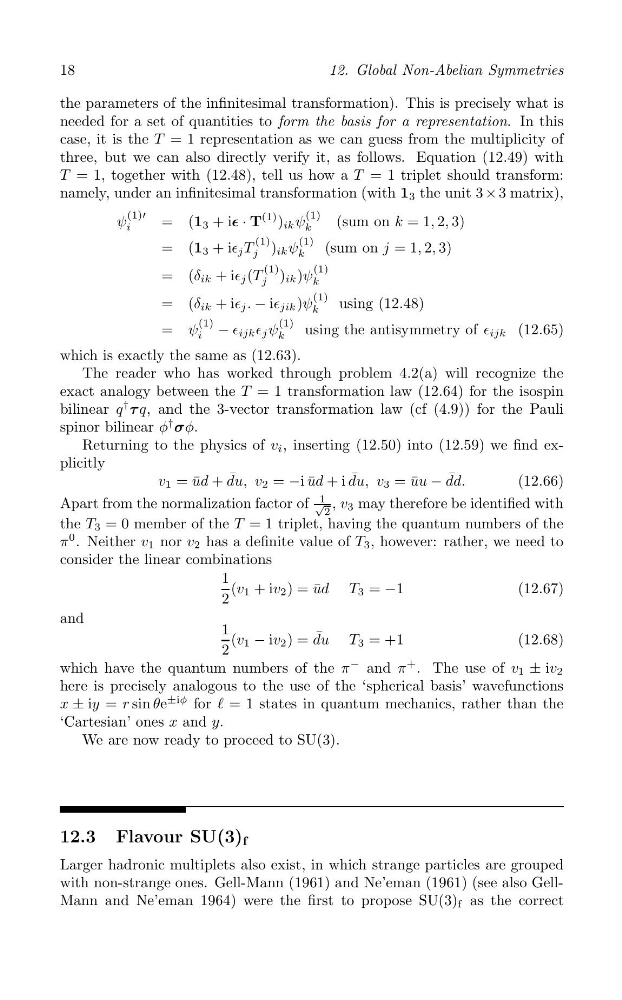
the parameters of the infinitesimal transformation). This is precisely what is
needed for a set of quantities to form the basis for a representation. In this
case, it is the T = 1 representation as we can guess from the multiplicity of
three, but we can also directly verify it, as follows. Equation (12.49) with
T = 1, together with (12.48), tell us how a T = 1 triplet should transform:
namely, under an infinitesimal transformation (with 1 3 the unit 3 × 3 matrix),
(1)′
T
(1) ) ik ψ
(1)
ψ
= (1 3 + i∊ ·
(sum on k = 1, 2, 3)
i
k
(1)
(1)
= (1 3 + i∈ j T ) ik ψ
(sum on j = 1, 2, 3)
j
k
(1)
(1)
= (δ ik + i∈ j (T j ) ik )ψ k
= (δ ik + i∈ j . − i∈ jik )ψ
(1) using (12.48)
k
(1)
(1)
= ψ − ∈ ijk ∈ j ψ
using the antisymmetry of ∈ ijk (12.65)
i
k
which is exactly the same as (12.63).
The reader who has worked through problem 4.2(a) will recognize the
exact analogy between the T = 1 transformation law (12.64) for the isospin
bilinear q
†
τ q, and the 3-vector transformation law (cf (4.9)) for the Pauli
spinor bilinear φ
†
σφ.
Returning to the physics of v i , inserting (12.50) into (12.59) we find explicitly
¯
− ¯
v 1 = ¯
ud + ¯
=
ud + i du, v 3 = ¯
uu dd.
(12.66)
du, v 2 −i ¯
Apart from the normalization factor of √ 1 , v 3 may therefore be identified with
2
the T 3 = 0 member of the T = 1 triplet, having the quantum numbers of the
π
0 . Neither v 1 nor v 2 has a definite value of T 3 , however: rather, we need to
consider the linear combinations
1 (v 1 + iv 2 ) = ¯
ud T 3 = −1
(12.67)
2
and
1 (v 1 − iv 2 ) = du ¯
T 3 = +1
(12.68)
2
which have the quantum numbers of the π
− and π
+ . The use of v 1 ± iv 2
here is precisely analogous to the use of the ‘spherical basis’ wavefunctions
±iφ
x ± iy = r sin θe
for e = 1 states in quantum mechanics, rather than the
‘Cartesian’ ones x and y.
We are now ready to proceed to SU(3).
12.3 Flavour SU(3) f
Larger hadronic multiplets also exist, in which strange particles are grouped
with non-strange ones. Gell-Mann (1961) and Ne’eman (1961) (see also GellMann and Ne’eman 1964) were the first to propose SU(3) f as the correct
12. Global Non-Abelian Symmetries
the parameters of the infinitesimal transformation). This is precisely what is
needed for a set of quantities to form the basis for a representation. In this
case, it is the T = 1 representation as we can guess from the multiplicity of
three, but we can also directly verify it, as follows. Equation (12.49) with
T = 1, together with (12.48), tell us how a T = 1 triplet should transform:
namely, under an infinitesimal transformation (with 1 3 the unit 3 × 3 matrix),
(1)′
T
(1) ) ik ψ
(1)
ψ
= (1 3 + i∊ ·
(sum on k = 1, 2, 3)
i
k
(1)
(1)
= (1 3 + i∈ j T ) ik ψ
(sum on j = 1, 2, 3)
j
k
(1)
(1)
= (δ ik + i∈ j (T j ) ik )ψ k
= (δ ik + i∈ j . − i∈ jik )ψ
(1) using (12.48)
k
(1)
(1)
= ψ − ∈ ijk ∈ j ψ
using the antisymmetry of ∈ ijk (12.65)
i
k
which is exactly the same as (12.63).
The reader who has worked through problem 4.2(a) will recognize the
exact analogy between the T = 1 transformation law (12.64) for the isospin
bilinear q
†
τ q, and the 3-vector transformation law (cf (4.9)) for the Pauli
spinor bilinear φ
†
σφ.
Returning to the physics of v i , inserting (12.50) into (12.59) we find explicitly
¯
− ¯
v 1 = ¯
ud + ¯
=
ud + i du, v 3 = ¯
uu dd.
(12.66)
du, v 2 −i ¯
Apart from the normalization factor of √ 1 , v 3 may therefore be identified with
2
the T 3 = 0 member of the T = 1 triplet, having the quantum numbers of the
π
0 . Neither v 1 nor v 2 has a definite value of T 3 , however: rather, we need to
consider the linear combinations
1 (v 1 + iv 2 ) = ¯
ud T 3 = −1
(12.67)
2
and
1 (v 1 − iv 2 ) = du ¯
T 3 = +1
(12.68)
2
which have the quantum numbers of the π
− and π
+ . The use of v 1 ± iv 2
here is precisely analogous to the use of the ‘spherical basis’ wavefunctions
±iφ
x ± iy = r sin θe
for e = 1 states in quantum mechanics, rather than the
‘Cartesian’ ones x and y.
We are now ready to proceed to SU(3).
12.3 Flavour SU(3) f
Larger hadronic multiplets also exist, in which strange particles are grouped
with non-strange ones. Gell-Mann (1961) and Ne’eman (1961) (see also GellMann and Ne’eman 1964) were the first to propose SU(3) f as the correct