

30
1. The Particles and Forces of the Standard Model
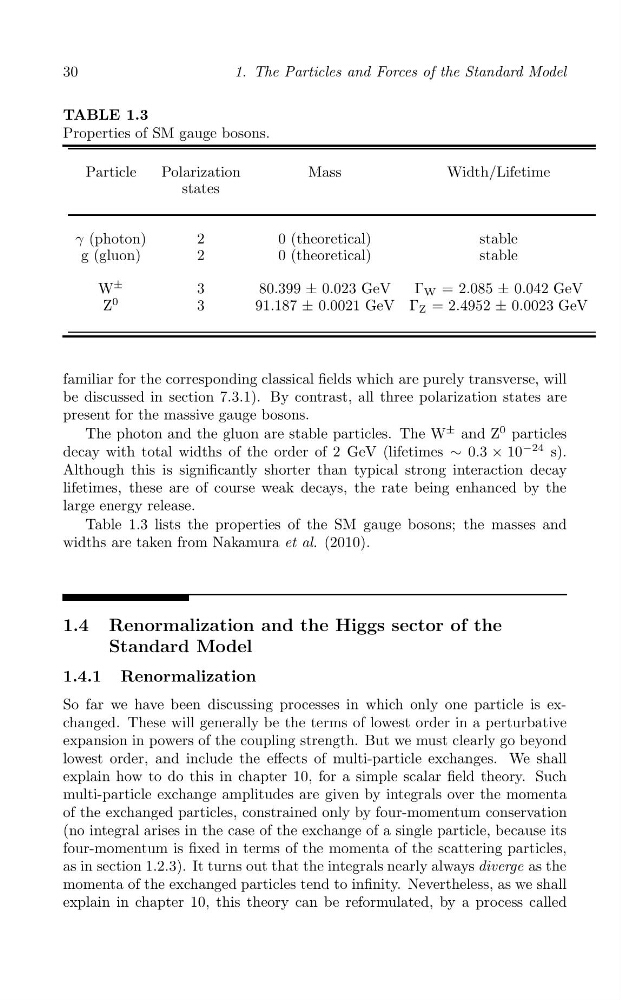
TABLE 1.3
Properties of SM gauge bosons.
Particle
Polarization
Mass
Width/Lifetime
states
γ (photon)
2
0 (theoretical)
stable
g (gluon)
2
0 (theoretical)
stable
W
±
3
80.399 ± 0.023 GeV
Γ W = 2.085 ± 0.042 GeV
Z
0
3
91.187 ± 0.0021 GeV Γ Z = 2.4952 ± 0.0023 GeV
familiar for the corresponding classical fields which are purely transverse, will
be discussed in section 7.3.1). By contrast, all three polarization states are
present for the massive gauge bosons.
The photon and the gluon are stable particles. The W
± and Z
0 particles
decay with total widths of the order of 2 GeV (lifetimes ∼ 0.3 × 10
−24 s).
Although this is significantly shorter than typical strong interaction decay
lifetimes, these are of course weak decays, the rate being enhanced by the
large energy release.
Table 1.3 lists the properties of the SM gauge bosons; the masses and
widths are taken from Nakamura et al. (2010).
1.4 Renormalization and the Higgs sector of the
Standard Model
1.4.1 Renormalization
So far we have been discussing processes in which only one particle is exchanged. These will generally be the terms of lowest order in a perturbative
expansion in powers of the coupling strength. But we must clearly go beyond
lowest order, and include the effects of multi-particle exchanges. We shall
explain how to do this in chapter 10, for a simple scalar field theory. Such
multi-particle exchange amplitudes are given by integrals over the momenta
of the exchanged particles, constrained only by four-momentum conservation
(no integral arises in the case of the exchange of a single particle, because its
four-momentum is fixed in terms of the momenta of the scattering particles,
as in section 1.2.3). It turns out that the integrals nearly always diverge as the
momenta of the exchanged particles tend to infinity. Nevertheless, as we shall
explain in chapter 10, this theory can be reformulated, by a process called
1. The Particles and Forces of the Standard Model
TABLE 1.3
Properties of SM gauge bosons.
Particle
Polarization
Mass
Width/Lifetime
states
γ (photon)
2
0 (theoretical)
stable
g (gluon)
2
0 (theoretical)
stable
W
±
3
80.399 ± 0.023 GeV
Γ W = 2.085 ± 0.042 GeV
Z
0
3
91.187 ± 0.0021 GeV Γ Z = 2.4952 ± 0.0023 GeV
familiar for the corresponding classical fields which are purely transverse, will
be discussed in section 7.3.1). By contrast, all three polarization states are
present for the massive gauge bosons.
The photon and the gluon are stable particles. The W
± and Z
0 particles
decay with total widths of the order of 2 GeV (lifetimes ∼ 0.3 × 10
−24 s).
Although this is significantly shorter than typical strong interaction decay
lifetimes, these are of course weak decays, the rate being enhanced by the
large energy release.
Table 1.3 lists the properties of the SM gauge bosons; the masses and
widths are taken from Nakamura et al. (2010).
1.4 Renormalization and the Higgs sector of the
Standard Model
1.4.1 Renormalization
So far we have been discussing processes in which only one particle is exchanged. These will generally be the terms of lowest order in a perturbative
expansion in powers of the coupling strength. But we must clearly go beyond
lowest order, and include the effects of multi-particle exchanges. We shall
explain how to do this in chapter 10, for a simple scalar field theory. Such
multi-particle exchange amplitudes are given by integrals over the momenta
of the exchanged particles, constrained only by four-momentum conservation
(no integral arises in the case of the exchange of a single particle, because its
four-momentum is fixed in terms of the momenta of the scattering particles,
as in section 1.2.3). It turns out that the integrals nearly always diverge as the
momenta of the exchanged particles tend to infinity. Nevertheless, as we shall
explain in chapter 10, this theory can be reformulated, by a process called