

28
1. The Particles and Forces of the Standard Model
u b
u r
g s
g s
d b
d r
¯ r
b
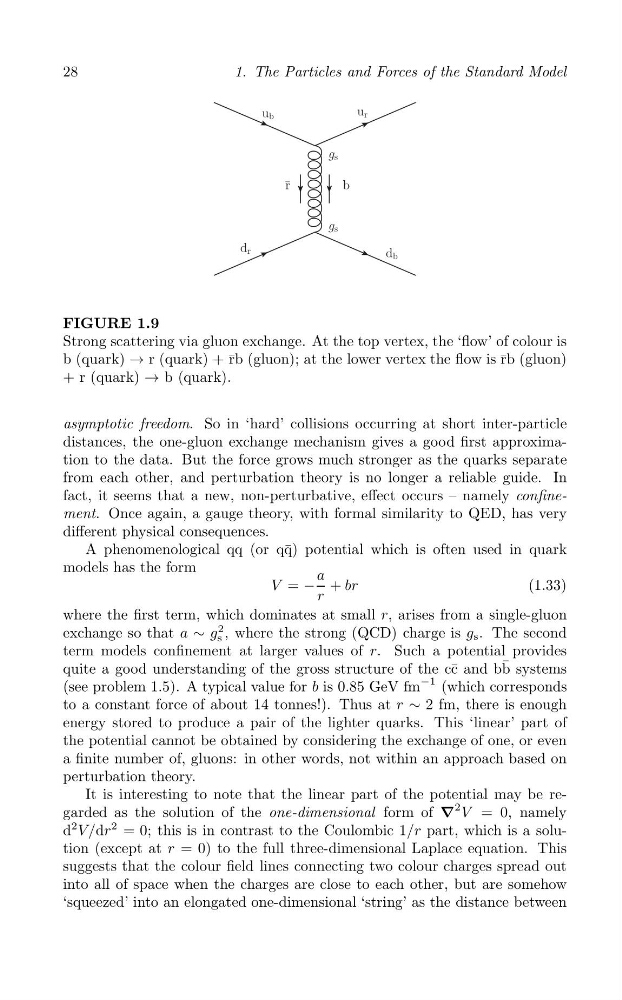
FIGURE 1.9
Strong scattering via gluon exchange. At the top vertex, the ‘flow’ of colour is
b (quark) → r (quark) + ¯ rb (gluon); at the lower vertex the flow is ¯ rb (gluon)
+ r (quark) → b (quark).
asymptotic freedom. So in ‘hard’ collisions occurring at short inter-particle
distances, the one-gluon exchange mechanism gives a good first approximation to the data. But the force grows much stronger as the quarks separate
from each other, and perturbation theory is no longer a reliable guide. In
fact, it seems that a new, non-perturbative, effect occurs – namely confinement. Once again, a gauge theory, with formal similarity to QED, has very
different physical consequences.
A phenomenological qq (or q¯ q) potential which is often used in quark
models has the form
a
V = − + br
(1.33)
r
where the first term, which dominates at small r, arises from a single-gluon
2
exchange so that a ∼ g , where the strong (QCD) charge is g s . The second
s
term models confinement at larger values of r. Such a potential provides
quite a good understanding of the gross structure of the c¯ c and b ¯
b systems
(see problem 1.5). A typical value for b is 0.85 GeV fm
−1 (which corresponds
to a constant force of about 14 tonnes!). Thus at r ∼ 2 fm, there is enough
energy stored to produce a pair of the lighter quarks. This ‘linear’ part of
the potential cannot be obtained by considering the exchange of one, or even
a finite number of, gluons: in other words, not within an approach based on
perturbation theory.
It is interesting to note that the linear part of the potential may be regarded as the solution of the one-dimensional form of ∇
2 V = 0, namely
2
d
2 V/dr = 0; this is in contrast to the Coulombic 1/r part, which is a solution (except at r = 0) to the full three-dimensional Laplace equation. This
suggests that the colour field lines connecting two colour charges spread out
into all of space when the charges are close to each other, but are somehow
‘squeezed’ into an elongated one-dimensional ‘string’ as the distance between
1. The Particles and Forces of the Standard Model
u b
u r
g s
g s
d b
d r
¯ r
b
FIGURE 1.9
Strong scattering via gluon exchange. At the top vertex, the ‘flow’ of colour is
b (quark) → r (quark) + ¯ rb (gluon); at the lower vertex the flow is ¯ rb (gluon)
+ r (quark) → b (quark).
asymptotic freedom. So in ‘hard’ collisions occurring at short inter-particle
distances, the one-gluon exchange mechanism gives a good first approximation to the data. But the force grows much stronger as the quarks separate
from each other, and perturbation theory is no longer a reliable guide. In
fact, it seems that a new, non-perturbative, effect occurs – namely confinement. Once again, a gauge theory, with formal similarity to QED, has very
different physical consequences.
A phenomenological qq (or q¯ q) potential which is often used in quark
models has the form
a
V = − + br
(1.33)
r
where the first term, which dominates at small r, arises from a single-gluon
2
exchange so that a ∼ g , where the strong (QCD) charge is g s . The second
s
term models confinement at larger values of r. Such a potential provides
quite a good understanding of the gross structure of the c¯ c and b ¯
b systems
(see problem 1.5). A typical value for b is 0.85 GeV fm
−1 (which corresponds
to a constant force of about 14 tonnes!). Thus at r ∼ 2 fm, there is enough
energy stored to produce a pair of the lighter quarks. This ‘linear’ part of
the potential cannot be obtained by considering the exchange of one, or even
a finite number of, gluons: in other words, not within an approach based on
perturbation theory.
It is interesting to note that the linear part of the potential may be regarded as the solution of the one-dimensional form of ∇
2 V = 0, namely
2
d
2 V/dr = 0; this is in contrast to the Coulombic 1/r part, which is a solution (except at r = 0) to the full three-dimensional Laplace equation. This
suggests that the colour field lines connecting two colour charges spread out
into all of space when the charges are close to each other, but are somehow
‘squeezed’ into an elongated one-dimensional ‘string’ as the distance between