

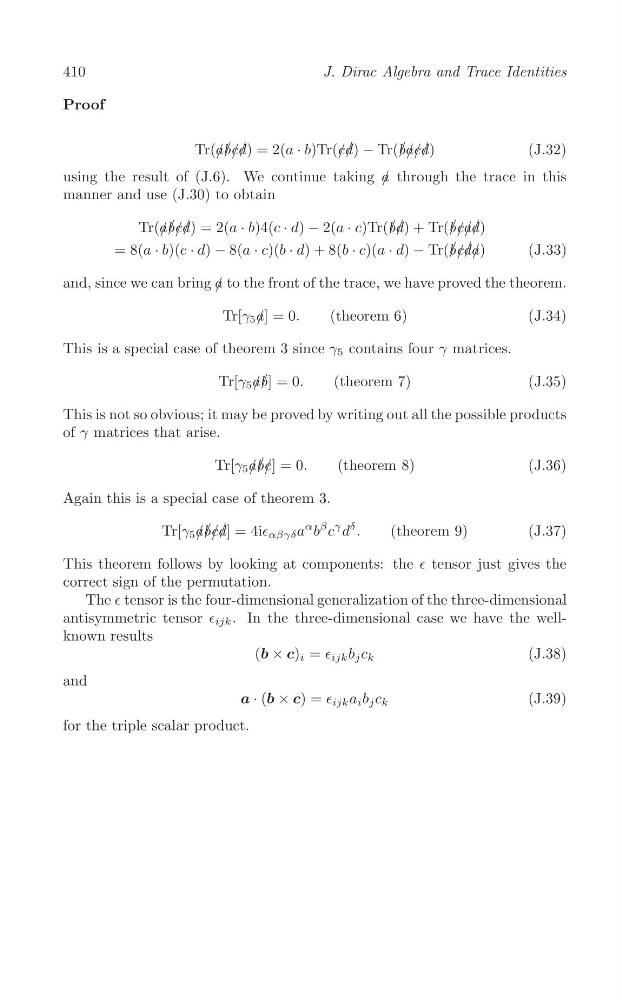
410
J. Dirac Algebra and Trace Identities
Proof
Tr(a / / b/ cd /) = 2(a · b)Tr(/ cd /) − Tr(/ ba // cd /)
(J.32)
using the result of (J.6). We continue taking a / through the trace in this
manner and use (J.30) to obtain
Tr(a / / b/ cd /) = 2(a · b)4(c · d) − 2(a · c)Tr(/ b/ d) + Tr(/ b/ ca /d /)
= 8(a · b)(c · d) − 8(a · c)(b · d) + 8(b · c)(a · d) − Tr(/ b/ cd /a /)
(J.33)
and, since we can bring a / to the front of the trace, we have proved the theorem.
Tr[γ 5 a /] = 0.
(theorem 6)
(J.34)
This is a special case of theorem 3 since γ 5 contains four γ matrices.
Tr[γ 5 a / / b] = 0.
(theorem 7)
(J.35)
This is not so obvious; it may be proved by writing out all the possible products
of γ matrices that arise.
Tr[γ 5 a / / b/ c] = 0.
(theorem 8)
(J.36)
Again this is a special case of theorem 3.
α b
β γ d
δ
Tr[γ 5 a / / b/ cd /] = 4i∈ αβγδ a
c .
(theorem 9)
(J.37)
This theorem follows by looking at components: the ∈ tensor just gives the
correct sign of the permutation.
The ∈ tensor is the four-dimensional generalization of the three-dimensional
antisymmetric tensor ∈ ijk . In the three-dimensional case we have the wellknown results
(b × c) i = ∈ ijk b j c k
(J.38)
and
a · (b × c) = ∈ ijk a i b j c k
(J.39)
for the triple scalar product.
J. Dirac Algebra and Trace Identities
Proof
Tr(a / / b/ cd /) = 2(a · b)Tr(/ cd /) − Tr(/ ba // cd /)
(J.32)
using the result of (J.6). We continue taking a / through the trace in this
manner and use (J.30) to obtain
Tr(a / / b/ cd /) = 2(a · b)4(c · d) − 2(a · c)Tr(/ b/ d) + Tr(/ b/ ca /d /)
= 8(a · b)(c · d) − 8(a · c)(b · d) + 8(b · c)(a · d) − Tr(/ b/ cd /a /)
(J.33)
and, since we can bring a / to the front of the trace, we have proved the theorem.
Tr[γ 5 a /] = 0.
(theorem 6)
(J.34)
This is a special case of theorem 3 since γ 5 contains four γ matrices.
Tr[γ 5 a / / b] = 0.
(theorem 7)
(J.35)
This is not so obvious; it may be proved by writing out all the possible products
of γ matrices that arise.
Tr[γ 5 a / / b/ c] = 0.
(theorem 8)
(J.36)
Again this is a special case of theorem 3.
α b
β γ d
δ
Tr[γ 5 a / / b/ cd /] = 4i∈ αβγδ a
c .
(theorem 9)
(J.37)
This theorem follows by looking at components: the ∈ tensor just gives the
correct sign of the permutation.
The ∈ tensor is the four-dimensional generalization of the three-dimensional
antisymmetric tensor ∈ ijk . In the three-dimensional case we have the wellknown results
(b × c) i = ∈ ijk b j c k
(J.38)
and
a · (b × c) = ∈ ijk a i b j c k
(J.39)
for the triple scalar product.