

400
H. Elements of Non-relativistic Scattering Theory
with different k’s, to make a wave-packet of any desired localization. But
the dimensions of practical beams are so much greater than the de Broglie
wavelength λ = h/p of our particles, that our plane wave will be a very good
approximation to a realistic packet.
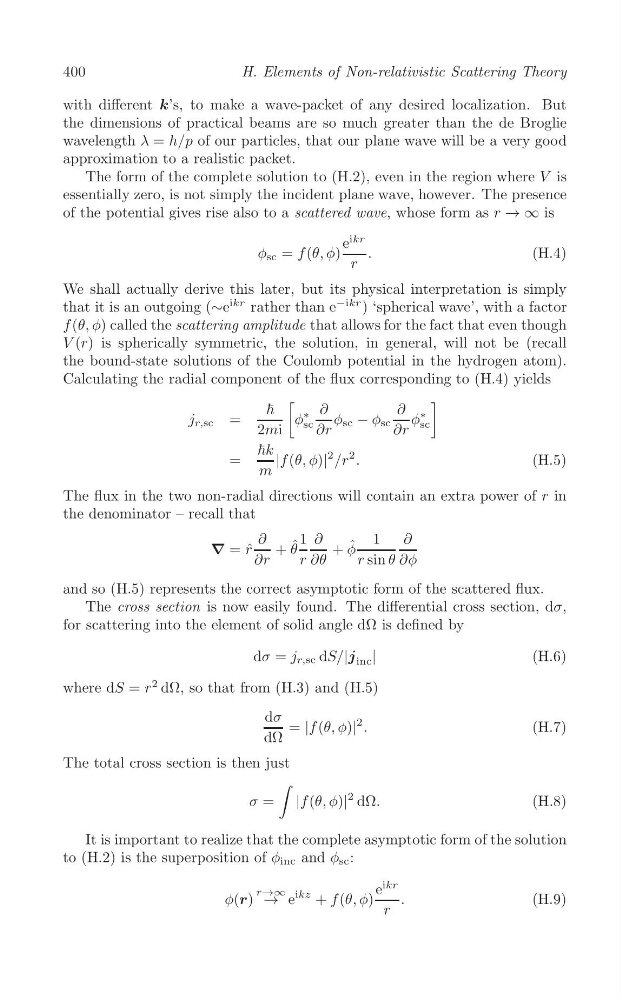
The form of the complete solution to (H.2), even in the region where V is
essentially zero, is not simply the incident plane wave, however. The presence
of the potential gives rise also to a scattered wave, whose form as r → ∞ is
ikr
e
φ sc = f (θ, φ)
.
(H.4)
r
We shall actually derive this later, but its physical interpretation is simply
that it is an outgoing (∼e
ikr rather than e
−ikr ) ‘spherical wave’, with a factor
f (θ, φ) called the scattering amplitude that allows for the fact that even though
V (r) is spherically symmetric, the solution, in general, will not be (recall
the bound-state solutions of the Coulomb potential in the hydrogen atom).
Calculating the radial component of the flux corresponding to (H.4) yields
[
]
ħ
∂
∂
φ
∗
φ
∗
j r,sc =
sc
φ sc − φ sc
sc
2mi
∂r
∂r
ħk
=
|f (θ, φ)|
2 /r
2 .
(H.5)
m
The flux in the two non-radial directions will contain an extra power of r in
the denominator – recall that
∂
1 ∂
1
∂
∇ = ˆ
r
+ θ ˆ
+ φ ˆ
∂r
r ∂θ
r sin θ ∂φ
and so (H.5) represents the correct asymptotic form of the scattered flux.
The cross section is now easily found. The differential cross section, dσ,
for scattering into the element of solid angle dΩ is defined by
dσ = j r,sc dS/|j inc |
(H.6)
where dS = r
2 dΩ, so that from (H.3) and (H.5)
dσ
2
= |f (θ, φ)| .
(H.7)
dΩ
The total cross section is then just
∫
σ = |f (θ, φ)|
2 dΩ.
(H.8)
It is important to realize that the complete asymptotic form of the solution
to (H.2) is the superposition of φ inc and φ sc :
ikr
e
r→∞ ikz
φ(r) → e + f (θ, φ)
.
(H.9)
r
H. Elements of Non-relativistic Scattering Theory
with different k’s, to make a wave-packet of any desired localization. But
the dimensions of practical beams are so much greater than the de Broglie
wavelength λ = h/p of our particles, that our plane wave will be a very good
approximation to a realistic packet.
The form of the complete solution to (H.2), even in the region where V is
essentially zero, is not simply the incident plane wave, however. The presence
of the potential gives rise also to a scattered wave, whose form as r → ∞ is
ikr
e
φ sc = f (θ, φ)
.
(H.4)
r
We shall actually derive this later, but its physical interpretation is simply
that it is an outgoing (∼e
ikr rather than e
−ikr ) ‘spherical wave’, with a factor
f (θ, φ) called the scattering amplitude that allows for the fact that even though
V (r) is spherically symmetric, the solution, in general, will not be (recall
the bound-state solutions of the Coulomb potential in the hydrogen atom).
Calculating the radial component of the flux corresponding to (H.4) yields
[
]
ħ
∂
∂
φ
∗
φ
∗
j r,sc =
sc
φ sc − φ sc
sc
2mi
∂r
∂r
ħk
=
|f (θ, φ)|
2 /r
2 .
(H.5)
m
The flux in the two non-radial directions will contain an extra power of r in
the denominator – recall that
∂
1 ∂
1
∂
∇ = ˆ
r
+ θ ˆ
+ φ ˆ
∂r
r ∂θ
r sin θ ∂φ
and so (H.5) represents the correct asymptotic form of the scattered flux.
The cross section is now easily found. The differential cross section, dσ,
for scattering into the element of solid angle dΩ is defined by
dσ = j r,sc dS/|j inc |
(H.6)
where dS = r
2 dΩ, so that from (H.3) and (H.5)
dσ
2
= |f (θ, φ)| .
(H.7)
dΩ
The total cross section is then just
∫
σ = |f (θ, φ)|
2 dΩ.
(H.8)
It is important to realize that the complete asymptotic form of the solution
to (H.2) is the superposition of φ inc and φ sc :
ikr
e
r→∞ ikz
φ(r) → e + f (θ, φ)
.
(H.9)
r