

370
C. Maxwell’s Equations: Choice of Units
Generally, systems in which the 4π factors appear in the force equations rather
than the field equations are called ‘rationalized’.
Of course, (C.3) is only the first of the Maxwell equations in Heaviside–
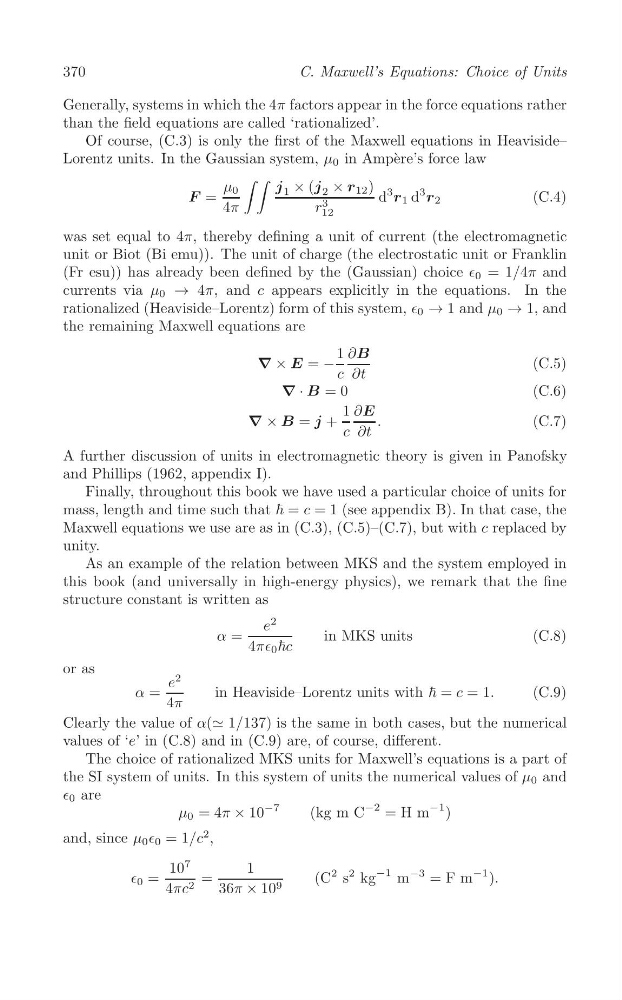
Lorentz units. In the Gaussian system, μ 0 in Amp` ere’s force law
∫ ∫
μ 0
j 1 × (j 2 × r 12 )
F =
d
3
r 1 d
3
r 2
(C.4)
3
4π
r 12
was set equal to 4π, thereby defining a unit of current (the electromagnetic
unit or Biot (Bi emu)). The unit of charge (the electrostatic unit or Franklin
(Fr esu)) has already been defined by the (Gaussian) choice ∈ 0 = 1/4π and
currents via μ 0 → 4π, and c appears explicitly in the equations. In the
rationalized (Heaviside–Lorentz) form of this system, ∈ 0 → 1 and μ 0 → 1, and
the remaining Maxwell equations are
1 ∂B
∇ × E = −
(C.5)
c ∂t
∇ · B = 0
(C.6)
1 ∂E
∇ × B = j +
.
(C.7)
c ∂t
A further discussion of units in electromagnetic theory is given in Panofsky
and Phillips (1962, appendix I).
Finally, throughout this book we have used a particular choice of units for
mass, length and time such that ħ = c = 1 (see appendix B). In that case, the
Maxwell equations we use are as in (C.3), (C.5)–(C.7), but with c replaced by
unity.
As an example of the relation between MKS and the system employed in
this book (and universally in high-energy physics), we remark that the fine
structure constant is written as
2
e
α =
in MKS units
(C.8)
4π∈ 0 ħc
or as
2
e
α =
in Heaviside–Lorentz units with ħ = c = 1.
(C.9)
4π
Clearly the value of α(≃ 1/137) is the same in both cases, but the numerical
values of ‘e’ in (C.8) and in (C.9) are, of course, different.
The choice of rationalized MKS units for Maxwell’s equations is a part of
the SI system of units. In this system of units the numerical values of μ 0 and
∈ 0 are
μ 0 = 4π × 10
−7
(kg m C
−2 = H m
−1 )
and, since μ 0 ∈ 0 = 1/c
2 ,
10
7
1
∈ 0 =
=
(C
2 s
2 kg
−1 m
−3 = F m
−1 ).
4πc 2
36π × 10 9
C. Maxwell’s Equations: Choice of Units
Generally, systems in which the 4π factors appear in the force equations rather
than the field equations are called ‘rationalized’.
Of course, (C.3) is only the first of the Maxwell equations in Heaviside–
Lorentz units. In the Gaussian system, μ 0 in Amp` ere’s force law
∫ ∫
μ 0
j 1 × (j 2 × r 12 )
F =
d
3
r 1 d
3
r 2
(C.4)
3
4π
r 12
was set equal to 4π, thereby defining a unit of current (the electromagnetic
unit or Biot (Bi emu)). The unit of charge (the electrostatic unit or Franklin
(Fr esu)) has already been defined by the (Gaussian) choice ∈ 0 = 1/4π and
currents via μ 0 → 4π, and c appears explicitly in the equations. In the
rationalized (Heaviside–Lorentz) form of this system, ∈ 0 → 1 and μ 0 → 1, and
the remaining Maxwell equations are
1 ∂B
∇ × E = −
(C.5)
c ∂t
∇ · B = 0
(C.6)
1 ∂E
∇ × B = j +
.
(C.7)
c ∂t
A further discussion of units in electromagnetic theory is given in Panofsky
and Phillips (1962, appendix I).
Finally, throughout this book we have used a particular choice of units for
mass, length and time such that ħ = c = 1 (see appendix B). In that case, the
Maxwell equations we use are as in (C.3), (C.5)–(C.7), but with c replaced by
unity.
As an example of the relation between MKS and the system employed in
this book (and universally in high-energy physics), we remark that the fine
structure constant is written as
2
e
α =
in MKS units
(C.8)
4π∈ 0 ħc
or as
2
e
α =
in Heaviside–Lorentz units with ħ = c = 1.
(C.9)
4π
Clearly the value of α(≃ 1/137) is the same in both cases, but the numerical
values of ‘e’ in (C.8) and in (C.9) are, of course, different.
The choice of rationalized MKS units for Maxwell’s equations is a part of
the SI system of units. In this system of units the numerical values of μ 0 and
∈ 0 are
μ 0 = 4π × 10
−7
(kg m C
−2 = H m
−1 )
and, since μ 0 ∈ 0 = 1/c
2 ,
10
7
1
∈ 0 =
=
(C
2 s
2 kg
−1 m
−3 = F m
−1 ).
4πc 2
36π × 10 9