

366
B. Natural Units
[T] are equivalent by our choice of c = 1, we can choose [M] as the single
independent dimension for our natural units:
[M] = [L]
−1 = [T]
−1 .
(B.9)
An example: the pion Compton wavelength How do we convert from natural units to more conventional units? Consider the pion Compton wavelength
λ π = ħ/M π c
(B.10)
evaluated in both natural and conventional units. In natural units
λ π = 1/M π
(B.11)
where M π ≃ 140 MeV/c
2 . In conventional units, using M π , ħ (B.7) and c
(B.2), we have the familiar result
λ π = 1.41 fm
(B.12)
where the ‘fermi’ or femtometre, fm, is defined as
1 fm = 10
−15 m.
We therefore have the correspondence
λ π = 1/M π = 1.41 fm.
(B.13)
Practical cross section calculations: An easy-to-remember relation may be
derived from the result
ħc ≃ 200 MeV fm
(B.14)
obtained directly from (B.2) and (B.7). Hence, in natural units, we have the
relation
1 fm ≃
1
= 5 (GeV)
−1 .
(B.15)
200 MeV
Cross sections are calculated without ħ’s and c’s and all masses, energies and
momenta typically in MeV or GeV. To convert the result to an area, we merely
remember the dimensions of a cross section:
[σ] = [L]
2 = [M]
−2 .
(B.16)
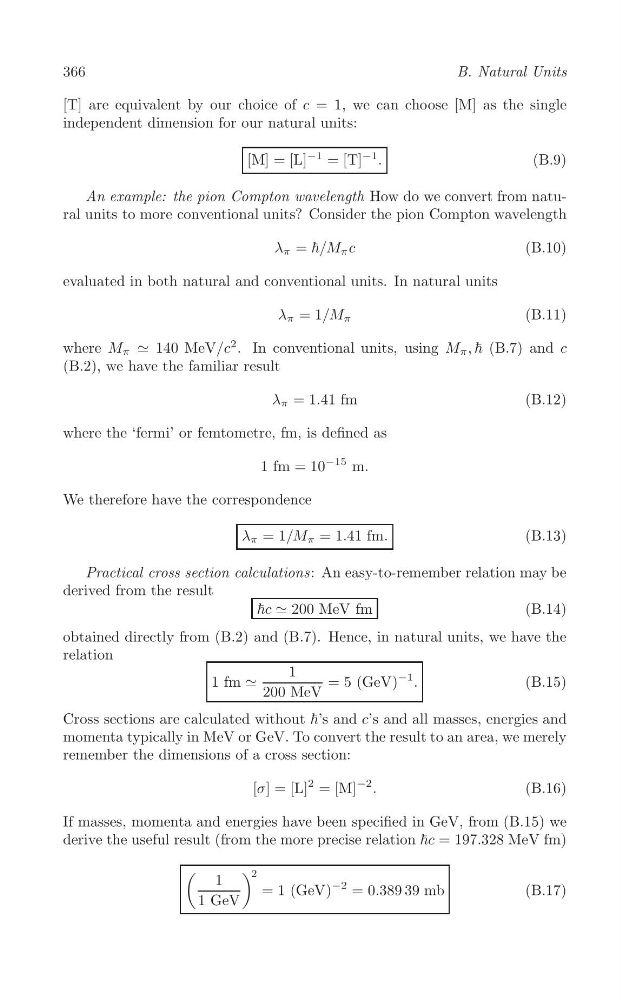
If masses, momenta and energies have been specified in GeV, from (B.15) we
derive the useful result (from the more precise relation ħc = 197.328 MeV fm)
(
) 2
1
= 1 (GeV)
−2 = 0.389 39 mb
(B.17)
1 GeV
B. Natural Units
[T] are equivalent by our choice of c = 1, we can choose [M] as the single
independent dimension for our natural units:
[M] = [L]
−1 = [T]
−1 .
(B.9)
An example: the pion Compton wavelength How do we convert from natural units to more conventional units? Consider the pion Compton wavelength
λ π = ħ/M π c
(B.10)
evaluated in both natural and conventional units. In natural units
λ π = 1/M π
(B.11)
where M π ≃ 140 MeV/c
2 . In conventional units, using M π , ħ (B.7) and c
(B.2), we have the familiar result
λ π = 1.41 fm
(B.12)
where the ‘fermi’ or femtometre, fm, is defined as
1 fm = 10
−15 m.
We therefore have the correspondence
λ π = 1/M π = 1.41 fm.
(B.13)
Practical cross section calculations: An easy-to-remember relation may be
derived from the result
ħc ≃ 200 MeV fm
(B.14)
obtained directly from (B.2) and (B.7). Hence, in natural units, we have the
relation
1 fm ≃
1
= 5 (GeV)
−1 .
(B.15)
200 MeV
Cross sections are calculated without ħ’s and c’s and all masses, energies and
momenta typically in MeV or GeV. To convert the result to an area, we merely
remember the dimensions of a cross section:
[σ] = [L]
2 = [M]
−2 .
(B.16)
If masses, momenta and energies have been specified in GeV, from (B.15) we
derive the useful result (from the more precise relation ħc = 197.328 MeV fm)
(
) 2
1
= 1 (GeV)
−2 = 0.389 39 mb
(B.17)
1 GeV