

11.8. Which theories are renormalizable – and does it matter?
359
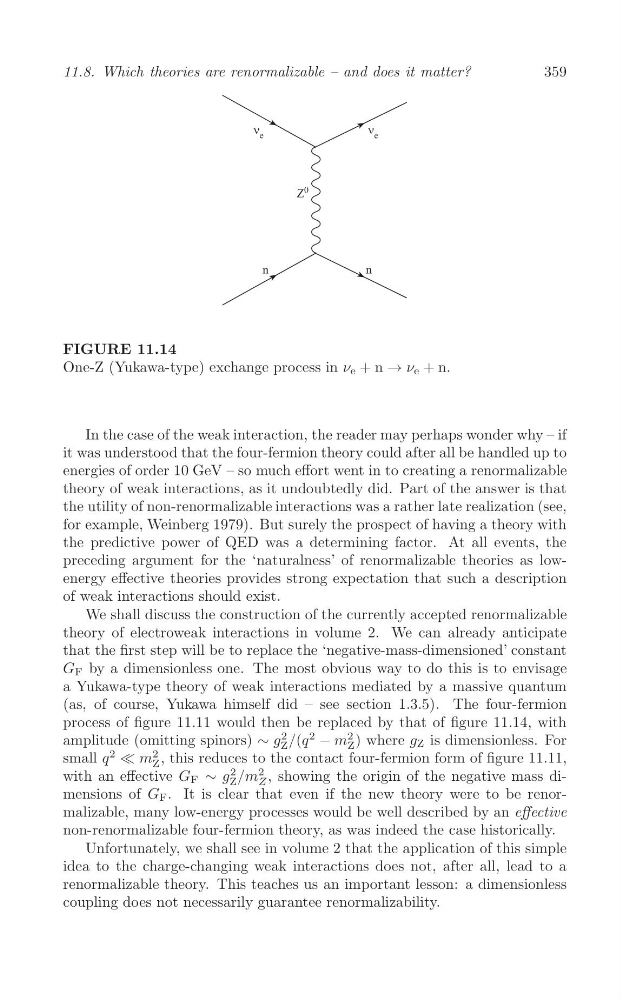
FIGURE 11.14
One-Z (Yukawa-type) exchange process in ν e + n → ν e + n.
In the case of the weak interaction, the reader may perhaps wonder why – if
it was understood that the four-fermion theory could after all be handled up to
energies of order 10 GeV – so much effort went in to creating a renormalizable
theory of weak interactions, as it undoubtedly did. Part of the answer is that
the utility of non-renormalizable interactions was a rather late realization (see,
for example, Weinberg 1979). But surely the prospect of having a theory with
the predictive power of QED was a determining factor. At all events, the
preceding argument for the ‘naturalness’ of renormalizable theories as lowenergy effective theories provides strong expectation that such a description
of weak interactions should exist.
We shall discuss the construction of the currently accepted renormalizable
theory of electroweak interactions in volume 2. We can already anticipate
that the first step will be to replace the ‘negative-mass-dimensioned’ constant
G F by a dimensionless one. The most obvious way to do this is to envisage
a Yukawa-type theory of weak interactions mediated by a massive quantum
(as, of course, Yukawa himself did – see section 1.3.5). The four-fermion
process of figure 11.11 would then be replaced by that of figure 11.14, with
2
2
−
2
amplitude (omitting spinors) ∼ g /(q
m ) where g Z is dimensionless. For
Z
Z
2
≪
2
small q
m , this reduces to the contact four-fermion form of figure 11.11,
Z
2
with an effective G F ∼ g /m
2 , showing the origin of the negative mass diZ
Z
mensions of G F . It is clear that even if the new theory were to be renormalizable, many low-energy processes would be well described by an effective
non-renormalizable four-fermion theory, as was indeed the case historically.
Unfortunately, we shall see in volume 2 that the application of this simple
idea to the charge-changing weak interactions does not, after all, lead to a
renormalizable theory. This teaches us an important lesson: a dimensionless
coupling does not necessarily guarantee renormalizability.
359
FIGURE 11.14
One-Z (Yukawa-type) exchange process in ν e + n → ν e + n.
In the case of the weak interaction, the reader may perhaps wonder why – if
it was understood that the four-fermion theory could after all be handled up to
energies of order 10 GeV – so much effort went in to creating a renormalizable
theory of weak interactions, as it undoubtedly did. Part of the answer is that
the utility of non-renormalizable interactions was a rather late realization (see,
for example, Weinberg 1979). But surely the prospect of having a theory with
the predictive power of QED was a determining factor. At all events, the
preceding argument for the ‘naturalness’ of renormalizable theories as lowenergy effective theories provides strong expectation that such a description
of weak interactions should exist.
We shall discuss the construction of the currently accepted renormalizable
theory of electroweak interactions in volume 2. We can already anticipate
that the first step will be to replace the ‘negative-mass-dimensioned’ constant
G F by a dimensionless one. The most obvious way to do this is to envisage
a Yukawa-type theory of weak interactions mediated by a massive quantum
(as, of course, Yukawa himself did – see section 1.3.5). The four-fermion
process of figure 11.11 would then be replaced by that of figure 11.14, with
2
2
−
2
amplitude (omitting spinors) ∼ g /(q
m ) where g Z is dimensionless. For
Z
Z
2
≪
2
small q
m , this reduces to the contact four-fermion form of figure 11.11,
Z
2
with an effective G F ∼ g /m
2 , showing the origin of the negative mass diZ
Z
mensions of G F . It is clear that even if the new theory were to be renormalizable, many low-energy processes would be well described by an effective
non-renormalizable four-fermion theory, as was indeed the case historically.
Unfortunately, we shall see in volume 2 that the application of this simple
idea to the charge-changing weak interactions does not, after all, lead to a
renormalizable theory. This teaches us an important lesson: a dimensionless
coupling does not necessarily guarantee renormalizability.