

11.8. Which theories are renormalizable – and does it matter?
355
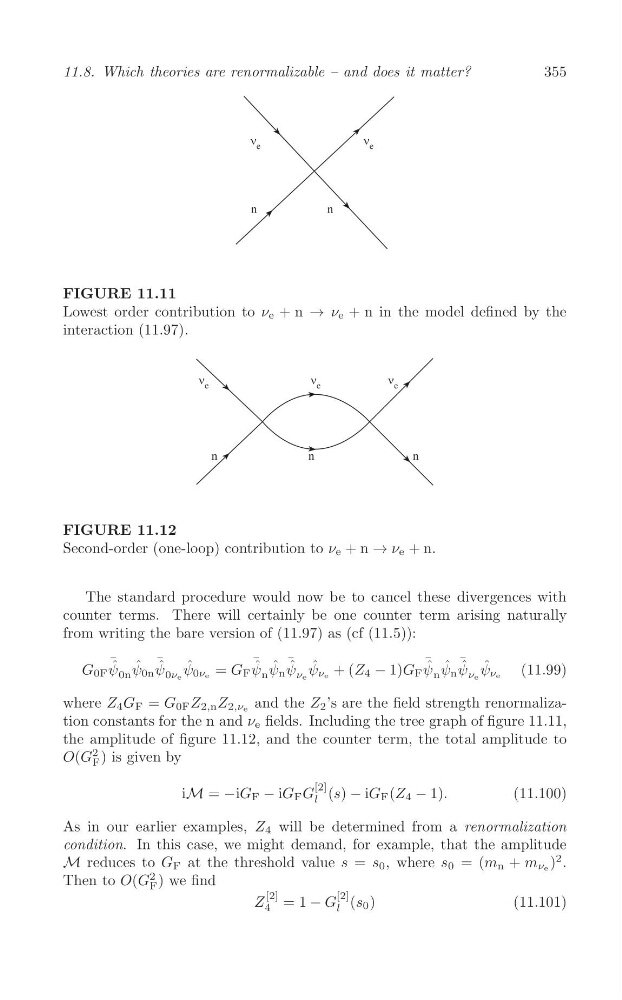
FIGURE 11.11
Lowest order contribution to ν e + n → ν e + n in the model defined by the
interaction (11.97).
FIGURE 11.12
Second-order (one-loop) contribution to ν e + n → ν e + n.
The standard procedure would now be to cancel these divergences with
counter terms. There will certainly be one counter term arising naturally
from writing the bare version of (11.97) as (cf (11.5)):
¯
¯
¯
¯
¯
¯
ˆ ˆ ˆ ˆ
ˆ ˆ ˆ ˆ
ˆ ˆ ˆ ˆ
G 0F
ψ 0n
ψ 0νe = G F ψ ψ n
ψ νe + (Z 4 − 1)G F ψ ψ n
ψ νe (11.99)
ψ 0n
ψ 0νe
n
ψ νe
n
ψ νe
where Z 4 G F = G 0F Z 2,n Z 2,νe and the Z 2 ’s are the field strength renormalization constants for the n and ν e fields. Including the tree graph of figure 11.11,
the amplitude of figure 11.12, and the counter term, the total amplitude to
O(G
2 ) is given by
F
[2]
iM =
(s) − iG F (Z 4 − 1).
(11.100)
−iG F − iG F G l
As in our earlier examples, Z 4 will be determined from a renormalization
condition. In this case, we might demand, for example, that the amplitude
M reduces to G F at the threshold value s = s 0 , where s 0 = (m n + m νe )
2 .
Then to O(G
2 ) we find
F
[2]
[2]
Z 4 = 1 − G l (s 0 )
(11.101)
355
FIGURE 11.11
Lowest order contribution to ν e + n → ν e + n in the model defined by the
interaction (11.97).
FIGURE 11.12
Second-order (one-loop) contribution to ν e + n → ν e + n.
The standard procedure would now be to cancel these divergences with
counter terms. There will certainly be one counter term arising naturally
from writing the bare version of (11.97) as (cf (11.5)):
¯
¯
¯
¯
¯
¯
ˆ ˆ ˆ ˆ
ˆ ˆ ˆ ˆ
ˆ ˆ ˆ ˆ
G 0F
ψ 0n
ψ 0νe = G F ψ ψ n
ψ νe + (Z 4 − 1)G F ψ ψ n
ψ νe (11.99)
ψ 0n
ψ 0νe
n
ψ νe
n
ψ νe
where Z 4 G F = G 0F Z 2,n Z 2,νe and the Z 2 ’s are the field strength renormalization constants for the n and ν e fields. Including the tree graph of figure 11.11,
the amplitude of figure 11.12, and the counter term, the total amplitude to
O(G
2 ) is given by
F
[2]
iM =
(s) − iG F (Z 4 − 1).
(11.100)
−iG F − iG F G l
As in our earlier examples, Z 4 will be determined from a renormalization
condition. In this case, we might demand, for example, that the amplitude
M reduces to G F at the threshold value s = s 0 , where s 0 = (m n + m νe )
2 .
Then to O(G
2 ) we find
F
[2]
[2]
Z 4 = 1 − G l (s 0 )
(11.101)