

349
11.7. The anomalous magnetic moment and tests of QED
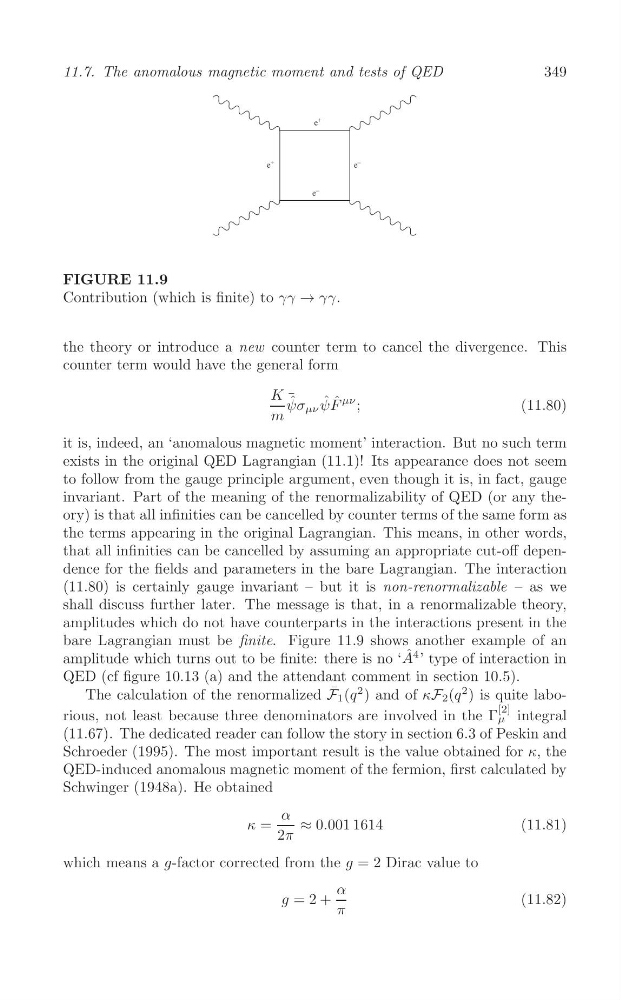
FIGURE 11.9
Contribution (which is finite) to γγ → γγ.
the theory or introduce a new counter term to cancel the divergence. This
counter term would have the general form
¯ ˆ
ˆ F
μν
K ψσ μν ψ ˆ ;
(11.80)
m
it is, indeed, an ‘anomalous magnetic moment’ interaction. But no such term
exists in the original QED Lagrangian (11.1)! Its appearance does not seem
to follow from the gauge principle argument, even though it is, in fact, gauge
invariant. Part of the meaning of the renormalizability of QED (or any theory) is that all infinities can be cancelled by counter terms of the same form as
the terms appearing in the original Lagrangian. This means, in other words,
that all infinities can be cancelled by assuming an appropriate cut-off dependence for the fields and parameters in the bare Lagrangian. The interaction
(11.80) is certainly gauge invariant – but it is non-renormalizable – as we
shall discuss further later. The message is that, in a renormalizable theory,
amplitudes which do not have counterparts in the interactions present in the
bare Lagrangian must be finite. Figure 11.9 shows another example of an
A ˆ 4 ’
amplitude which turns out to be finite: there is no ‘
type of interaction in
QED (cf figure 10.13 (a) and the attendant comment in section 10.5).
The calculation of the renormalized F ¯ 1 (q
2 ) and of κF 2 (q
2 ) is quite labo[2]
rious, not least because three denominators are involved in the Γ μ integral
(11.67). The dedicated reader can follow the story in section 6.3 of Peskin and
Schroeder (1995). The most important result is the value obtained for κ, the
QED-induced anomalous magnetic moment of the fermion, first calculated by
Schwinger (1948a). He obtained
α
κ =
≈ 0.001 1614
(11.81)
2π
which means a g-factor corrected from the g = 2 Dirac value to
α
g = 2 +
(11.82)
π
11.7. The anomalous magnetic moment and tests of QED
FIGURE 11.9
Contribution (which is finite) to γγ → γγ.
the theory or introduce a new counter term to cancel the divergence. This
counter term would have the general form
¯ ˆ
ˆ F
μν
K ψσ μν ψ ˆ ;
(11.80)
m
it is, indeed, an ‘anomalous magnetic moment’ interaction. But no such term
exists in the original QED Lagrangian (11.1)! Its appearance does not seem
to follow from the gauge principle argument, even though it is, in fact, gauge
invariant. Part of the meaning of the renormalizability of QED (or any theory) is that all infinities can be cancelled by counter terms of the same form as
the terms appearing in the original Lagrangian. This means, in other words,
that all infinities can be cancelled by assuming an appropriate cut-off dependence for the fields and parameters in the bare Lagrangian. The interaction
(11.80) is certainly gauge invariant – but it is non-renormalizable – as we
shall discuss further later. The message is that, in a renormalizable theory,
amplitudes which do not have counterparts in the interactions present in the
bare Lagrangian must be finite. Figure 11.9 shows another example of an
A ˆ 4 ’
amplitude which turns out to be finite: there is no ‘
type of interaction in
QED (cf figure 10.13 (a) and the attendant comment in section 10.5).
The calculation of the renormalized F ¯ 1 (q
2 ) and of κF 2 (q
2 ) is quite labo[2]
rious, not least because three denominators are involved in the Γ μ integral
(11.67). The dedicated reader can follow the story in section 6.3 of Peskin and
Schroeder (1995). The most important result is the value obtained for κ, the
QED-induced anomalous magnetic moment of the fermion, first calculated by
Schwinger (1948a). He obtained
α
κ =
≈ 0.001 1614
(11.81)
2π
which means a g-factor corrected from the g = 2 Dirac value to
α
g = 2 +
(11.82)
π