

332
11. Loops and Renormalization II: QED
∫
( ∫
[
])
1
d
4 k
′
2k μ
′ k
′
iΠ
[2]
2
ν
g μν
μν (q
2 ) = −4e
dx
−
(2π) 4 (k ′2 − Δ γ + i∈) 2
(k ′2 − Δ γ + i∈)
0
∫
∫
1
d
4 k
′
x(1 − x)
+ 8e
2 (q μ q ν − g μν q
2 )
dx
. (11.18)
(2π) 4 (k ′2 − Δ γ + i∈) 2
0
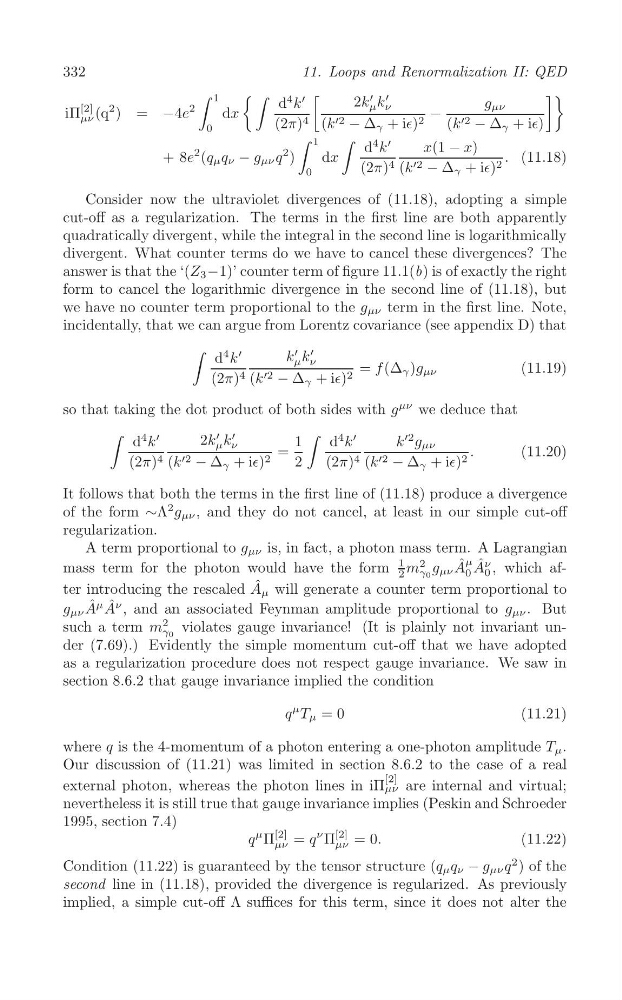
Consider now the ultraviolet divergences of (11.18), adopting a simple
cut-off as a regularization. The terms in the first line are both apparently
quadratically divergent, while the integral in the second line is logarithmically
divergent. What counter terms do we have to cancel these divergences? The
answer is that the ‘(Z 3 −1)’ counter term of figure 11.1(b) is of exactly the right
form to cancel the logarithmic divergence in the second line of (11.18), but
we have no counter term proportional to the g μν term in the first line. Note,
incidentally, that we can argue from Lorentz covariance (see appendix D) that
∫ d
4 k
′
k μ
′ k
′
ν
= f (Δ γ )g μν
(11.19)
(2π) 4 (k ′2 − Δ γ + i∈) 2
μν
so that taking the dot product of both sides with g we deduce that
∫
∫
d
4 k
′
2k μ
′ k ν
′
1
d
4 k
′
k
′2 g μν
=
.
(11.20)
(2π) 4 (k ′2 − Δ γ + i∈) 2
2
(2π) 4 (k ′2 − Δ γ + i∈) 2
It follows that both the terms in the first line of (11.18) produce a divergence
of the form ∼Λ
2 g μν , and they do not cancel, at least in our simple cut-off
regularization.
A term proportional to g μν is, in fact, a photon mass term. A Lagrangian
2
ˆ μ ˆ
mass term for the photon would have the form
1 m g μν A A
ν
0 , which af2 γ0
0
ter introducing the rescaled A ˆ μ will generate a counter term proportional to
g μν A ˆ μ A ˆ ν , and an associated Feynman amplitude proportional to g μν . But
2
such a term m violates gauge invariance! (It is plainly not invariant unγ0
der (7.69).) Evidently the simple momentum cut-off that we have adopted
as a regularization procedure does not respect gauge invariance. We saw in
section 8.6.2 that gauge invariance implied the condition
q
μ T μ = 0
(11.21)
where q is the 4-momentum of a photon entering a one-photon amplitude T μ .
Our discussion of (11.21) was limited in section 8.6.2 to the case of a real
[2]
external photon, whereas the photon lines in iΠ μν are internal and virtual;
nevertheless it is still true that gauge invariance implies (Peskin and Schroeder
1995, section 7.4)
μ Π
[2]
ν Π
[2]
q
= q μν = 0.
(11.22)
μν
Condition (11.22) is guaranteed by the tensor structure (q μ q ν − g μν q
2 ) of the
second line in (11.18), provided the divergence is regularized. As previously
implied, a simple cut-off Λ suffices for this term, since it does not alter the
11. Loops and Renormalization II: QED
∫
( ∫
[
])
1
d
4 k
′
2k μ
′ k
′
iΠ
[2]
2
ν
g μν
μν (q
2 ) = −4e
dx
−
(2π) 4 (k ′2 − Δ γ + i∈) 2
(k ′2 − Δ γ + i∈)
0
∫
∫
1
d
4 k
′
x(1 − x)
+ 8e
2 (q μ q ν − g μν q
2 )
dx
. (11.18)
(2π) 4 (k ′2 − Δ γ + i∈) 2
0
Consider now the ultraviolet divergences of (11.18), adopting a simple
cut-off as a regularization. The terms in the first line are both apparently
quadratically divergent, while the integral in the second line is logarithmically
divergent. What counter terms do we have to cancel these divergences? The
answer is that the ‘(Z 3 −1)’ counter term of figure 11.1(b) is of exactly the right
form to cancel the logarithmic divergence in the second line of (11.18), but
we have no counter term proportional to the g μν term in the first line. Note,
incidentally, that we can argue from Lorentz covariance (see appendix D) that
∫ d
4 k
′
k μ
′ k
′
ν
= f (Δ γ )g μν
(11.19)
(2π) 4 (k ′2 − Δ γ + i∈) 2
μν
so that taking the dot product of both sides with g we deduce that
∫
∫
d
4 k
′
2k μ
′ k ν
′
1
d
4 k
′
k
′2 g μν
=
.
(11.20)
(2π) 4 (k ′2 − Δ γ + i∈) 2
2
(2π) 4 (k ′2 − Δ γ + i∈) 2
It follows that both the terms in the first line of (11.18) produce a divergence
of the form ∼Λ
2 g μν , and they do not cancel, at least in our simple cut-off
regularization.
A term proportional to g μν is, in fact, a photon mass term. A Lagrangian
2
ˆ μ ˆ
mass term for the photon would have the form
1 m g μν A A
ν
0 , which af2 γ0
0
ter introducing the rescaled A ˆ μ will generate a counter term proportional to
g μν A ˆ μ A ˆ ν , and an associated Feynman amplitude proportional to g μν . But
2
such a term m violates gauge invariance! (It is plainly not invariant unγ0
der (7.69).) Evidently the simple momentum cut-off that we have adopted
as a regularization procedure does not respect gauge invariance. We saw in
section 8.6.2 that gauge invariance implied the condition
q
μ T μ = 0
(11.21)
where q is the 4-momentum of a photon entering a one-photon amplitude T μ .
Our discussion of (11.21) was limited in section 8.6.2 to the case of a real
[2]
external photon, whereas the photon lines in iΠ μν are internal and virtual;
nevertheless it is still true that gauge invariance implies (Peskin and Schroeder
1995, section 7.4)
μ Π
[2]
ν Π
[2]
q
= q μν = 0.
(11.22)
μν
Condition (11.22) is guaranteed by the tensor structure (q μ q ν − g μν q
2 ) of the
second line in (11.18), provided the divergence is regularized. As previously
implied, a simple cut-off Λ suffices for this term, since it does not alter the