

329
11.2. The O(e
2 ) fermion self-energy
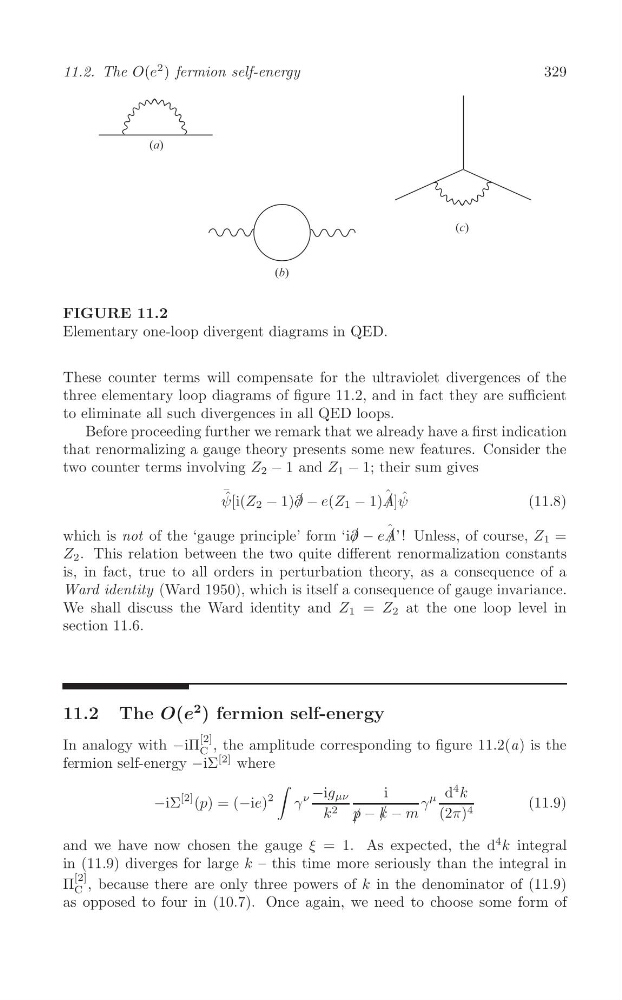
FIGURE 11.2
Elementary one-loop divergent diagrams in QED.
These counter terms will compensate for the ultraviolet divergences of the
three elementary loop diagrams of figure 11.2, and in fact they are sufficient
to eliminate all such divergences in all QED loops.
Before proceeding further we remark that we already have a first indication
that renormalizing a gauge theory presents some new features. Consider the
two counter terms involving Z 2 − 1 and Z 1 − 1; their sum gives
¯
ψ ˆ [i(Z 2 − 1)∂ / − e(Z 1 − 1)A ˆ /]ψ ˆ
(11.8)
which is not of the ‘gauge principle’ form ‘i∂ / − eA ˆ /’ ! Unless, of course, Z 1 =
Z 2 . This relation between the two quite different renormalization constants
is, in fact, true to all orders in perturbation theory, as a consequence of a
Ward identity (Ward 1950), which is itself a consequence of gauge invariance.
We shall discuss the Ward identity and Z 1 = Z 2 at the one loop level in
section 11.6.
11.2 The O(e
2 ) fermion self-energy
[2]
In analogy with −iΠ , the amplitude corresponding to figure 11.2(a) is the
C
fermion self-energy −iΣ
[2] where
−iΣ
[2] (p) = (−ie)
2
∫
γ
ν −ig μν
k 2
i
/ p − /
k − m
γ
μ d
4 k
(2π) 4
(11.9)
and we have now chosen the gauge ξ = 1. As expected, the d
4 k integral
in (11.9) diverges for large k – this time more seriously than the integral in
[2]
Π , because there are only three powers of k in the denominator of (11.9)
as opposed to four in (10.7). Once again, we need to choose some form of
C
11.2. The O(e
2 ) fermion self-energy
FIGURE 11.2
Elementary one-loop divergent diagrams in QED.
These counter terms will compensate for the ultraviolet divergences of the
three elementary loop diagrams of figure 11.2, and in fact they are sufficient
to eliminate all such divergences in all QED loops.
Before proceeding further we remark that we already have a first indication
that renormalizing a gauge theory presents some new features. Consider the
two counter terms involving Z 2 − 1 and Z 1 − 1; their sum gives
¯
ψ ˆ [i(Z 2 − 1)∂ / − e(Z 1 − 1)A ˆ /]ψ ˆ
(11.8)
which is not of the ‘gauge principle’ form ‘i∂ / − eA ˆ /’ ! Unless, of course, Z 1 =
Z 2 . This relation between the two quite different renormalization constants
is, in fact, true to all orders in perturbation theory, as a consequence of a
Ward identity (Ward 1950), which is itself a consequence of gauge invariance.
We shall discuss the Ward identity and Z 1 = Z 2 at the one loop level in
section 11.6.
11.2 The O(e
2 ) fermion self-energy
[2]
In analogy with −iΠ , the amplitude corresponding to figure 11.2(a) is the
C
fermion self-energy −iΣ
[2] where
−iΣ
[2] (p) = (−ie)
2
∫
γ
ν −ig μν
k 2
i
/ p − /
k − m
γ
μ d
4 k
(2π) 4
(11.9)
and we have now chosen the gauge ξ = 1. As expected, the d
4 k integral
in (11.9) diverges for large k – this time more seriously than the integral in
[2]
Π , because there are only three powers of k in the denominator of (11.9)
as opposed to four in (10.7). Once again, we need to choose some form of
C