

17
1.3. Particle interactions in the Standard Model
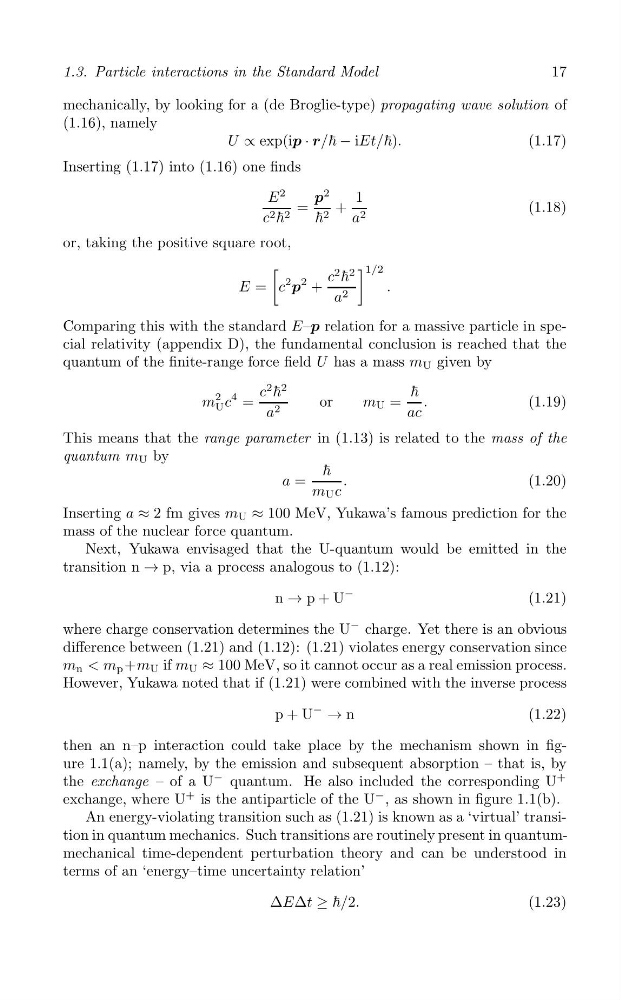
mechanically, by looking for a (de Broglie-type) propagating wave solution of
(1.16), namely
U ∝ exp(ip · r/ħ − iEt/ħ).
(1.17)
Inserting (1.17) into (1.16) one finds
2
E
2
p
1
=
+
(1.18)
c 2 ħ 2
ħ 2
a 2
or, taking the positive square root,
[
] 1/2
2
ħ
2
c
2 2
E = c p +
.
a 2
Comparing this with the standard E–p relation for a massive particle in special relativity (appendix D), the fundamental conclusion is reached that the
quantum of the finite-range force field U has a mass m U given by
2
ħ
2
c
ħ
2 4
m U c =
or
m U = .
(1.19)
a 2
ac
This means that the range parameter in (1.13) is related to the mass of the
quantum m U by
ħ
a =
.
(1.20)
m U c
Inserting a ≈ 2 fm gives m U ≈ 100 MeV, Yukawa’s famous prediction for the
mass of the nuclear force quantum.
Next, Yukawa envisaged that the U-quantum would be emitted in the
transition n → p, via a process analogous to (1.12):
n → p + U
−
(1.21)
where charge conservation determines the U
− charge. Yet there is an obvious
difference between (1.21) and (1.12): (1.21) violates energy conservation since
m n < m p +m U if m U ≈ 100 MeV, so it cannot occur as a real emission process.
However, Yukawa noted that if (1.21) were combined with the inverse process
p + U
−
→ n
(1.22)
then an n–p interaction could take place by the mechanism shown in figure 1.1(a); namely, by the emission and subsequent absorption – that is, by
the exchange – of a U
− quantum. He also included the corresponding U
+
exchange, where U
+ is the antiparticle of the U
− , as shown in figure 1.1(b).
An energy-violating transition such as (1.21) is known as a ‘virtual’ transition in quantum mechanics. Such transitions are routinely present in quantummechanical time-dependent perturbation theory and can be understood in
terms of an ‘energy–time uncertainty relation’
ΔEΔt ≥ ħ/2.
(1.23)
1.3. Particle interactions in the Standard Model
mechanically, by looking for a (de Broglie-type) propagating wave solution of
(1.16), namely
U ∝ exp(ip · r/ħ − iEt/ħ).
(1.17)
Inserting (1.17) into (1.16) one finds
2
E
2
p
1
=
+
(1.18)
c 2 ħ 2
ħ 2
a 2
or, taking the positive square root,
[
] 1/2
2
ħ
2
c
2 2
E = c p +
.
a 2
Comparing this with the standard E–p relation for a massive particle in special relativity (appendix D), the fundamental conclusion is reached that the
quantum of the finite-range force field U has a mass m U given by
2
ħ
2
c
ħ
2 4
m U c =
or
m U = .
(1.19)
a 2
ac
This means that the range parameter in (1.13) is related to the mass of the
quantum m U by
ħ
a =
.
(1.20)
m U c
Inserting a ≈ 2 fm gives m U ≈ 100 MeV, Yukawa’s famous prediction for the
mass of the nuclear force quantum.
Next, Yukawa envisaged that the U-quantum would be emitted in the
transition n → p, via a process analogous to (1.12):
n → p + U
−
(1.21)
where charge conservation determines the U
− charge. Yet there is an obvious
difference between (1.21) and (1.12): (1.21) violates energy conservation since
m n < m p +m U if m U ≈ 100 MeV, so it cannot occur as a real emission process.
However, Yukawa noted that if (1.21) were combined with the inverse process
p + U
−
→ n
(1.22)
then an n–p interaction could take place by the mechanism shown in figure 1.1(a); namely, by the emission and subsequent absorption – that is, by
the exchange – of a U
− quantum. He also included the corresponding U
+
exchange, where U
+ is the antiparticle of the U
− , as shown in figure 1.1(b).
An energy-violating transition such as (1.21) is known as a ‘virtual’ transition in quantum mechanics. Such transitions are routinely present in quantummechanical time-dependent perturbation theory and can be understood in
terms of an ‘energy–time uncertainty relation’
ΔEΔt ≥ ħ/2.
(1.23)