

294
9. Deep Inelastic Electron–Nucleon Scattering and the Parton Model
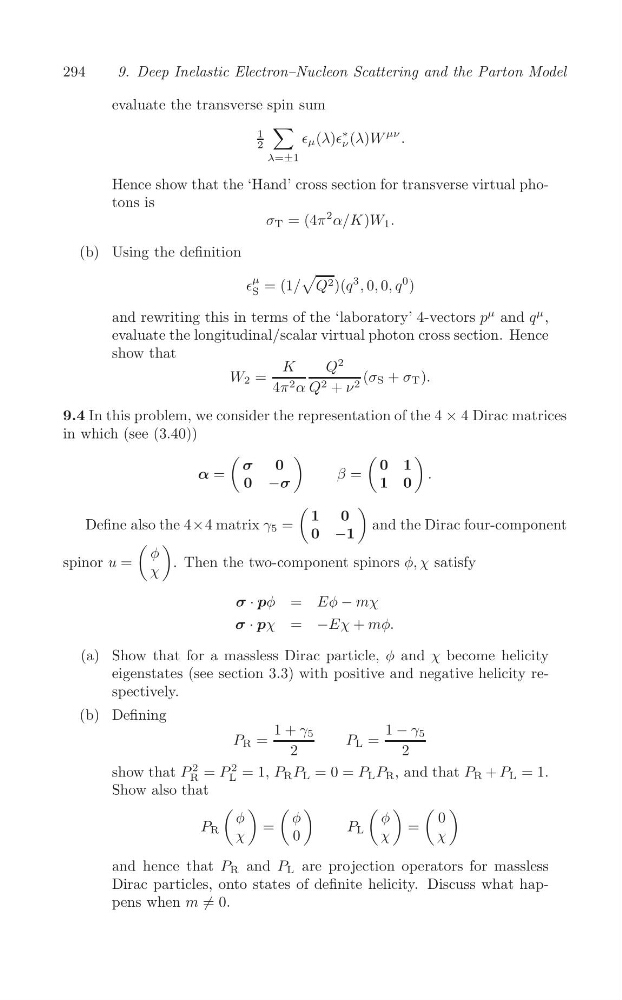
evaluate the transverse spin sum
∑
1
ν (λ)W
μν
∈ μ (λ)∈
∗
.
2
λ=±1
Hence show that the ‘Hand’ cross section for transverse virtual photons is
σ T = (4π
2 α/K)W 1 .
(b) Using the definition
√
∈
μ = (1/ Q 2 )(q
3 , 0, 0, q
0 )
S
μ
and rewriting this in terms of the ‘laboratory’ 4-vectors p
μ and q ,
evaluate the longitudinal/scalar virtual photon cross section. Hence
show that
K
Q
2
W 2 =
(σ S + σ T ).
4π 2 α Q 2 + ν 2
9.4 In this problem, we consider the representation of the 4 × 4 Dirac matrices
in which (see (3.40))
(
)
(
)
σ
0
0 1
α =
β =
.
0 −σ
1 0
(
)
1 0
Define also the 4×4 matrix γ 5 =
and the Dirac four-component
0 −1
( )
φ
spinor u =
. Then the two-component spinors φ, χ satisfy
χ
σ · pφ = Eφ − mχ
σ · pχ = −Eχ + mφ.
(a) Show that for a massless Dirac particle, φ and χ become helicity
eigenstates (see section 3.3) with positive and negative helicity respectively.
(b) Defining
1 + γ 5
1 − γ 5
P R =
P L =
2
2
show that P
2 = P
2 = 1, P R P L = 0 = P L P R , and that P R + P L = 1.
R
L
Show also that
( ) ( )
( ) ( )
φ
φ
φ
0
P R
=
P L
=
χ
0
χ
χ
and hence that P R and P L are projection operators for massless
Dirac particles, onto states of definite helicity. Discuss what happens when m / = 0.
9. Deep Inelastic Electron–Nucleon Scattering and the Parton Model
evaluate the transverse spin sum
∑
1
ν (λ)W
μν
∈ μ (λ)∈
∗
.
2
λ=±1
Hence show that the ‘Hand’ cross section for transverse virtual photons is
σ T = (4π
2 α/K)W 1 .
(b) Using the definition
√
∈
μ = (1/ Q 2 )(q
3 , 0, 0, q
0 )
S
μ
and rewriting this in terms of the ‘laboratory’ 4-vectors p
μ and q ,
evaluate the longitudinal/scalar virtual photon cross section. Hence
show that
K
Q
2
W 2 =
(σ S + σ T ).
4π 2 α Q 2 + ν 2
9.4 In this problem, we consider the representation of the 4 × 4 Dirac matrices
in which (see (3.40))
(
)
(
)
σ
0
0 1
α =
β =
.
0 −σ
1 0
(
)
1 0
Define also the 4×4 matrix γ 5 =
and the Dirac four-component
0 −1
( )
φ
spinor u =
. Then the two-component spinors φ, χ satisfy
χ
σ · pφ = Eφ − mχ
σ · pχ = −Eχ + mφ.
(a) Show that for a massless Dirac particle, φ and χ become helicity
eigenstates (see section 3.3) with positive and negative helicity respectively.
(b) Defining
1 + γ 5
1 − γ 5
P R =
P L =
2
2
show that P
2 = P
2 = 1, P R P L = 0 = P L P R , and that P R + P L = 1.
R
L
Show also that
( ) ( )
( ) ( )
φ
φ
φ
0
P R
=
P L
=
χ
0
χ
χ
and hence that P R and P L are projection operators for massless
Dirac particles, onto states of definite helicity. Discuss what happens when m / = 0.