

14
1. The Particles and Forces of the Standard Model
that electromagnetic waves somehow also had a particle-like aspect, the photon. At about the same time, the intuitive understanding of the nature of
matter began to fail as well: supposedly particle-like things, like electrons,
displayed wave-like properties (interference and diffraction). Thus the conceptual distinction between matter and forces, or between particle and field,
was no longer so clear. On the one hand, electromagnetic forces, treated in
terms of fields, now had a particle aspect; and on the other hand, particles
now had a wave-like or field aspect. ‘Electrons’, writes Feynman (1965a) at
the beginning of volume 3 of his Lectures on Physics, ‘behave just like light’.
How can we build a theory of electrons and photons which does justice to
all the ‘point-like’, ‘local’, ‘wave/particle’ ideas just discussed? Consider the
apparently quite simple process of spontaneous decay of an excited atomic
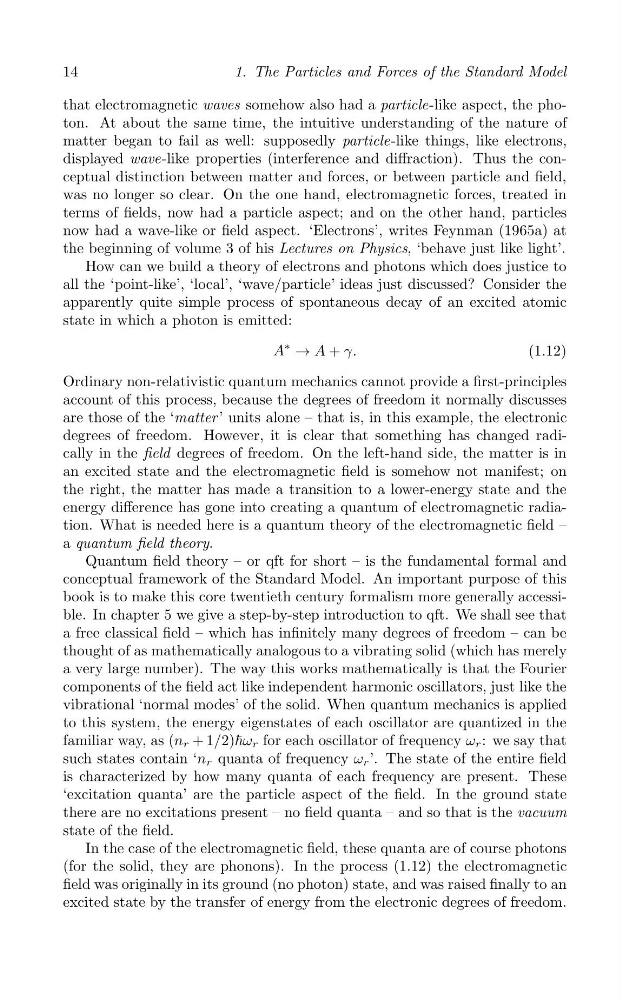
state in which a photon is emitted:
A
∗
→ A + γ.
(1.12)
Ordinary non-relativistic quantum mechanics cannot provide a first-principles
account of this process, because the degrees of freedom it normally discusses
are those of the ‘matter ’ units alone – that is, in this example, the electronic
degrees of freedom. However, it is clear that something has changed radically in the field degrees of freedom. On the left-hand side, the matter is in
an excited state and the electromagnetic field is somehow not manifest; on
the right, the matter has made a transition to a lower-energy state and the
energy difference has gone into creating a quantum of electromagnetic radiation. What is needed here is a quantum theory of the electromagnetic field –
a quantum field theory.
Quantum field theory – or qft for short – is the fundamental formal and
conceptual framework of the Standard Model. An important purpose of this
book is to make this core twentieth century formalism more generally accessible. In chapter 5 we give a step-by-step introduction to qft. We shall see that
a free classical field – which has infinitely many degrees of freedom – can be
thought of as mathematically analogous to a vibrating solid (which has merely
a very large number). The way this works mathematically is that the Fourier
components of the field act like independent harmonic oscillators, just like the
vibrational ‘normal modes’ of the solid. When quantum mechanics is applied
to this system, the energy eigenstates of each oscillator are quantized in the
familiar way, as (n r + 1/2)ħω r for each oscillator of frequency ω r : we say that
such states contain ‘n r quanta of frequency ω r ’. The state of the entire field
is characterized by how many quanta of each frequency are present. These
‘excitation quanta’ are the particle aspect of the field. In the ground state
there are no excitations present – no field quanta – and so that is the vacuum
state of the field.
In the case of the electromagnetic field, these quanta are of course photons
(for the solid, they are phonons). In the process (1.12) the electromagnetic
field was originally in its ground (no photon) state, and was raised finally to an
excited state by the transfer of energy from the electronic degrees of freedom.
1. The Particles and Forces of the Standard Model
that electromagnetic waves somehow also had a particle-like aspect, the photon. At about the same time, the intuitive understanding of the nature of
matter began to fail as well: supposedly particle-like things, like electrons,
displayed wave-like properties (interference and diffraction). Thus the conceptual distinction between matter and forces, or between particle and field,
was no longer so clear. On the one hand, electromagnetic forces, treated in
terms of fields, now had a particle aspect; and on the other hand, particles
now had a wave-like or field aspect. ‘Electrons’, writes Feynman (1965a) at
the beginning of volume 3 of his Lectures on Physics, ‘behave just like light’.
How can we build a theory of electrons and photons which does justice to
all the ‘point-like’, ‘local’, ‘wave/particle’ ideas just discussed? Consider the
apparently quite simple process of spontaneous decay of an excited atomic
state in which a photon is emitted:
A
∗
→ A + γ.
(1.12)
Ordinary non-relativistic quantum mechanics cannot provide a first-principles
account of this process, because the degrees of freedom it normally discusses
are those of the ‘matter ’ units alone – that is, in this example, the electronic
degrees of freedom. However, it is clear that something has changed radically in the field degrees of freedom. On the left-hand side, the matter is in
an excited state and the electromagnetic field is somehow not manifest; on
the right, the matter has made a transition to a lower-energy state and the
energy difference has gone into creating a quantum of electromagnetic radiation. What is needed here is a quantum theory of the electromagnetic field –
a quantum field theory.
Quantum field theory – or qft for short – is the fundamental formal and
conceptual framework of the Standard Model. An important purpose of this
book is to make this core twentieth century formalism more generally accessible. In chapter 5 we give a step-by-step introduction to qft. We shall see that
a free classical field – which has infinitely many degrees of freedom – can be
thought of as mathematically analogous to a vibrating solid (which has merely
a very large number). The way this works mathematically is that the Fourier
components of the field act like independent harmonic oscillators, just like the
vibrational ‘normal modes’ of the solid. When quantum mechanics is applied
to this system, the energy eigenstates of each oscillator are quantized in the
familiar way, as (n r + 1/2)ħω r for each oscillator of frequency ω r : we say that
such states contain ‘n r quanta of frequency ω r ’. The state of the entire field
is characterized by how many quanta of each frequency are present. These
‘excitation quanta’ are the particle aspect of the field. In the ground state
there are no excitations present – no field quanta – and so that is the vacuum
state of the field.
In the case of the electromagnetic field, these quanta are of course photons
(for the solid, they are phonons). In the process (1.12) the electromagnetic
field was originally in its ground (no photon) state, and was raised finally to an
excited state by the transfer of energy from the electronic degrees of freedom.