

281
9.3. Partons as quarks and gluons
9.3 Partons as quarks and gluons
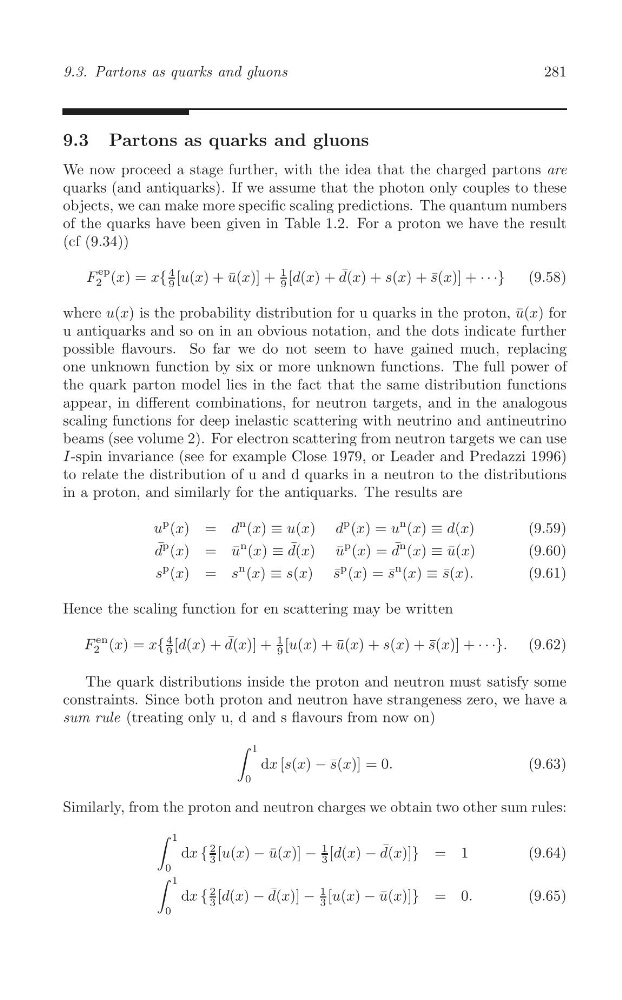
We now proceed a stage further, with the idea that the charged partons are
quarks (and antiquarks). If we assume that the photon only couples to these
objects, we can make more specific scaling predictions. The quantum numbers
of the quarks have been given in Table 1.2. For a proton we have the result
(cf (9.34))
F
ep (x) = x{
4 [u(x) + u ¯(x)] +
1 [d(x) + d ¯ (x) + s(x) + s ¯(x)] + · · ·}
(9.58)
2
9
9
where u(x) is the probability distribution for u quarks in the proton, ¯
u(x) for
u antiquarks and so on in an obvious notation, and the dots indicate further
possible flavours. So far we do not seem to have gained much, replacing
one unknown function by six or more unknown functions. The full power of
the quark parton model lies in the fact that the same distribution functions
appear, in different combinations, for neutron targets, and in the analogous
scaling functions for deep inelastic scattering with neutrino and antineutrino
beams (see volume 2). For electron scattering from neutron targets we can use
I-spin invariance (see for example Close 1979, or Leader and Predazzi 1996)
to relate the distribution of u and d quarks in a neutron to the distributions
in a proton, and similarly for the antiquarks. The results are
u
p (x) = d
n (x) ≡ u(x) d
p (x) = u
n (x) ≡ d(x)
(9.59)
d ¯ p (x) = u ¯
n (x) ≡ d ¯ (x) u ¯
p (x) = d ¯ n (x) ≡ u ¯(x)
(9.60)
s
p (x) = s
n (x) ≡ s(x) s ¯
p (x) = s ¯
n (x) ≡ s ¯(x).
(9.61)
Hence the scaling function for en scattering may be written
en
F (x) = x{
4 [d(x) + d ¯ (x)] +
1 [u(x) + u ¯(x) + s(x) + s ¯(x)] + · · ·}. (9.62)
2
9
9
The quark distributions inside the proton and neutron must satisfy some
constraints. Since both proton and neutron have strangeness zero, we have a
sum rule (treating only u, d and s flavours from now on)
∫ 1
dx [s(x) − s ¯(x)] = 0.
(9.63)
0
Similarly, from the proton and neutron charges we obtain two other sum rules:
∫ 1
¯
dx {
2 [u(x) − u ¯(x)] −
1 [d(x) − d(x)]} = 1
(9.64)
3
3
0
∫ 1
¯
dx {
2 [d(x) − d(x)] −
1 [u(x) − u ¯(x)]} = 0.
(9.65)
3
3
0
9.3. Partons as quarks and gluons
9.3 Partons as quarks and gluons
We now proceed a stage further, with the idea that the charged partons are
quarks (and antiquarks). If we assume that the photon only couples to these
objects, we can make more specific scaling predictions. The quantum numbers
of the quarks have been given in Table 1.2. For a proton we have the result
(cf (9.34))
F
ep (x) = x{
4 [u(x) + u ¯(x)] +
1 [d(x) + d ¯ (x) + s(x) + s ¯(x)] + · · ·}
(9.58)
2
9
9
where u(x) is the probability distribution for u quarks in the proton, ¯
u(x) for
u antiquarks and so on in an obvious notation, and the dots indicate further
possible flavours. So far we do not seem to have gained much, replacing
one unknown function by six or more unknown functions. The full power of
the quark parton model lies in the fact that the same distribution functions
appear, in different combinations, for neutron targets, and in the analogous
scaling functions for deep inelastic scattering with neutrino and antineutrino
beams (see volume 2). For electron scattering from neutron targets we can use
I-spin invariance (see for example Close 1979, or Leader and Predazzi 1996)
to relate the distribution of u and d quarks in a neutron to the distributions
in a proton, and similarly for the antiquarks. The results are
u
p (x) = d
n (x) ≡ u(x) d
p (x) = u
n (x) ≡ d(x)
(9.59)
d ¯ p (x) = u ¯
n (x) ≡ d ¯ (x) u ¯
p (x) = d ¯ n (x) ≡ u ¯(x)
(9.60)
s
p (x) = s
n (x) ≡ s(x) s ¯
p (x) = s ¯
n (x) ≡ s ¯(x).
(9.61)
Hence the scaling function for en scattering may be written
en
F (x) = x{
4 [d(x) + d ¯ (x)] +
1 [u(x) + u ¯(x) + s(x) + s ¯(x)] + · · ·}. (9.62)
2
9
9
The quark distributions inside the proton and neutron must satisfy some
constraints. Since both proton and neutron have strangeness zero, we have a
sum rule (treating only u, d and s flavours from now on)
∫ 1
dx [s(x) − s ¯(x)] = 0.
(9.63)
0
Similarly, from the proton and neutron charges we obtain two other sum rules:
∫ 1
¯
dx {
2 [u(x) − u ¯(x)] −
1 [d(x) − d(x)]} = 1
(9.64)
3
3
0
∫ 1
¯
dx {
2 [d(x) − d(x)] −
1 [u(x) − u ¯(x)]} = 0.
(9.65)
3
3
0