

278
9. Deep Inelastic Electron–Nucleon Scattering and the Parton Model
and so are led to the result
√
3
∈
μ (λ = 0) = (1/ Q 2 )(q , 0, 0, q
0 )
(9.41)
with
∈
2 (λ = 0) = +1.
(9.42)
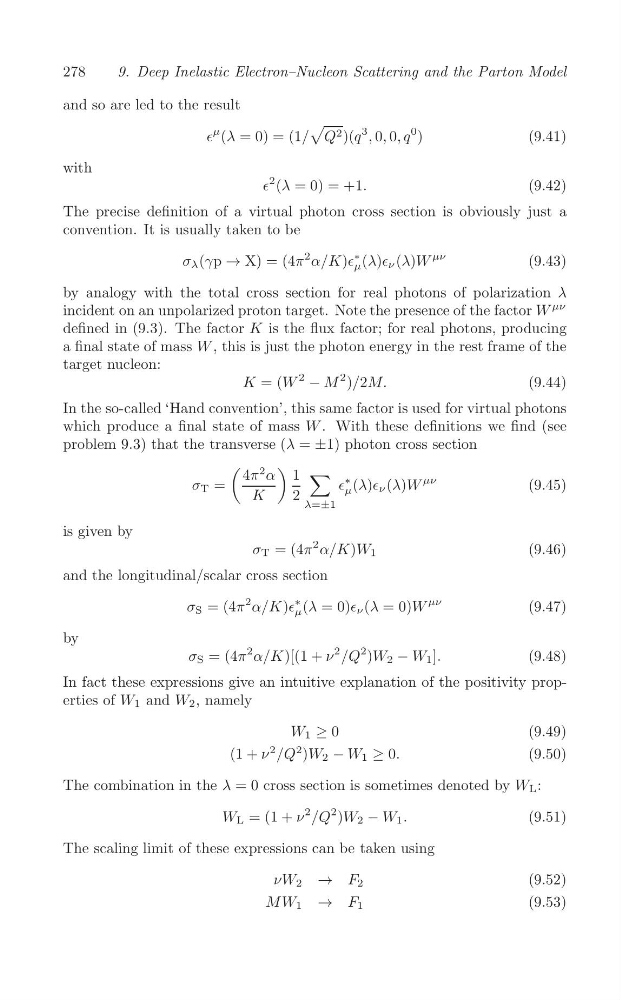
The precise definition of a virtual photon cross section is obviously just a
convention. It is usually taken to be
μ (λ)∈ ν (λ)W
μν
σ λ (γp → X) = (4π
2 α/K)∈
∗
(9.43)
by analogy with the total cross section for real photons of polarization λ
incident on an unpolarized proton target. Note the presence of the factor W
μν
defined in (9.3). The factor K is the flux factor; for real photons, producing
a final state of mass W , this is just the photon energy in the rest frame of the
target nucleon:
K = (W
2
− M
2 )/2M.
(9.44)
In the so-called ‘Hand convention’, this same factor is used for virtual photons
which produce a final state of mass W . With these definitions we find (see
problem 9.3) that the transverse (λ = ±1) photon cross section
(
) ∑
4π
2 α 1
∈
∗
μ (λ)∈ ν (λ)W
μν
σ T =
(9.45)
K
2
λ=±1
is given by
σ T = (4π
2 α/K)W 1
(9.46)
and the longitudinal/scalar cross section
σ S = (4π
2 α/K)∈
∗
μ (λ = 0)∈ ν (λ = 0)W
μν
(9.47)
by
σ S = (4π
2 α/K)[(1 + ν
2 /Q
2 )W 2 − W 1 ].
(9.48)
In fact these expressions give an intuitive explanation of the positivity properties of W 1 and W 2 , namely
W 1 ≥ 0
(9.49)
(1 + ν
2 /Q
2 )W 2 − W 1 ≥ 0.
(9.50)
The combination in the λ = 0 cross section is sometimes denoted by W L :
W L = (1 + ν
2 /Q
2 )W 2 − W 1 .
(9.51)
The scaling limit of these expressions can be taken using
νW 2 → F 2
(9.52)
M W 1 → F 1
(9.53)
9. Deep Inelastic Electron–Nucleon Scattering and the Parton Model
and so are led to the result
√
3
∈
μ (λ = 0) = (1/ Q 2 )(q , 0, 0, q
0 )
(9.41)
with
∈
2 (λ = 0) = +1.
(9.42)
The precise definition of a virtual photon cross section is obviously just a
convention. It is usually taken to be
μ (λ)∈ ν (λ)W
μν
σ λ (γp → X) = (4π
2 α/K)∈
∗
(9.43)
by analogy with the total cross section for real photons of polarization λ
incident on an unpolarized proton target. Note the presence of the factor W
μν
defined in (9.3). The factor K is the flux factor; for real photons, producing
a final state of mass W , this is just the photon energy in the rest frame of the
target nucleon:
K = (W
2
− M
2 )/2M.
(9.44)
In the so-called ‘Hand convention’, this same factor is used for virtual photons
which produce a final state of mass W . With these definitions we find (see
problem 9.3) that the transverse (λ = ±1) photon cross section
(
) ∑
4π
2 α 1
∈
∗
μ (λ)∈ ν (λ)W
μν
σ T =
(9.45)
K
2
λ=±1
is given by
σ T = (4π
2 α/K)W 1
(9.46)
and the longitudinal/scalar cross section
σ S = (4π
2 α/K)∈
∗
μ (λ = 0)∈ ν (λ = 0)W
μν
(9.47)
by
σ S = (4π
2 α/K)[(1 + ν
2 /Q
2 )W 2 − W 1 ].
(9.48)
In fact these expressions give an intuitive explanation of the positivity properties of W 1 and W 2 , namely
W 1 ≥ 0
(9.49)
(1 + ν
2 /Q
2 )W 2 − W 1 ≥ 0.
(9.50)
The combination in the λ = 0 cross section is sometimes denoted by W L :
W L = (1 + ν
2 /Q
2 )W 2 − W 1 .
(9.51)
The scaling limit of these expressions can be taken using
νW 2 → F 2
(9.52)
M W 1 → F 1
(9.53)