

11
1.2. The fermions of the Standard Model
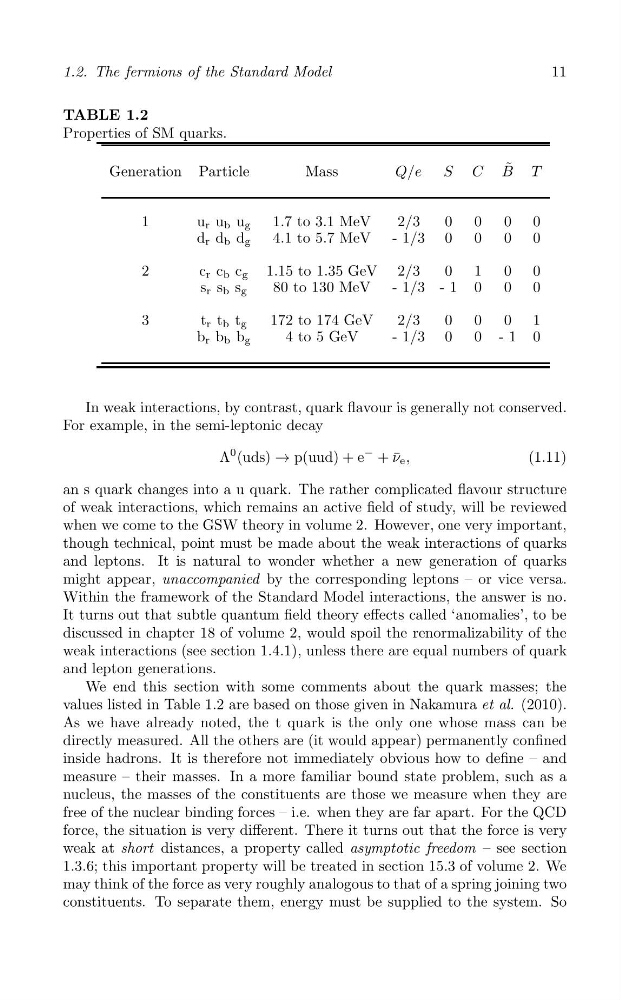
TABLE 1.2
Properties of SM quarks.
˜
Generation Particle
Mass
Q/e S C B T
1
u r u b u g
d r d b d g
1.7 to 3.1 MeV
4.1 to 5.7 MeV
2/3
- 1/3
0
0
0
0
0
0
0
0
2
c r c b c g
s r s b s g
1.15 to 1.35 GeV
80 to 130 MeV
2/3
- 1/3
0
- 1
1
0
0
0
0
0
3
t r t b t g
b r b b b g
172 to 174 GeV
4 to 5 GeV
2/3
- 1/3
0
0
0
0
0
- 1
1
0
In weak interactions, by contrast, quark flavour is generally not conserved.
For example, in the semi-leptonic decay
Λ
0 (uds) → p(uud) + e
− + ¯
ν e ,
(1.11)
an s quark changes into a u quark. The rather complicated flavour structure
of weak interactions, which remains an active field of study, will be reviewed
when we come to the GSW theory in volume 2. However, one very important,
though technical, point must be made about the weak interactions of quarks
and leptons. It is natural to wonder whether a new generation of quarks
might appear, unaccompanied by the corresponding leptons – or vice versa.
Within the framework of the Standard Model interactions, the answer is no.
It turns out that subtle quantum field theory effects called ‘anomalies’, to be
discussed in chapter 18 of volume 2, would spoil the renormalizability of the
weak interactions (see section 1.4.1), unless there are equal numbers of quark
and lepton generations.
We end this section with some comments about the quark masses; the
values listed in Table 1.2 are based on those given in Nakamura et al. (2010).
As we have already noted, the t quark is the only one whose mass can be
directly measured. All the others are (it would appear) permanently confined
inside hadrons. It is therefore not immediately obvious how to define – and
measure – their masses. In a more familiar bound state problem, such as a
nucleus, the masses of the constituents are those we measure when they are
free of the nuclear binding forces – i.e. when they are far apart. For the QCD
force, the situation is very different. There it turns out that the force is very
weak at short distances, a property called asymptotic freedom – see section
1.3.6; this important property will be treated in section 15.3 of volume 2. We
may think of the force as very roughly analogous to that of a spring joining two
constituents. To separate them, energy must be supplied to the system. So
1.2. The fermions of the Standard Model
TABLE 1.2
Properties of SM quarks.
˜
Generation Particle
Mass
Q/e S C B T
1
u r u b u g
d r d b d g
1.7 to 3.1 MeV
4.1 to 5.7 MeV
2/3
- 1/3
0
0
0
0
0
0
0
0
2
c r c b c g
s r s b s g
1.15 to 1.35 GeV
80 to 130 MeV
2/3
- 1/3
0
- 1
1
0
0
0
0
0
3
t r t b t g
b r b b b g
172 to 174 GeV
4 to 5 GeV
2/3
- 1/3
0
0
0
0
0
- 1
1
0
In weak interactions, by contrast, quark flavour is generally not conserved.
For example, in the semi-leptonic decay
Λ
0 (uds) → p(uud) + e
− + ¯
ν e ,
(1.11)
an s quark changes into a u quark. The rather complicated flavour structure
of weak interactions, which remains an active field of study, will be reviewed
when we come to the GSW theory in volume 2. However, one very important,
though technical, point must be made about the weak interactions of quarks
and leptons. It is natural to wonder whether a new generation of quarks
might appear, unaccompanied by the corresponding leptons – or vice versa.
Within the framework of the Standard Model interactions, the answer is no.
It turns out that subtle quantum field theory effects called ‘anomalies’, to be
discussed in chapter 18 of volume 2, would spoil the renormalizability of the
weak interactions (see section 1.4.1), unless there are equal numbers of quark
and lepton generations.
We end this section with some comments about the quark masses; the
values listed in Table 1.2 are based on those given in Nakamura et al. (2010).
As we have already noted, the t quark is the only one whose mass can be
directly measured. All the others are (it would appear) permanently confined
inside hadrons. It is therefore not immediately obvious how to define – and
measure – their masses. In a more familiar bound state problem, such as a
nucleus, the masses of the constituents are those we measure when they are
free of the nuclear binding forces – i.e. when they are far apart. For the QCD
force, the situation is very different. There it turns out that the force is very
weak at short distances, a property called asymptotic freedom – see section
1.3.6; this important property will be treated in section 15.3 of volume 2. We
may think of the force as very roughly analogous to that of a spring joining two
constituents. To separate them, energy must be supplied to the system. So