

+
8.5. The form factor in the time-like region: e e
−
→ π
+ π
− and crossing symmetry 249
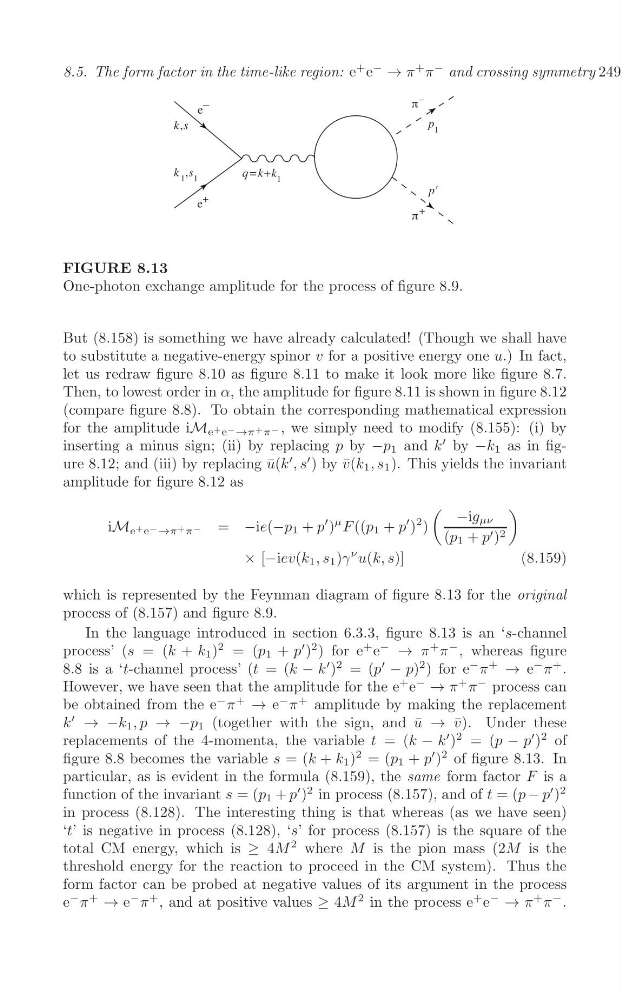
FIGURE 8.13
One-photon exchange amplitude for the process of figure 8.9.
But (8.158) is something we have already calculated! (Though we shall have
to substitute a negative-energy spinor v for a positive energy one u.) In fact,
let us redraw figure 8.10 as figure 8.11 to make it look more like figure 8.7.
Then, to lowest order in α, the amplitude for figure 8.11 is shown in figure 8.12
(compare figure 8.8). To obtain the corresponding mathematical expression
for the amplitude iM e + e − →π + π − , we simply need to modify (8.155): (i) by
′
inserting a minus sign; (ii) by replacing p by −p 1 and k by −k 1 as in fig′
ure 8.12; and (iii) by replacing ¯
u(k , s
′ ) by ¯
v(k 1 , s 1 ). This yields the invariant
amplitude for figure 8.12 as
(
)
−ig μν
iM e + e − →π + π − = −ie(−p 1 + p
′ )
μ F ((p 1 + p
′ )
2 ) (p 1 + p ′ ) 2
× [−iev ¯(k 1 , s 1 )γ
ν u(k, s)]
(8.159)
which is represented by the Feynman diagram of figure 8.13 for the original
process of (8.157) and figure 8.9.
In the language introduced in section 6.3.3, figure 8.13 is an ‘s-channel
−
process’ (s = (k + k 1 )
2 = (p 1 + p
′ )
2 ) for e
+ e → π
+ π
− , whereas figure
′
8.8 is a ‘t-channel process’ (t = (k − k
′ )
2 = (p − p)
2 ) for e
− π
+
→ e
− π
+ .
However, we have seen that the amplitude for the e
+ e
−
→ π
+ π
− process can
be obtained from the e
− π
+
→ e
− π
+ amplitude by making the replacement
′
k → −k 1 , p → −p 1 (together with the sign, and ¯
u → v ¯). Under these
replacements of the 4-momenta, the variable t = (k − k
′ )
2 = (p − p
′ )
2 of
figure 8.8 becomes the variable s = (k + k 1 )
2 = (p 1 + p
′ )
2 of figure 8.13. In
particular, as is evident in the formula (8.159), the same form factor F is a
function of the invariant s = (p 1 + p
′ )
2 in process (8.157), and of t = (p − p
′ )
2
in process (8.128). The interesting thing is that whereas (as we have seen)
‘t’ is negative in process (8.128), ‘s’ for process (8.157) is the square of the
total CM energy, which is ≥ 4M
2 where M is the pion mass (2M is the
threshold energy for the reaction to proceed in the CM system). Thus the
form factor can be probed at negative values of its argument in the process
e
− π
+
→ e
− π
+ , and at positive values ≥ 4M
2 in the process e
+ e
−
→ π
+ π
− .
8.5. The form factor in the time-like region: e e
−
→ π
+ π
− and crossing symmetry 249
FIGURE 8.13
One-photon exchange amplitude for the process of figure 8.9.
But (8.158) is something we have already calculated! (Though we shall have
to substitute a negative-energy spinor v for a positive energy one u.) In fact,
let us redraw figure 8.10 as figure 8.11 to make it look more like figure 8.7.
Then, to lowest order in α, the amplitude for figure 8.11 is shown in figure 8.12
(compare figure 8.8). To obtain the corresponding mathematical expression
for the amplitude iM e + e − →π + π − , we simply need to modify (8.155): (i) by
′
inserting a minus sign; (ii) by replacing p by −p 1 and k by −k 1 as in fig′
ure 8.12; and (iii) by replacing ¯
u(k , s
′ ) by ¯
v(k 1 , s 1 ). This yields the invariant
amplitude for figure 8.12 as
(
)
−ig μν
iM e + e − →π + π − = −ie(−p 1 + p
′ )
μ F ((p 1 + p
′ )
2 ) (p 1 + p ′ ) 2
× [−iev ¯(k 1 , s 1 )γ
ν u(k, s)]
(8.159)
which is represented by the Feynman diagram of figure 8.13 for the original
process of (8.157) and figure 8.9.
In the language introduced in section 6.3.3, figure 8.13 is an ‘s-channel
−
process’ (s = (k + k 1 )
2 = (p 1 + p
′ )
2 ) for e
+ e → π
+ π
− , whereas figure
′
8.8 is a ‘t-channel process’ (t = (k − k
′ )
2 = (p − p)
2 ) for e
− π
+
→ e
− π
+ .
However, we have seen that the amplitude for the e
+ e
−
→ π
+ π
− process can
be obtained from the e
− π
+
→ e
− π
+ amplitude by making the replacement
′
k → −k 1 , p → −p 1 (together with the sign, and ¯
u → v ¯). Under these
replacements of the 4-momenta, the variable t = (k − k
′ )
2 = (p − p
′ )
2 of
figure 8.8 becomes the variable s = (k + k 1 )
2 = (p 1 + p
′ )
2 of figure 8.13. In
particular, as is evident in the formula (8.159), the same form factor F is a
function of the invariant s = (p 1 + p
′ )
2 in process (8.157), and of t = (p − p
′ )
2
in process (8.128). The interesting thing is that whereas (as we have seen)
‘t’ is negative in process (8.128), ‘s’ for process (8.157) is the square of the
total CM energy, which is ≥ 4M
2 where M is the pion mass (2M is the
threshold energy for the reaction to proceed in the CM system). Thus the
form factor can be probed at negative values of its argument in the process
e
− π
+
→ e
− π
+ , and at positive values ≥ 4M
2 in the process e
+ e
−
→ π
+ π
− .