

+
8.5. The form factor in the time-like region: e e
−
→ π
+ π
− and crossing symmetry 247
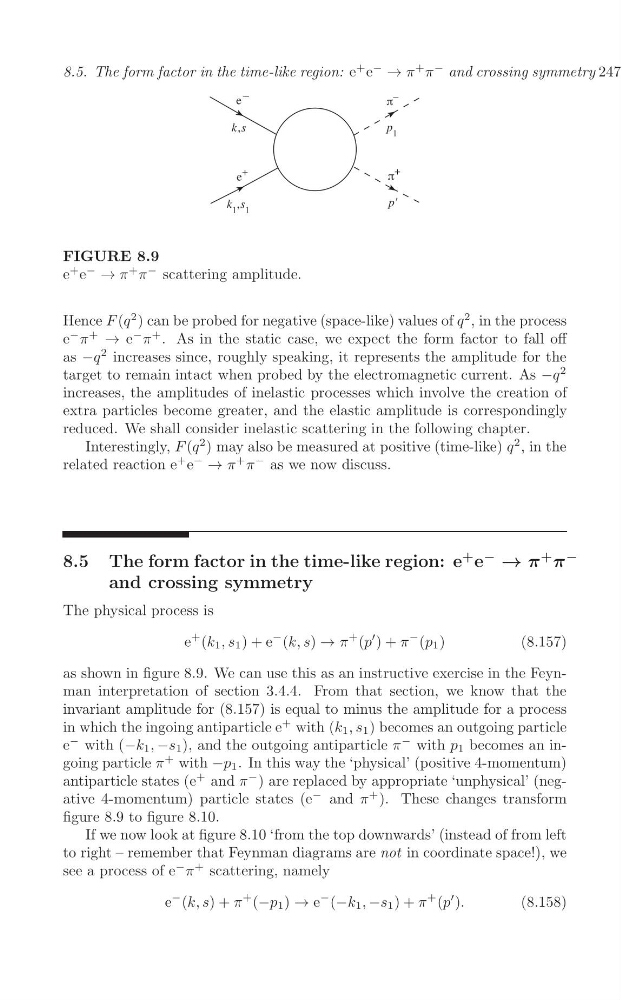
FIGURE 8.9
+
e e
−
→ π
+ π
− scattering amplitude.
2
Hence F (q
2 ) can be probed for negative (space-like) values of q , in the process
− π
+
− π
+
e
→ e
. As in the static case, we expect the form factor to fall off
2
as −q increases since, roughly speaking, it represents the amplitude for the
2
target to remain intact when probed by the electromagnetic current. As −q
increases, the amplitudes of inelastic processes which involve the creation of
extra particles become greater, and the elastic amplitude is correspondingly
reduced. We shall consider inelastic scattering in the following chapter.
Interestingly, F (q
2 ) may also be measured at positive (time-like) q
2 , in the
related reaction e
+ e
−
→ π
+ π
− as we now discuss.
8.5 The form factor in the time-like region: e
+ e
−
→ π
+
π
−
and crossing symmetry
The physical process is
e
+ (k 1 , s 1 ) + e
− (k, s) → π
+ (p
′ ) + π
− (p 1 )
(8.157)
as shown in figure 8.9. We can use this as an instructive exercise in the Feynman interpretation of section 3.4.4. From that section, we know that the
invariant amplitude for (8.157) is equal to minus the amplitude for a process
in which the ingoing antiparticle e
+ with (k 1 , s 1 ) becomes an outgoing particle
e
− with (−k 1 , −s 1 ), and the outgoing antiparticle π
− with p 1 becomes an ingoing particle π
+ with −p 1 . In this way the ‘physical’ (positive 4-momentum)
antiparticle states (e
+ and π
− ) are replaced by appropriate ‘unphysical’ (negative 4-momentum) particle states (e
− and π
+ ). These changes transform
figure 8.9 to figure 8.10.
If we now look at figure 8.10 ‘from the top downwards’ (instead of from left
to right – remember that Feynman diagrams are not in coordinate space!), we
see a process of e
− π
+ scattering, namely
e
− (k, s) + π
+ (−p 1 ) → e
− (−k 1 , −s 1 ) + π
+ (p
′ ).
(8.158)
8.5. The form factor in the time-like region: e e
−
→ π
+ π
− and crossing symmetry 247
FIGURE 8.9
+
e e
−
→ π
+ π
− scattering amplitude.
2
Hence F (q
2 ) can be probed for negative (space-like) values of q , in the process
− π
+
− π
+
e
→ e
. As in the static case, we expect the form factor to fall off
2
as −q increases since, roughly speaking, it represents the amplitude for the
2
target to remain intact when probed by the electromagnetic current. As −q
increases, the amplitudes of inelastic processes which involve the creation of
extra particles become greater, and the elastic amplitude is correspondingly
reduced. We shall consider inelastic scattering in the following chapter.
Interestingly, F (q
2 ) may also be measured at positive (time-like) q
2 , in the
related reaction e
+ e
−
→ π
+ π
− as we now discuss.
8.5 The form factor in the time-like region: e
+ e
−
→ π
+
π
−
and crossing symmetry
The physical process is
e
+ (k 1 , s 1 ) + e
− (k, s) → π
+ (p
′ ) + π
− (p 1 )
(8.157)
as shown in figure 8.9. We can use this as an instructive exercise in the Feynman interpretation of section 3.4.4. From that section, we know that the
invariant amplitude for (8.157) is equal to minus the amplitude for a process
in which the ingoing antiparticle e
+ with (k 1 , s 1 ) becomes an outgoing particle
e
− with (−k 1 , −s 1 ), and the outgoing antiparticle π
− with p 1 becomes an ingoing particle π
+ with −p 1 . In this way the ‘physical’ (positive 4-momentum)
antiparticle states (e
+ and π
− ) are replaced by appropriate ‘unphysical’ (negative 4-momentum) particle states (e
− and π
+ ). These changes transform
figure 8.9 to figure 8.10.
If we now look at figure 8.10 ‘from the top downwards’ (instead of from left
to right – remember that Feynman diagrams are not in coordinate space!), we
see a process of e
− π
+ scattering, namely
e
− (k, s) + π
+ (−p 1 ) → e
− (−k 1 , −s 1 ) + π
+ (p
′ ).
(8.158)