

245
8.4. Scattering from a non-point-like object
μ
to j π + (p, p
′ ), which will include strong interaction effects. Whatever these
effects are, they cannot destroy the 4-vector character of the current. To
μ
construct the general form of j (p, p
′ ) therefore, we must first enumerate the
π +
independent momentum 4-vectors we have at our disposal to parametrize the
4-vector nature of the current. These are just
′
p
p
and
q
(8.138)
subject to the condition
′
p = p + q.
(8.139)
There are two independent combinations; these we can choose to be the linear
combinations
′
(p + p) μ
(8.140)
and
′
(p − p) μ = q μ .
(8.141)
Both of these 4-vectors can, in general, parametrize the 4-vector nature of the
electromagnetic current of a real pion. Moreover, they can be multiplied by
an unknown scalar function of the available Lorentz scalar products for this
process. Since
2
′ 2
p = p = M
2
(8.142)
and
′
q
2 = 2M
2
− 2p · p
(8.143)
there is only one independent scalar in the problem, which we may take to be
q
2 , the 4-momentum transfer to the vertex. Thus, from Lorentz invariance,
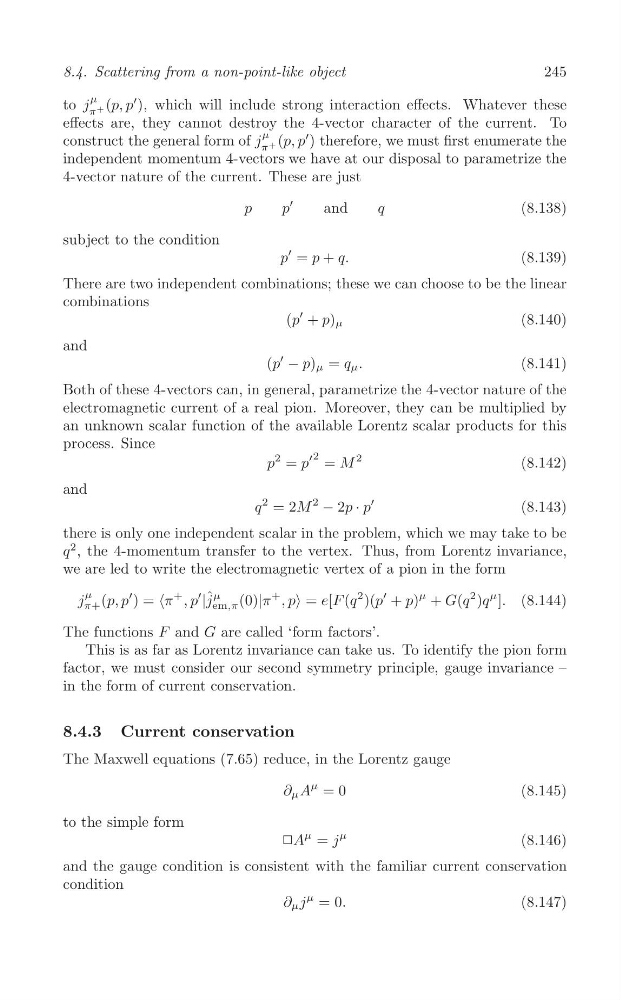
we are led to write the electromagnetic vertex of a pion in the form
μ
′
′
| ˆ j
μ
+ p)
μ
2 )q
μ ].
j (p, p
′ ) = <π
+ , p em,π (0)|π
+ , p> = e[F (q
2 )(p
+ G(q
(8.144)
π+
The functions F and G are called ‘form factors’.
This is as far as Lorentz invariance can take us. To identify the pion form
factor, we must consider our second symmetry principle, gauge invariance –
in the form of current conservation.
8.4.3 Current conservation
The Maxwell equations (7.65) reduce, in the Lorentz gauge
∂ μ A
μ = 0
(8.145)
to the simple form
❗A
μ = j
μ
(8.146)
and the gauge condition is consistent with the familiar current conservation
condition
∂ μ j
μ = 0.
(8.147)
8.4. Scattering from a non-point-like object
μ
to j π + (p, p
′ ), which will include strong interaction effects. Whatever these
effects are, they cannot destroy the 4-vector character of the current. To
μ
construct the general form of j (p, p
′ ) therefore, we must first enumerate the
π +
independent momentum 4-vectors we have at our disposal to parametrize the
4-vector nature of the current. These are just
′
p
p
and
q
(8.138)
subject to the condition
′
p = p + q.
(8.139)
There are two independent combinations; these we can choose to be the linear
combinations
′
(p + p) μ
(8.140)
and
′
(p − p) μ = q μ .
(8.141)
Both of these 4-vectors can, in general, parametrize the 4-vector nature of the
electromagnetic current of a real pion. Moreover, they can be multiplied by
an unknown scalar function of the available Lorentz scalar products for this
process. Since
2
′ 2
p = p = M
2
(8.142)
and
′
q
2 = 2M
2
− 2p · p
(8.143)
there is only one independent scalar in the problem, which we may take to be
q
2 , the 4-momentum transfer to the vertex. Thus, from Lorentz invariance,
we are led to write the electromagnetic vertex of a pion in the form
μ
′
′
| ˆ j
μ
+ p)
μ
2 )q
μ ].
j (p, p
′ ) = <π
+ , p em,π (0)|π
+ , p> = e[F (q
2 )(p
+ G(q
(8.144)
π+
The functions F and G are called ‘form factors’.
This is as far as Lorentz invariance can take us. To identify the pion form
factor, we must consider our second symmetry principle, gauge invariance –
in the form of current conservation.
8.4.3 Current conservation
The Maxwell equations (7.65) reduce, in the Lorentz gauge
∂ μ A
μ = 0
(8.145)
to the simple form
❗A
μ = j
μ
(8.146)
and the gauge condition is consistent with the familiar current conservation
condition
∂ μ j
μ = 0.
(8.147)