

233
8.2. Coulomb scattering of charged spin1 particles
2
we shall just list the trace ‘theorems’ that we shall use to evaluate L
μν : more
complete statements of trace theorems and γ-matrix algebra, together with
proofs of these theorems, are given in appendix J .
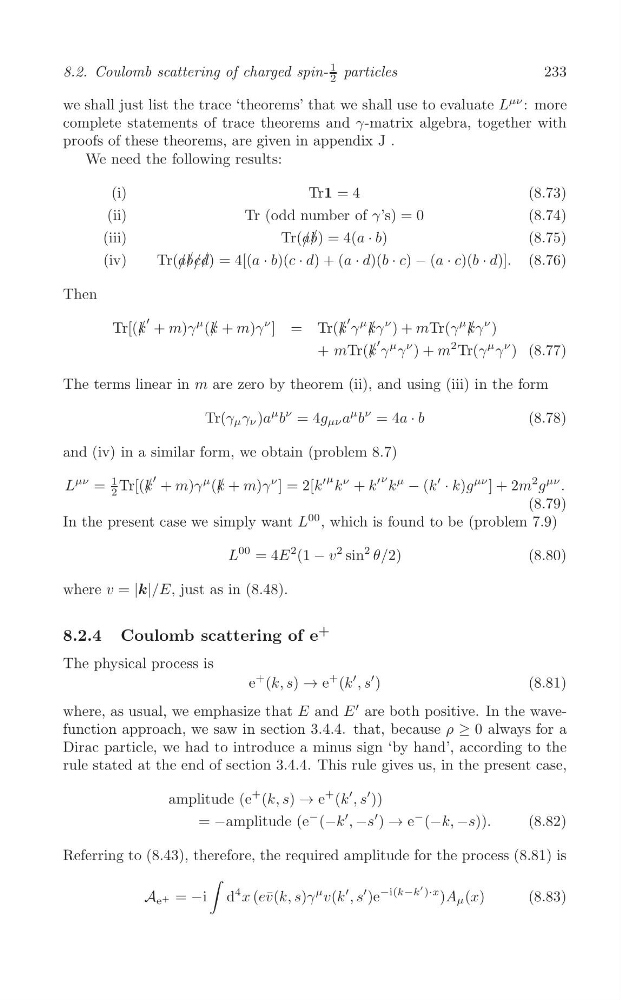
We need the following results:
(i)
Tr1 = 4
(8.73)
(ii)
Tr (odd number of γ’s) = 0
(8.74)
(iii)
Tr(a / / b) = 4(a · b)
(8.75)
(iv)
Tr(a / / b/ cd /) = 4[(a · b)(c · d) + (a · d)(b · c) − (a · c)(b · d)]. (8.76)
Then
′
′
Tr[(k / + m)γ
μ (/ m)γ
ν ] =
k kγ
ν ) +
kγ
ν )
k +
Tr(/ γ
μ /
mTr(γ
μ /
′
+ mTr(k / γ
μ γ
ν ) + m
2 Tr(γ
μ γ
ν ) (8.77)
The terms linear in m are zero by theorem (ii), and using (iii) in the form
Tr(γ μ γ ν )a
μ b
ν = 4g μν a
μ b
ν = 4a · b
(8.78)
and (iv) in a similar form, we obtain (problem 8.7)
′
L
μν
1
+ k
′ ν
2 μν
= Tr[(k / + m)γ
μ (k / + m)γ
ν ] = 2[k
′ μ k
ν
k
μ
− (k
′
· k)g
μν ] + 2m g .
2
(8.79)
In the present case we simply want L
00 , which is found to be (problem 7.9)
L
00 = 4E
2 (1 − v
2 sin
2 θ/2)
(8.80)
where v = |k|/E, just as in (8.48).
8.2.4 Coulomb scattering of e +
The physical process is
e
+ (k, s) → e
+ (k
′ , s
′ )
(8.81)
where, as usual, we emphasize that E and E
′ are both positive. In the wavefunction approach, we saw in section 3.4.4. that, because ρ ≥ 0 always for a
Dirac particle, we had to introduce a minus sign ‘by hand’, according to the
rule stated at the end of section 3.4.4. This rule gives us, in the present case,
amplitude (e
+ (k, s) → e
+ (k
′ , s
′ ))
= −amplitude (e
− (−k
′ , −s
′ ) → e
− (−k, −s)).
(8.82)
Referring to (8.43), therefore, the required amplitude for the process (8.81) is
∫
A e + = −i d
4 x (ev ¯(k, s)γ
μ v(k
′ , s
′ )e
−i(k−k
' )·x )A μ (x)
(8.83)
8.2. Coulomb scattering of charged spin1 particles
2
we shall just list the trace ‘theorems’ that we shall use to evaluate L
μν : more
complete statements of trace theorems and γ-matrix algebra, together with
proofs of these theorems, are given in appendix J .
We need the following results:
(i)
Tr1 = 4
(8.73)
(ii)
Tr (odd number of γ’s) = 0
(8.74)
(iii)
Tr(a / / b) = 4(a · b)
(8.75)
(iv)
Tr(a / / b/ cd /) = 4[(a · b)(c · d) + (a · d)(b · c) − (a · c)(b · d)]. (8.76)
Then
′
′
Tr[(k / + m)γ
μ (/ m)γ
ν ] =
k kγ
ν ) +
kγ
ν )
k +
Tr(/ γ
μ /
mTr(γ
μ /
′
+ mTr(k / γ
μ γ
ν ) + m
2 Tr(γ
μ γ
ν ) (8.77)
The terms linear in m are zero by theorem (ii), and using (iii) in the form
Tr(γ μ γ ν )a
μ b
ν = 4g μν a
μ b
ν = 4a · b
(8.78)
and (iv) in a similar form, we obtain (problem 8.7)
′
L
μν
1
+ k
′ ν
2 μν
= Tr[(k / + m)γ
μ (k / + m)γ
ν ] = 2[k
′ μ k
ν
k
μ
− (k
′
· k)g
μν ] + 2m g .
2
(8.79)
In the present case we simply want L
00 , which is found to be (problem 7.9)
L
00 = 4E
2 (1 − v
2 sin
2 θ/2)
(8.80)
where v = |k|/E, just as in (8.48).
8.2.4 Coulomb scattering of e +
The physical process is
e
+ (k, s) → e
+ (k
′ , s
′ )
(8.81)
where, as usual, we emphasize that E and E
′ are both positive. In the wavefunction approach, we saw in section 3.4.4. that, because ρ ≥ 0 always for a
Dirac particle, we had to introduce a minus sign ‘by hand’, according to the
rule stated at the end of section 3.4.4. This rule gives us, in the present case,
amplitude (e
+ (k, s) → e
+ (k
′ , s
′ ))
= −amplitude (e
− (−k
′ , −s
′ ) → e
− (−k, −s)).
(8.82)
Referring to (8.43), therefore, the required amplitude for the process (8.81) is
∫
A e + = −i d
4 x (ev ¯(k, s)γ
μ v(k
′ , s
′ )e
−i(k−k
' )·x )A μ (x)
(8.83)