

216
7. Quantum Field Theory III
∑
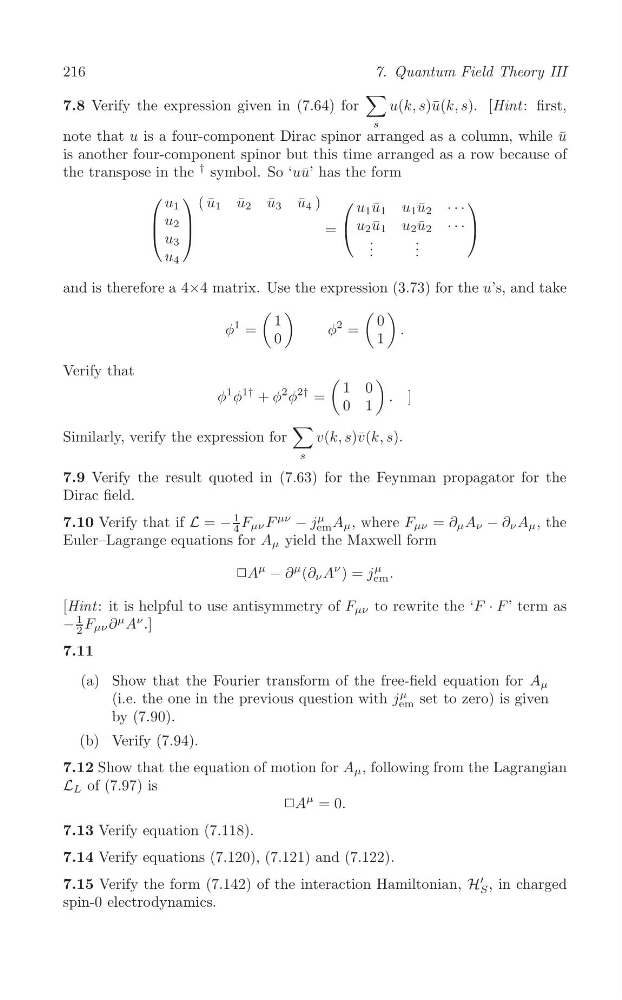
7.8 Verify the expression given in (7.64) for
u(k, s)¯ u(k, s). [Hint : first,
s
note that u is a four-component Dirac spinor arranged as a column, while ¯
u
is another four-component spinor but this time arranged as a row because of
the transpose in the
† symbol. So ‘uu ¯’ has the form
( )
(
)
u 1 ( ¯
u 1 u ¯ 2 u ¯ 3 u ¯ 4 )
u 1 u ¯ 1 u 1 u ¯ 2 · · ·
| u 2 |
( )
= ( u 2 u ¯ 1 u 2 u ¯ 2 · · · )
u 3
.
.
.
.
.
.
u 4
and is therefore a 4×4 matrix. Use the expression (3.73) for the u’s, and take
( )
( )
1
0
φ
1
φ
2
=
=
.
0
1
Verify that
(
)
1 0
φ
1 φ
1† + φ
2 φ
2† =
. ]
0 1
∑
Similarly, verify the expression for
v(k, s)¯ v(k, s).
s
7.9 Verify the result quoted in (7.63) for the Feynman propagator for the
Dirac field.
7.10 Verify that if L = −
1 F μν F
μν
− j
μ A μ , where F μν = ∂ μ A ν − ∂ ν A μ , the
4
em
Euler–Lagrange equations for A μ yield the Maxwell form
❗A
μ
− ∂
μ (∂ ν A
ν ) = j
μ .
em
[Hint : it is helpful to use antisymmetry of F μν to rewrite the ‘F · F ’ term as
−
1 F μν ∂
μ A
ν .]
2
7.11
(a) Show that the Fourier transform of the free-field equation for A μ
(i.e. the one in the previous question with j
μ set to zero) is given
em
by (7.90).
(b) Verify (7.94).
7.12 Show that the equation of motion for A μ , following from the Lagrangian
L L of (7.97) is
❗A
μ = 0.
7.13 Verify equation (7.118).
7.14 Verify equations (7.120), (7.121) and (7.122).
′
7.15 Verify the form (7.142) of the interaction Hamiltonian, H , in charged
S
spin-0 electrodynamics.
7. Quantum Field Theory III
∑
7.8 Verify the expression given in (7.64) for
u(k, s)¯ u(k, s). [Hint : first,
s
note that u is a four-component Dirac spinor arranged as a column, while ¯
u
is another four-component spinor but this time arranged as a row because of
the transpose in the
† symbol. So ‘uu ¯’ has the form
( )
(
)
u 1 ( ¯
u 1 u ¯ 2 u ¯ 3 u ¯ 4 )
u 1 u ¯ 1 u 1 u ¯ 2 · · ·
| u 2 |
( )
= ( u 2 u ¯ 1 u 2 u ¯ 2 · · · )
u 3
.
.
.
.
.
.
u 4
and is therefore a 4×4 matrix. Use the expression (3.73) for the u’s, and take
( )
( )
1
0
φ
1
φ
2
=
=
.
0
1
Verify that
(
)
1 0
φ
1 φ
1† + φ
2 φ
2† =
. ]
0 1
∑
Similarly, verify the expression for
v(k, s)¯ v(k, s).
s
7.9 Verify the result quoted in (7.63) for the Feynman propagator for the
Dirac field.
7.10 Verify that if L = −
1 F μν F
μν
− j
μ A μ , where F μν = ∂ μ A ν − ∂ ν A μ , the
4
em
Euler–Lagrange equations for A μ yield the Maxwell form
❗A
μ
− ∂
μ (∂ ν A
ν ) = j
μ .
em
[Hint : it is helpful to use antisymmetry of F μν to rewrite the ‘F · F ’ term as
−
1 F μν ∂
μ A
ν .]
2
7.11
(a) Show that the Fourier transform of the free-field equation for A μ
(i.e. the one in the previous question with j
μ set to zero) is given
em
by (7.90).
(b) Verify (7.94).
7.12 Show that the equation of motion for A μ , following from the Lagrangian
L L of (7.97) is
❗A
μ = 0.
7.13 Verify equation (7.118).
7.14 Verify equations (7.120), (7.121) and (7.122).
′
7.15 Verify the form (7.142) of the interaction Hamiltonian, H , in charged
S
spin-0 electrodynamics.